K-ETA in 2026: Korea's own pages disagree on who is exempt
Cite this page
Hwang, J. (2026). K-ETA in 2026: Korea's own pages disagree on who is exempt. Korea, Verified. https://koreaverified.com/keta-required-by-nationality/ (checked 21 September 2026)
People do not search for “what is K-ETA”. They search for whether they need one, with a year bolted on the end, because they do not trust that the page in front of them is current. That instinct is correct, and it turns out to be more correct than the people having it realise.
The rule itself is simple. A block of nationalities has been excused from K-ETA since 1 April 2023, and the excusal now runs to 31 December 2026. The problem is finding out whether you are in the block. Korea publishes that answer across at least seven pages in two languages, and the only page that carries both a current date and a complete list is in English, and it contradicts the Korean one.
What the scheme is, before the disagreements
K-ETA is a pre-clearance you buy online before you fly. It applies to people who may enter Korea without a visa, which the Ministry of Justice puts at 112 countries and regions: 67 under visa-waiver agreements and 45 under the tourism-and-transit rule.
That number matters for reading the rest of this page. K-ETA is not the default for everyone on earth. If your passport is outside those 112, K-ETA is not your question at all. You need a visa, and the question becomes which mission may accept your file and how long that mission takes. In Vietnam the answer to the second half is published, and it is three different numbers for the same tourist visa. From the Philippines the change worth knowing is in the paperwork: the Manila centre dropped the bank statement but kept the bank certificate.
| Fee | 10,000 won, roughly 7 to 8 US dollars |
| Validity | 3 years, or until your passport expires if that comes first |
| Assessment | Generally within 72 hours |
| Recommended | Apply at least 72 hours before boarding |
| Effect | You are excused from the arrival card |
Some people never touch it whatever their nationality. The ministry excludes diplomatic and official passport holders, ABTC holders, crew and seafarers, transit passengers, and anyone aged 17 and under or 65 and over.
That transit line answers a question I see asked constantly and answered badly: if you are connecting through Incheon without entering Korea, the scheme is not aimed at you. Leaving the airport is a different act, and the airport operator tells transit tour joiners from visa-free countries outside the exemption to get a K-ETA anyway, which is the opposite instruction from the same government. What a layover in Korea actually requires puts the two statements side by side. Neither body defines what a transit passenger is.
The list, as the Korean pages have it
Twenty-two countries and regions, from 1 April 2023.
| Region | Countries and regions |
|---|---|
| Asia (5) | Japan, Taiwan, Hong Kong, Singapore, Macao |
| Americas (2) | United States (Guam included), Canada |
| Europe (13) | UK, Germany, France, Italy, Netherlands, Spain, Poland, Sweden, Finland, Norway, Belgium, Denmark, Austria |
| Oceania (2) | New Zealand, Australia |
Read the Americas row closely. The Korean text folds Guam into the United States entry, which is what a passport-based rule requires: there is no Guamanian passport.
The Asia row is worth a second look for a different reason. The waiver lifts K-ETA off these passports, but it says nothing about the visa-free entry underneath it, and that arrangement is not built the same way for every name in the row. Korea’s foreign ministry marks Singapore as resting on a treaty and Japan as resting on reciprocity, which is a difference in how the rule can move rather than in what it currently allows. Taiwan is in that row too, and what the waiver leaves a Taiwan passport holding, including a mutual automated-gate programme that neither English page ranking for the question mentions, is its own article.
The same list in English says 23, then lists 25 things
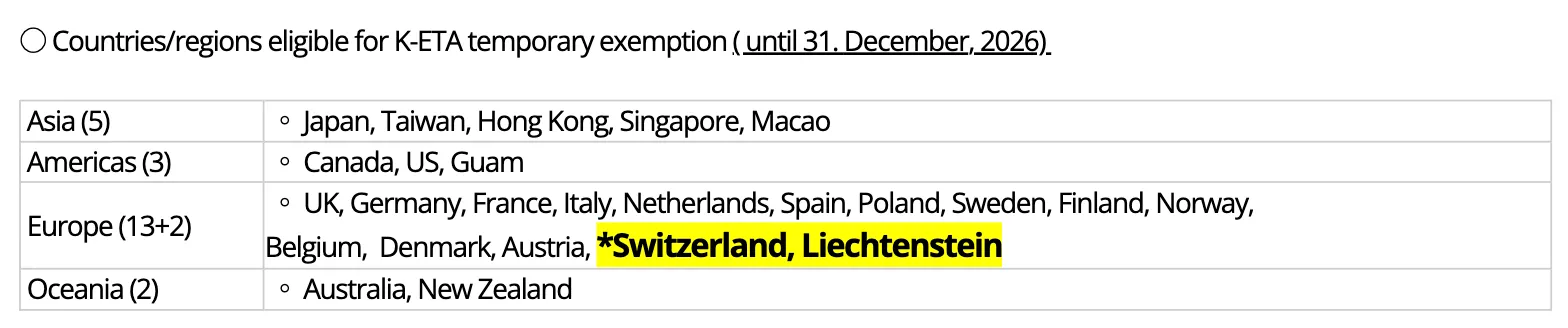
The Korean embassy in Bern publishes the exemption in English. Its heading calls it “the 23 countries/regions”, and it splits the Americas into three entries: Canada, US, Guam.
So the step from 22 to 23 is not a country. It is Guam being promoted to a line item. This is why you will find English pages confidently saying 22 and English pages confidently saying 23, both citing the Korean government, both describing the same set of passports. If you hold a US passport issued to a resident of Guam, you are one entry or two depending on which language you read the rule in, and you are exempt either way.
Then Bern’s Europe row does something else entirely. It reads “Europe (13+2)” and ends: Austria, *Switzerland, Liechtenstein. The page’s title is “Notice on Temporary Exemption of K-ETA to Switzerland and Liechtenstein (and the 23 countries/regions)”, and its body states:
Switzerland and Liechtenstein are temporarily exempted from the K-ETA requirement until 31 December 2026.
Those two are not a counting artefact. They are two more countries.
Where the two governments’ pages flatly contradict each other
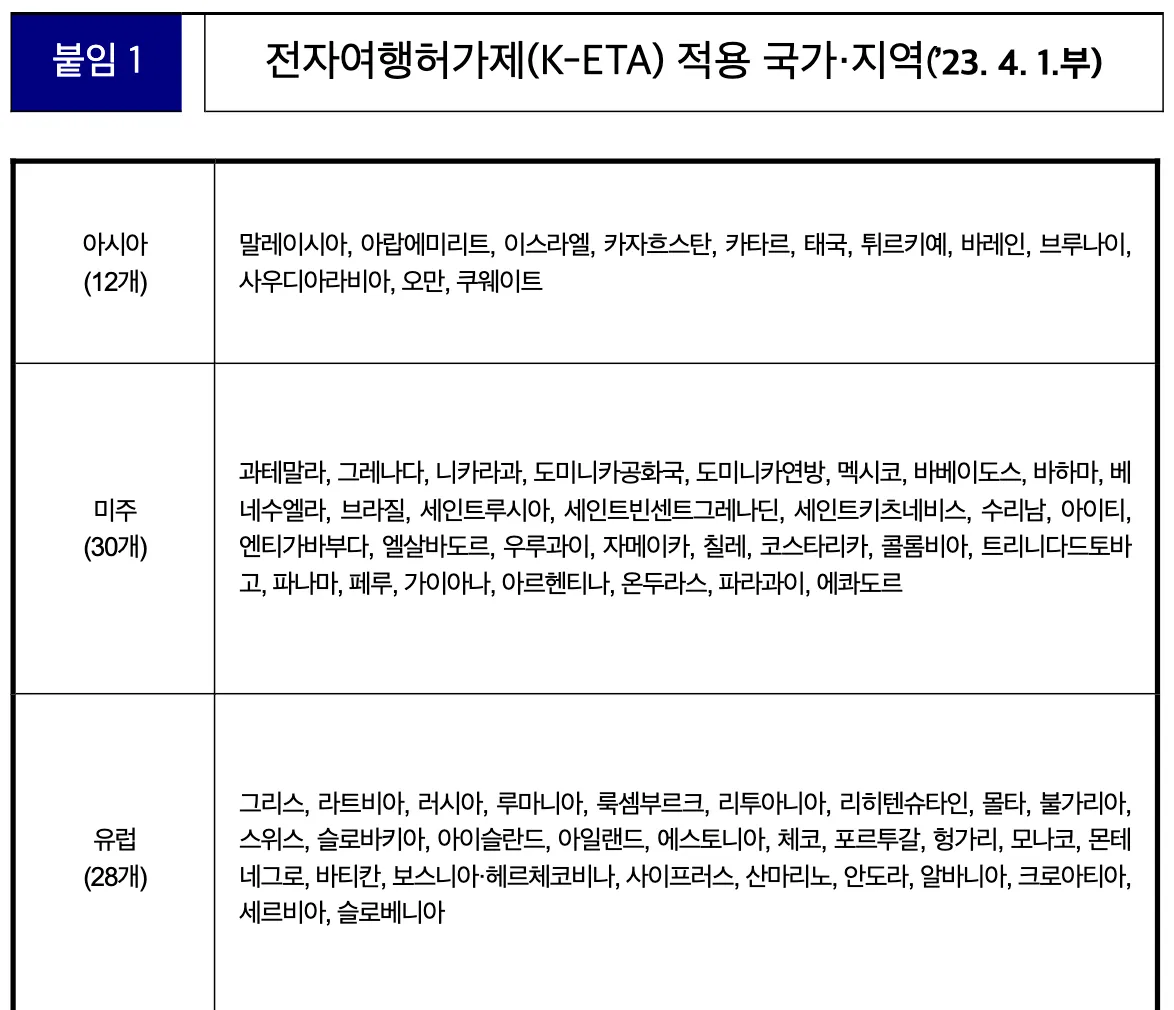
Neither Switzerland nor Liechtenstein is in the Korean list of 22. That is not a grouping quirk, because the same New York notice that carries the 22 also carries an appendix listing the countries that must apply, and Switzerland and Liechtenstein are both printed on it, under Europe.
The obvious explanation would be that Bern is newer: a 2025 addition against a 2023 list nobody updated. That explanation does not survive reading the dates inside the documents. Bern does not claim a recent change. It dates the Swiss and Liechtenstein exemption to 1 April 2023, in a sentence reading “K-ETA will be temporarily exempted to Switzerland, Liechtenstein, and the 23 countries/regions listed below starting from April 1, 2023”, under a subheading reading “as of April 1, 2023”. The New York appendix is headed with the same date and lists them as needing one.
So the two pages disagree about what was true on a single day three years ago, not about what changed since. One of them has been wrong from the start.
I want to be exact about what I have shown. I could not find any Korean-language page naming Switzerland or Liechtenstein as exempt. That is an absence of evidence on my side, and it is a weaker absence than I would like, for a reason I set out at the bottom of this page. Bern is the mission responsible for those two countries and it dated its notice; the New York page is a 2023 snapshot whose own exemption window expired in 2024 and which nobody has touched since. Neither is a live ministerial statement.
Now check the dates on the pages themselves
| Page | Written | Last edited | What its text says |
|---|---|---|---|
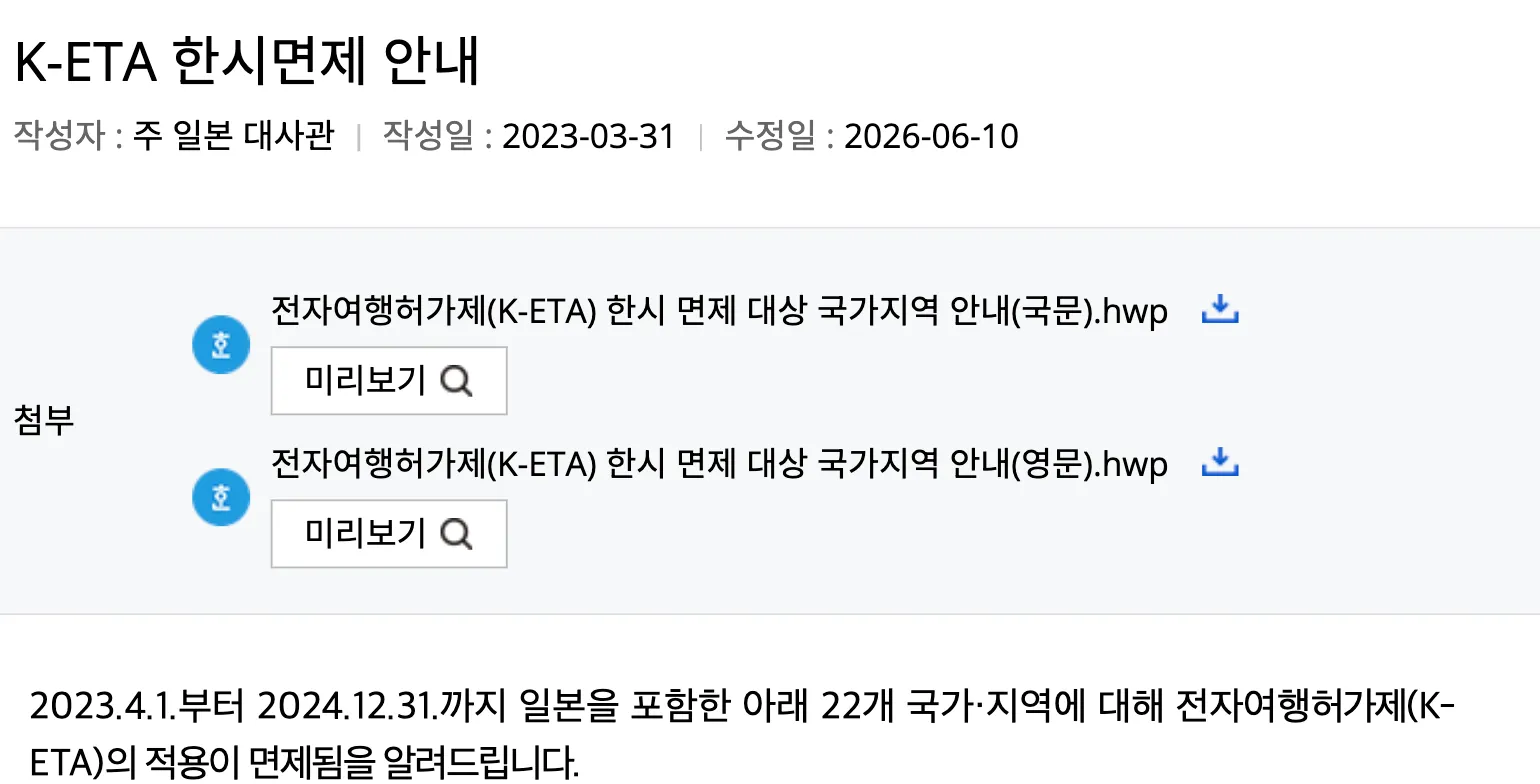
| Embassy in Tokyo (Korean) | 2023-03-31 | 2026-06-10 | Exemption runs 1 April 2023 to 31 December 2024 |
| Consulate in New York | 2023-04-01 | 2023-11-23 | Same expired window, but both full lists |
| Consulate in Atlanta | 2023-04-01 | 2026-01-02 | Extended to 31 December 2026, list only as an attachment |
| Embassy in the US | 2025-12-29 | not edited | Extended to 31 December 2026, no list |
| Embassy in Bern (English) | 2025-12-30 | not edited | To 31 December 2026, with a list, plus two extra countries |
The Tokyo row is the one to sit with. That page was edited on 10 June 2026, this summer. Somebody opened it, changed something, and saved it. Its body still says the exemption ended on 31 December 2024.
An edit date is not a review date. A page can be touched without being read.
The Atlanta page has the opposite defect. Its title and its opening sentence carry the correct 31 December 2026, and then the line actually stating the period renders it as 2026. 12. 3. A missing digit drags the deadline back into early December, and it does so in the one sentence a careful reader would treat as authoritative.
So how are you supposed to find out?
Officially, by starting an application you may not need. The extension notices all say the same thing: a “K-ETA exemption” pop-up appears during the application.
They used to look like they disagreed about when. The embassy in the US says it fires when you select your nationality; Atlanta says it fires when you scan the photo page of your passport. The scheme operator settles it. The K-ETA portal’s own notice, dated 23 December 2025, says the pop-up comes “when they scan a photo of their passport information page during the application”.
Atlanta is right and Washington is wrong, and the practical consequence is that finding out whether you were required to hand over your passport data requires handing over your passport data.
That same operator notice is the cleanest statement of how little Korea is willing to commit to in writing. It extends the exemption for a full year without naming one country: “The countries/regions that are currently exempt from K-ETA are subject to this extension.” The scheme’s own operator will tell you the exemption continues. It will not tell you who is in it.
The list nobody publishes, which is published
The other half of the New York notice is the thing I said in the arrival card article I could not find anywhere: the roster of countries that do need a K-ETA. It is there, as an appendix.
| Region | Count |
|---|---|
| Asia | 12 |
| Americas | 30 |
| Europe | 28 |
| Oceania | 11 |
| Africa | 8 |
- Malaysia, Thailand, Türkiye, Brazil, Mexico, South Africa and Russia are on it, and so are Switzerland and Liechtenstein, which is how the contradiction above became visible at all.
ministry’s current 112. I am not going to dress that up as a discovery: the appendix is three years old, the ministry’s figure is current, and a single country joining the visa-free list in three years explains it completely. It is worth stating only because it is the check anyone would run, and it does not close.
If you are exempt, you are not finished
This is the trap that catches the largest group of readers here, and it is not an inference. The Ministry of Justice’s e-Arrival Card page has two lists. Under people who must declare, the second entry is “K-ETA 면제자”, meaning K-ETA-exempt persons, spelled out as nationals of the temporarily exempt countries and as the 17-and-under and 65-and-over travellers from K-ETA countries. Under people excluded from declaring, the third entry is holders of a K-ETA.
So the American, the Briton, the Japanese and the Australian who have just been congratulated on needing nothing are precisely the people who must file the arrival card. The waiver attaches to the document, not to the nationality, and they were told not to buy the document. The full version of that, including who else is excused and what the form asks, is the e-Arrival Card page.
The notices are unusually candid about it. They state that an exempt traveller who wants the benefits of a K-ETA, and they name skipping the arrival card as one, may apply anyway and will be charged the fee. The government is selling the paperwork exemption back to the people it excused from the product.
Two more details from the same notices, both of which cost people money. A previously approved K-ETA stays valid to its expiry date, and the fee already paid is not refunded. If you bought one and your country was exempted afterwards, you did not get the money back, but you did not have to throw the authorisation away either, and while you hold it, you are excused from the arrival card.
What I would actually do
If your passport is in the table of 22: do not buy a K-ETA for the sake of it, and do plan to file the arrival card. The one case for buying anyway is a multi-trip year, since the authorisation runs three years while an arrival card dies after a single entry.
If you are Swiss or Liechtensteiner, you are relying on one English-language page against a Korean appendix that contradicts it, about the same date. Buying the K-ETA costs 10,000 won, removes the question entirely, and hands you the arrival card exemption as well. That is the cheapest way I know to not care who is right.
If your passport is on the ministry’s 112 and not on the table of 22: budget the 10,000 won and the 72 hours, and do not leave it to the airport. The ministry states that travellers subject to K-ETA can only board a Korea-bound aircraft or vessel once they hold the authorisation.
If you are flying to Jeju, none of this is the whole rule, because Jeju runs its own visa-free scheme with its own restriction on leaving the island. That is the Jeju page. If you are on an Indonesian passport, the answer is a visa rather than a K-ETA at all, which is the Indonesia page. And the residency check behind Seoul’s replacement transport pass is a different rule that lives in a form too.
What is not checked here
The fee, the validity, the exclusions, the 112-country scope and the age rule come from the Ministry of Justice’s own Korean page, read today. Every mission notice above was opened today and its edit date checked.
The Bern claim rests on one source. It is the strongest statement on this page and no second document supports it. I have not found a ministerial publication adding Switzerland and Liechtenstein, and I have not found one denying it.
I could not open the attachments, and they are the likeliest answer. The Atlanta page carries the current list as a PDF named “전자여행허가제(K-ETA) 한시 면제 대상 국가지역 안내(국문)”, and Tokyo carries the same document as a HWP in Korean and English. On a page edited in January 2026, that PDF is the most likely place in existence for a current Korean-language exemption list, and my tooling reads web pages, not attachments. So when I say I found no Korean page naming Switzerland, read it as: no Korean page I could open. The document that probably settles this article’s central question is sitting one click away from a source I cite, and I could not click it.
The K-ETA portal’s notice board is half-closed, and the half that works is easy to miss. Its list pages return an empty shell to anything that is not a browser, which is what a first pass at this article concluded the whole board did. Individual notices open normally. That is how the 23 December 2025 notice above got read, and the link to it was printed on the Bern page I was already quoting. The operator’s position on the pop-up was one click from a source already in my hand, and the near-miss is worth recording: a site that looks closed may only be closed at the door you tried.
And a standing warning, unchanged from the arrival card page: the K-ETA portal still carries a banner declaring Korea to be in a disaster situation under a special entry procedure, telling all foreigners to report before entering. That is pandemic-era wording, it was there today, and I can find nothing that ends it and nothing that confirms it applies. Nothing here relies on it.
If you have applied recently, I would like to know what the pop-up did, and especially whether a Swiss passport triggers it. Tell me and this page gets updated with the date on it.
Questions people actually ask
- Do I need a visa for Korea, a K-ETA, or neither?
- Three different answers, and which one you get was settled by your passport before you booked. The Ministry of Justice puts the visa-free block at 112 countries and regions: 67 under visa-waiver agreements and 45 under the tourism-and-transit rule. Outside those 112 you need a visa and K-ETA is not your question. Inside them you need a K-ETA, unless your nationality sits in the temporary exemption running to 31 December 2026, in which case you need neither. The exemption is real. Which passports are inside it depends on which Korean government page you open.
- K-ETA vs arrival card: does being exempt from one exempt me from the other?
- No, and it runs the opposite way to what people assume. The arrival card is waived for people who hold a K-ETA. If you are exempt you hold no K-ETA, so nothing is waived. The Ministry of Justice e-Arrival Card page states both halves: under people who must declare, the second entry is K-ETA 면제자, meaning K-ETA-exempt persons. Under people excluded from declaring, the third entry is holders of a K-ETA. Buying a K-ETA you do not need, for 10,000 won, is the documented way out of the paper form.
- What are the Korean visa requirements if my passport is outside the 112 visa-free countries?
- Then the question stops being K-ETA and becomes which mission may accept your file and how long that mission takes. Korea does not publish one national answer to the second half. In Vietnam it publishes three different numbers for the processing time of the same tourist visa. The document list is set by the mission handling your application rather than by the K-ETA portal, and nothing on this page applies to you.
- How much does a K-ETA cost, and is the 2026 exemption still running?
- 10,000 won, roughly 7 to 8 US dollars, valid three years or until your passport expires, with assessment generally inside 72 hours. The exemption is still running. The scheme operator extended it to 31 December 2026 in a notice dated 23 December 2025 that never names a single country, saying only that whoever is exempt now stays exempt. An out-of-date page is not evidence the scheme changed: the embassy in Tokyo edited its Korean notice on 10 June 2026 and it still states the exemption ran out on 31 December 2024.
Where these numbers came from
Read on . 6 of 9 are Korean-language primary pages.
- Ministry of Justice, Immigration Service, the K-ETA scheme: scope, fee, validity and who is excluded (Korean) KO
- K-ETA portal, the operator’s own notice extending the exemption, 23 December 2025
- Korean Consulate in New York, the notice carrying both full lists, last edited 23 November 2023 (Korean) KO
- Korean Embassy in Japan, the same 22-country list, edited 10 June 2026 (Korean) KO
- Korean Consulate in Atlanta, extension to 2026 with the list held as an attachment, edited 2 January 2026 (Korean) KO
- Korean Embassy in the United States, notice of the one-year extension, 29 December 2025 (Korean) KO
- Korean Embassy in Switzerland, the English notice adding Switzerland and Liechtenstein, 30 December 2025
- Ministry of Justice, e-Arrival Card, who must declare and who is excluded (Korean) KO
- K-ETA portal, application page showing the fee and assessment time