Korea visa for Vietnamese: filing yourself is the slow way
Cite this page
Hwang, J. (2026). Korea visa for Vietnamese: filing yourself is the slow way. Korea, Verified. https://koreaverified.com/korea-from-vietnam/ (checked 21 September 2026)
Ask how a Vietnamese passport holder gets into Korea and you will be told, correctly, that you need a visa, and then pointed at the Korean embassy in Hanoi or the consulate in Ho Chi Minh City.
Both halves of that are incomplete in ways that cost weeks.
There are three Korean missions in Vietnam, not two. And the queue is not one queue. The embassy publishes a table of screening times, and the same tourist visa is screened in 6 working days or 16 depending on who walks it in.
The table nobody translates
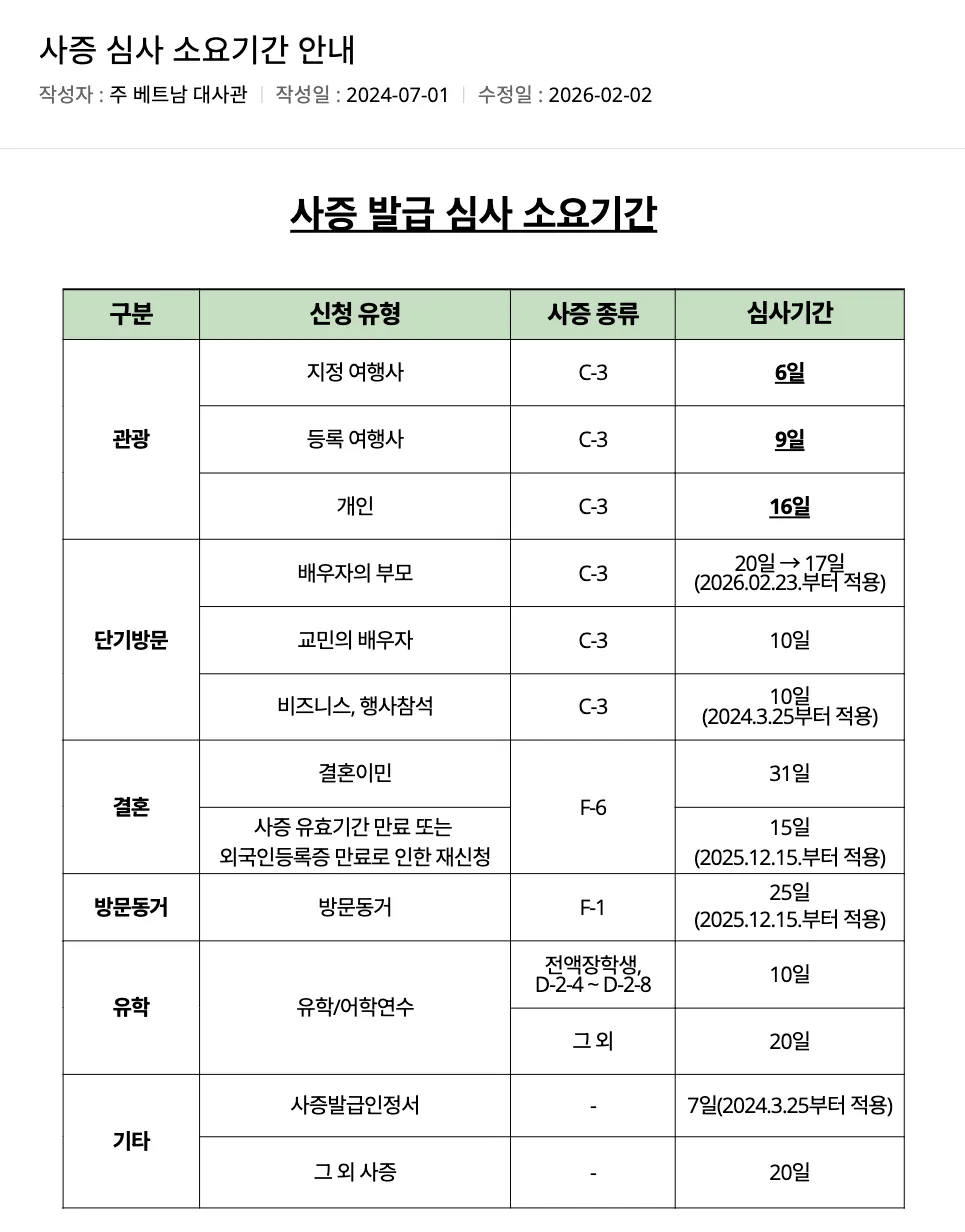
The embassy in Hanoi keeps a notice headed 사증 심사 소요기간 안내, screening times for visa issuance, last revised on 2 February 2026. It is a plain grid of how long each type of application is examined for, counted in working days. This is the tourism block.
| Who files it | Visa | Screening time |
|---|---|---|
| A designated travel agency | C-3 | 6 working days |
| A registered travel agency | C-3 | 9 working days |
| The applicant, in person | C-3 | 16 working days |
Same visa, three speeds, and the variable is the channel rather than anything about the traveller. It is the largest number on the page for an ordinary tourist and it is the one nobody quotes.
The rest of the table is worth having, because almost none of it appears in English either.
| Purpose | Visa | Screening time |
|---|---|---|
| Business, or attending an event | C-3 | 10 working days |
| Spouse of a Korean national resident in Vietnam | C-3 | 10 working days |
| A spouse’s parents | C-3 | 17 working days |
| Marriage migration | F-6 | 31 working days |
| The same, reapplying after a visa or residence card expired | F-6 | 15 working days |
| Visiting cohabitation | F-1 | 25 working days |
| Study, full scholarship holders and D-2-4 to D-2-8 | D-2 | 10 working days |
| Study, everyone else | D-2 | 20 working days |
| Applications backed by a certificate of visa issuance | 7 working days | |
| Anything not listed | 20 working days |
Two rows carry their own revision history. The spouse’s parents row used to read 20 working days and was cut to 17 with effect from 23 February 2026. The marriage reapplication row was set at 15 working days from 15 December 2025. The embassy notes at the foot that these are working days and can change with the workload at the mission, which is the honest caveat and also the reason to read the page rather than a blog quoting it.
Why the tourist queue has three speeds
This is not an accident of staffing. The embassy designed it and published the design.
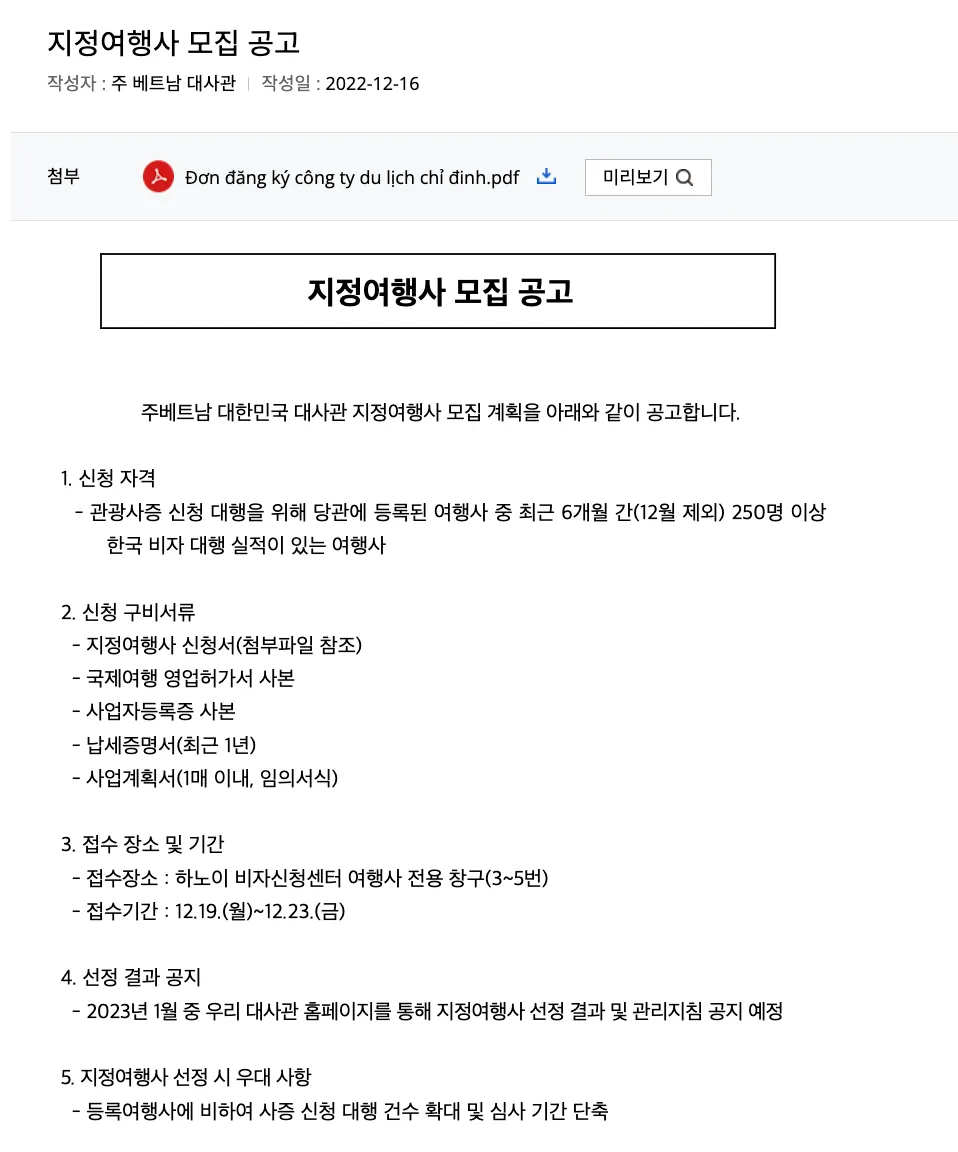
A notice recruiting 지정여행사, designated travel agencies, sets out who qualifies: a travel agency already registered with the embassy to file tourist visa applications, which has filed at least 250 Korean visa applications in the last six months, December excluded. Under the heading for what designation is worth, the notice says it directly. Designated agencies get a larger allowance of applications than registered agencies, and shorter screening.
So the ladder runs individual, registered agency, designated agency, and volume buys speed. The 6, 9 and 16 in the first table are that policy expressed as days.
Three things I would not read into it. That recruitment notice is dated December 2022, so the threshold of 250 belongs to that round and the current figure may differ. The registration prerequisite is specific to tourist visa filing but the 250 count is not, since the notice counts Korean visa work generally. And nothing in any of these documents says an agency has to pass its speed advantage to you at a sensible price, or at all. The embassy sets the queue. The agency sets its own fee.
Which office may take your file
Here I have to be careful about which notice I am quoting, because the embassy publishes its rules per visa type and the tourism document list sits in a PDF attachment I cannot read.
The notice that states the consular districts in plain body text is the short-stay C-3-1 guidance, and that notice is headed 친지방문, 관광 제외: visits to relatives and tourism excluded. It covers competitions, events, conferences and short technical training. What follows is its rule, and I have not confirmed that the tourism attachment words it the same way.
| Where you live | Where the file goes |
|---|---|
| North of Da Nang, apart from the four below | The embassy in Hanoi |
| Da Nang city, Hue, Quang Nam, Quang Ngai | The consulate general in Da Nang |
| South of Da Nang | The consulate general in Ho Chi Minh City |
The test is residence. The Hanoi intake is open to residents of the northern area, and the notice adds a compressed parenthetical for people who have moved away from their registered home place: they need to hold a residence permit. So the permit is how a mover proves where they live, not a separate criterion that overrides it.
The row that catches people is the middle one. Da Nang city, Hue, Quang Nam and Quang Ngai are named twice in the notice, once to remove them from the Hanoi intake and once to send them to the consulate in Da Nang. A traveller from Hue who reads an English guide listing two Korean offices will pick the wrong one of them.
There is a second reason to care which office you land in. The two that publish screening times do not publish the same ones. Hanoi lists marriage migration at 31 working days and a reapplication at 15. The consulate in Ho Chi Minh City, on a page last revised in September 2025, lists the same visa at 35 working days, and a reapplication at 16 working days. Those are separate queues with separate backlogs.
What it costs
The embassy quotes the visa fee on its guidance pages, and it is small. The short-stay notice gives 20 US dollars for a single entry, per person, and no multiple entry figure at all. The pair appears on the medical tourism notice: 20 dollars single, 80 multiple. Marriage migration is quoted at 30 dollars by the consulate in Ho Chi Minh City. The tourism notice quotes no fee in its body.
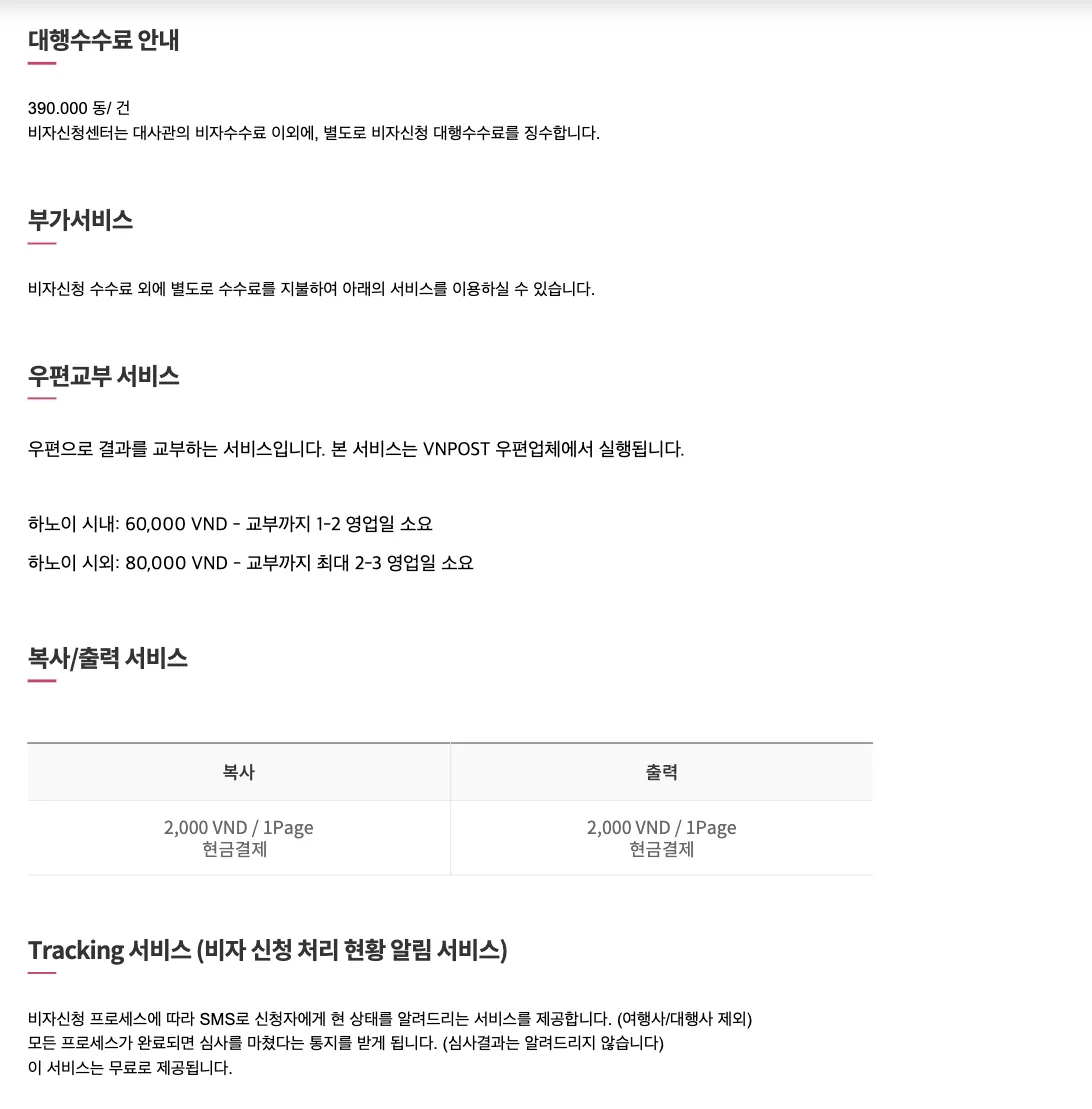
The charge people do not budget for is the visa application centre, and it is published rather than hidden. Filing in Hanoi goes through a centre run by Hana Tour, a private Korean travel company, and the centre’s own fee page gives the figures.
| Service | Charge |
|---|---|
| Agency fee, per application | 390,000 dong |
| Postal return of your passport inside Hanoi | 60,000 dong, one to two working days |
| Postal return outside Hanoi | 80,000 dong, up to two or three working days |
| Photocopying or printing | 2,000 dong a page, cash |
| SMS tracking of your application status | free, and not offered on agency filings |
The agency fee is stated to be separate from the embassy’s visa fee, so the two stack. The same 390,000 figure appears on the government notice that opened the centre back in 2019, so this one has held its value while everything around it moved. The centre separately sells a premium counter service, also at 390,000 dong, and says plainly that screening, agency and add-on fees are all extra on top of that.
Opening hours are the one place the centre contradicts itself. Its business panel lists filing at 08:30 to 17:30 on Monday, Wednesday and Friday, 08:30 to 19:30 on Tuesday and Thursday, and 08:30 to 11:30 on Saturday. A second block on the same page reads 08:00 to 16:30 on weekdays and 09:00 to 11:30 on Saturday, and a pop-up notice says the hours moved earlier from April. I cannot tell you which is live. Phone before you travel to it.
The lane where the fee is waived
On 1 July 2026 the Ministry of Justice extended a waiver of the visa fee for group tourists, quoted at 15 dollars or about 22,500 won, to 31 December 2026. It had been due to expire in June. It covers six nationalities: China, Vietnam, the Philippines, Indonesia, India and Cambodia.
The obvious next thought is that the group lane is both free and the 6-day lane, and I cannot show that. The waiver is a Ministry of Justice measure and the 6 working day row is the embassy’s designation of travel agencies. They are not obviously the same register. The embassy’s own medical tourism notice treats them as distinct: it has to say in so many words that applications from a justice ministry accredited hospital are timed like a designated agency’s tourist visa, which is a sentence you only write about two different lists.
The detail that would settle it, which visa subtype and which category of agency the waiver attaches to, is in the press release’s attached file. I could not read it. What is safe to say is narrower and still useful: an individual filing for themselves pays the fee and waits 16 working days, and the group route is cheaper and faster on every figure I can actually read.
The document rules, and whose rules they are
Same caution as above. These come from the short-stay notice that excludes tourism, so treat them as how this embassy words things rather than as the tourist checklist. The tourist checklist is the attachment.
- Documents prepared in Vietnam, in Vietnamese, need a notarised translation into Korean or English, from a notary office designated by the Vietnamese government. Documents prepared in Korea need no notarisation at all. The asymmetry is stated in the same paragraph and it is easy to read backwards.
- Unless a document carries its own validity period, it is only accepted if issued within three months of the application date.
- The passport must have six months of validity left, counted from the day you apply.
- The photograph is 35mm by 45mm on a white background.
- Employees can skip the labour contract by submitting the embassy’s consent form for social insurance data instead. People with no job, and small self-employed traders, submit three months of personal bank statements.
- Someone else can file for you, with proof of the relationship. A colleague brings their own labour contract. A family member brings the household register.
One change did land on the tourism side, and it needs its date read carefully. A notice dated 23 September 2024 announced that from 1 October 2024 an individual applying for the general tourist visa, C-3-9, would no longer submit a bank balance certificate or an original bankbook. The word it uses is 예정, scheduled, and the notice has not been revised since. Meanwhile the visa centre’s board carries a document list marked as taking effect on 30 March 2026, which is again an attachment. So the balance requirement was announced as going, and I cannot show you the current list that replaced it.
A newer trap sits on the centre’s front page and is stated in the body text. Vietnam began issuing criminal record certificates online, and because the centre says it cannot verify whether an electronic one is genuine, applicants bringing one are asked for three extra items: a screenshot of the submission, a screenshot of the detail view, and a printout.
K-ETA is not your step
K-ETA is the travel authorisation for people who may enter Korea without a visa. If you need a visa, the visa is the authorisation, and applying for K-ETA adds nothing.
This catches people because search results do not know what passport you hold, so they answer for the largest group of readers. Which nationalities are in the visa-free lane, and why the official lists disagree with each other about it, is its own article.
There is one route where a Vietnamese passport reaches Korea without a Korean visa, and it is not K-ETA either. If you already hold a visa or permanent residence for one of a short list of third countries, and Korea falls on the way to or from that country, immigration can admit you without a visa. The consulate in Toronto names Vietnamese travellers among the people the scheme is built for. The conditions are narrow and the itinerary has to pass through rather than double back, which is the layover article.
Jeju is a separate rule, and Vietnam is on the second list
Jeju runs its own visa-free entry scheme under the special law for the island. The Ministry of Justice designates two lists by formal notice: 23 nationalities barred from the scheme, and 64 that may use it but need permission before moving on to the rest of Korea.
Vietnam is not on the barred list. Vietnam is on the second one, in the group of 29 that applies to ordinary passports.
So a Vietnamese ordinary passport can reach Jeju without a visa, and cannot continue to the mainland on that entry without getting the stay-area expansion permit first. That restriction has teeth. A court upheld deportation against travellers who had bought a ferry ticket and were waiting to board, which is the Jeju article. The same two lists put Indonesia and the Philippines in exactly the same position, and those pages cover the Jakarta process and what changed for Filipino applicants in the same detail.
The parts that are the same for everybody
Reading a page like this can make a trip sound harder than it is, so it is worth saying which parts do not care about your passport.
Transport does not. A transit card behaves identically in anyone’s hand, and the saving that matters is the transfer rule rather than the card, which is the transit card article. Getting from the airport into the city is the same problem for everyone, including the last train time that catches late arrivals, in the airport article.
Two things do interact with the paperwork. Korea has moved its arrival declaration online, and who has to file it is not obvious from the form itself, which is the arrival card article. And a lot of Korean apps want a Korean phone number before they will verify you, which a data-only eSIM does not give you. That is the SIM article, and it matters more if you are visiting family and staying more than a few days.
What is not checked here yet
The screening times, the designated agency rule, the consular districts, the visa fees, the centre’s charges and the two Jeju lists all come from Korean government and operator pages read today, and the group visa fee waiver from the Ministry of Justice’s own release.
The gap on this page has one shape and it is worth naming precisely, because it runs through several sections. The embassy hangs its detailed document lists on attached PDF and HWP files, and I can only read web pages. So where a notice says “see the attachment”, this page reports what the notice says in its own body and stops. That is why the document rules above are labelled as coming from the short-stay notice for events and training rather than presented as the tourist checklist, and why I cannot tell you what the tourism document list effective 30 March 2026 contains.
Three specific things I did not establish. Whether the ministry’s group tour fee waiver and the embassy’s designated agency queue attach to the same companies. What a designated agency charges for the faster lane, which is the question that decides whether it is worth using. And whether the consular district rule is worded identically on the tourism notice, since I read it on a notice that excludes tourism in its title.
If you have filed at one of the three missions recently, or watched an agency quote a price against that 6 and 16 day gap, tell me. What happens at the counter is worth more than another reading of the same notice.
Questions people actually ask
- Do Vietnamese need visa for Korea, or does K-ETA cover the trip?
- A visa, and K-ETA does not cover it. K-ETA is the paperwork for the visa-free lane, and a Vietnamese passport is not in that lane, so the K-ETA advice filling most English guides is not describing your trip at all. What you need is a C-3 short-stay visa filed at a Korean mission in Vietnam, and there are three of them rather than the two most write-ups mention. Da Nang city, Hue, Quang Nam and Quang Ngai file at the consulate in Da Nang, not at Hanoi or Ho Chi Minh City.
- How to get a korea visa from Vietnam: does it matter who files it?
- It matters more than anything else on this page. The embassy in Hanoi publishes its screening times by application type, and the same C-3 tourist visa is screened in 6 working days when a designated travel agency files it, 9 when a registered agency does, and 16 when you file it yourself. The embassy bolded those three numbers itself. The gap is policy rather than backlog: its recruitment notice for designated agencies states that designation buys a larger quota and shorter screening, and an agency qualifies by filing at least 250 Korean visa applications in six months.
- Korean visa requirements from Vietnam: what does it cost, and what is the second fee?
- The embassy fee is the small one. The Korea Visa Application Center in Hanoi charges 390,000 dong per application on top of it and says so on its own fee page, so the two stack rather than replace each other. Its add-ons are published too: 60,000 dong to post your passport back inside Hanoi, 80,000 outside it, 2,000 dong a page for photocopying in cash, and free SMS tracking that agency filings do not get. Budget both fees, and expect the centre rather than the embassy to be the counter you actually stand at.
Where these numbers came from
Read on . 11 of 11 are Korean-language primary pages.
- Embassy of Korea in Vietnam, published screening times by application type KO
- Embassy of Korea in Vietnam, notice recruiting designated travel agencies and stating what designation is worth KO
- Embassy of Korea in Vietnam, short-stay C-3-1 guidance for events and training, which excludes tourism in its own title KO
- Embassy of Korea in Vietnam, medical tourism C-3-3 guidance, giving the single and multiple entry fees KO
- Embassy of Korea in Vietnam, notice on big-city resident, tourist and short-stay multiple visas KO
- Ministry of Justice press release extending the group tourist visa fee waiver to the end of 2026 KO
- Korean Consulate in Kobe, full text of the Jeju notice listing the barred countries and the countries needing a stay-area expansion permit KO
- Korea Visa Application Center, Hanoi, front page and notice board KO
- Korea Visa Application Center, Hanoi, published agency fee and add-on service charges KO
- Consulate General of Korea in Ho Chi Minh City, marriage migration F-6-1 requirements, fee and screening time KO
- Embassy of Korea in Vietnam, 2019 notice opening the visa application centre and quoting its service fee KO