Korea layovers: leaving Incheon Airport and transit tours
Cite this page
Hwang, J. (2026). Korea layovers: leaving Incheon Airport and transit tours. Korea, Verified. https://koreaverified.com/layover-transit-entry/ (checked 21 September 2026)
Almost every English page about connecting through Incheon answers a question nobody asked. It tells you the airport has showers, a garden and a free tour, and it tells you that if you stay airside you need nothing. Both are true and neither is the question. Staying airside is also not always the same as staying put: if your onward flight leaves from the other terminal, the airside crossing is two shuttle train rides and a door that only opens one way.
The question is what happens when you want to leave. And the answer is not one rule with one time limit. It is a set of separate permissions, granted under different conditions, for different lengths of time, by different bodies. The biggest of them is worth 30 days, and it is the one almost nothing in English mentions, because the people it was built for are not the people English travel sites write for.
The situations are not variations of each other
| What you do | What governs it | How long |
|---|---|---|
| Stay inside the transit area | Nothing to file. You never enter Korea | Your connection |
| Leave on an airport tour programme | Transit visa-free entry, B-2 | Up to 3 days |
| Leave holding a visa for a qualifying third country | Third-country transit visa-free entry, B-2 | Up to 30 days |
| Enter normally on a visa or visa-free | Your visa or your passport | Set by that |
Those middle two rows are separate schemes with separate paperwork, and the Ministry of Justice publishes them as separate numbered items. Guides that talk about “the Korean transit visa” are collapsing them.
The 30-day door
This is the part worth reading twice, and it is aimed squarely at people who need a visa to enter Korea in the ordinary way.
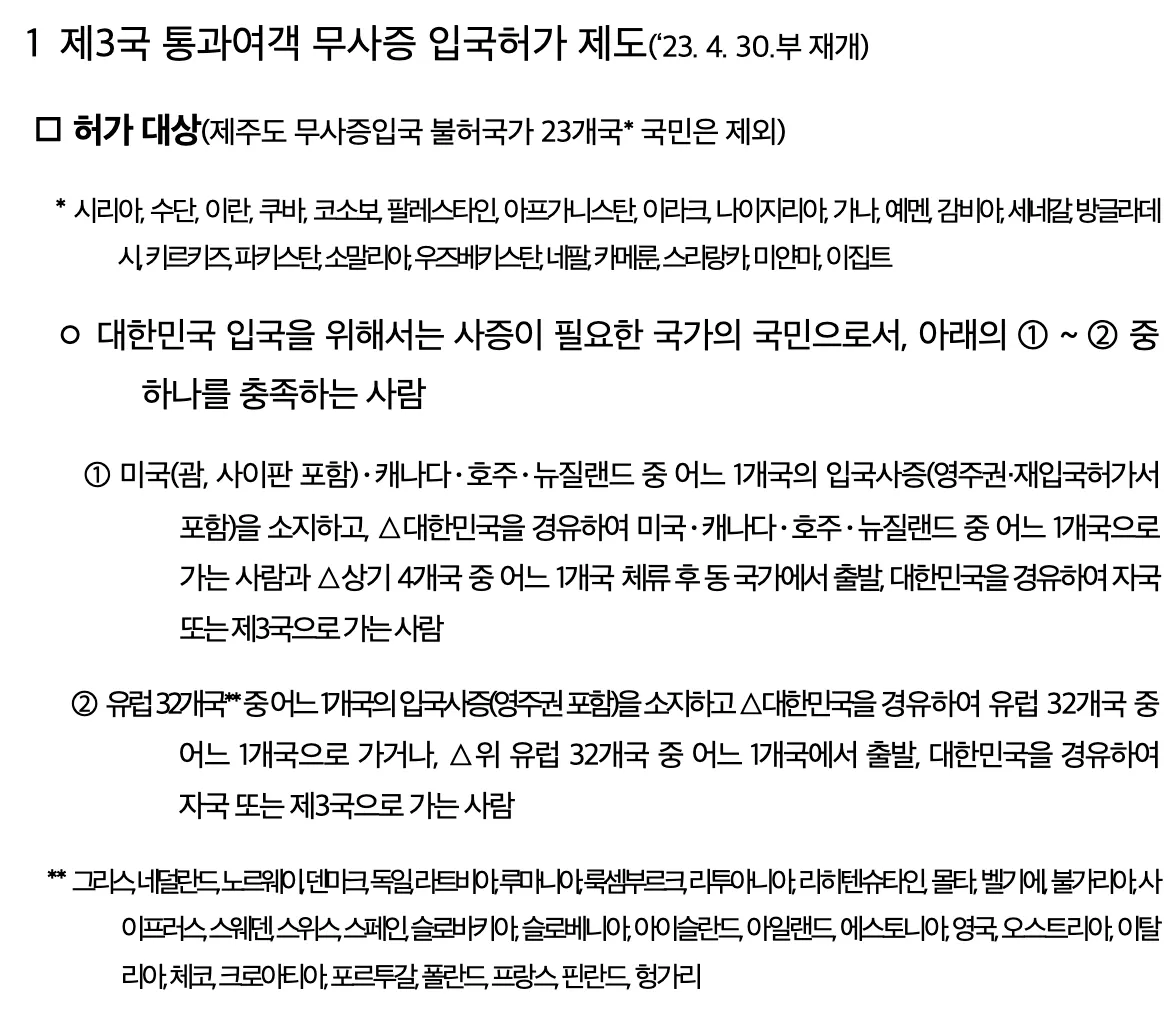
The scheme is called third-country transit visa-free entry permission. It resumed on 30 April 2023. If you are a national of a country that needs a visa for Korea, and you hold a valid entry visa or permanent residence for one of the United States including Guam and Saipan, Canada, Australia or New Zealand, and Korea is on the way to or from any of those four, immigration can admit you without a Korean visa. It does not have to be the country that issued the visa. Holding a US visa and flying to Canada through Korea qualifies. The same works inside the group of 32 European countries, travelling to or from any one of them.
The status granted is tourist in transit, B-2, and the period is 30 days. Not a day, not a night in an airport hotel. Thirty.
The Toronto consulate spells out who this is for in English, and the list is our readers: nationals of China, Mongolia, Vietnam, the Philippines and India, flying home from Canada, or flying to Canada, with Korea in the middle. If you are Vietnamese and you already went through the visa queue at the embassy once, this is the scheme that means you might not have to again.
The conditions are real and they are checked at the counter:
| Condition | Detail |
|---|---|
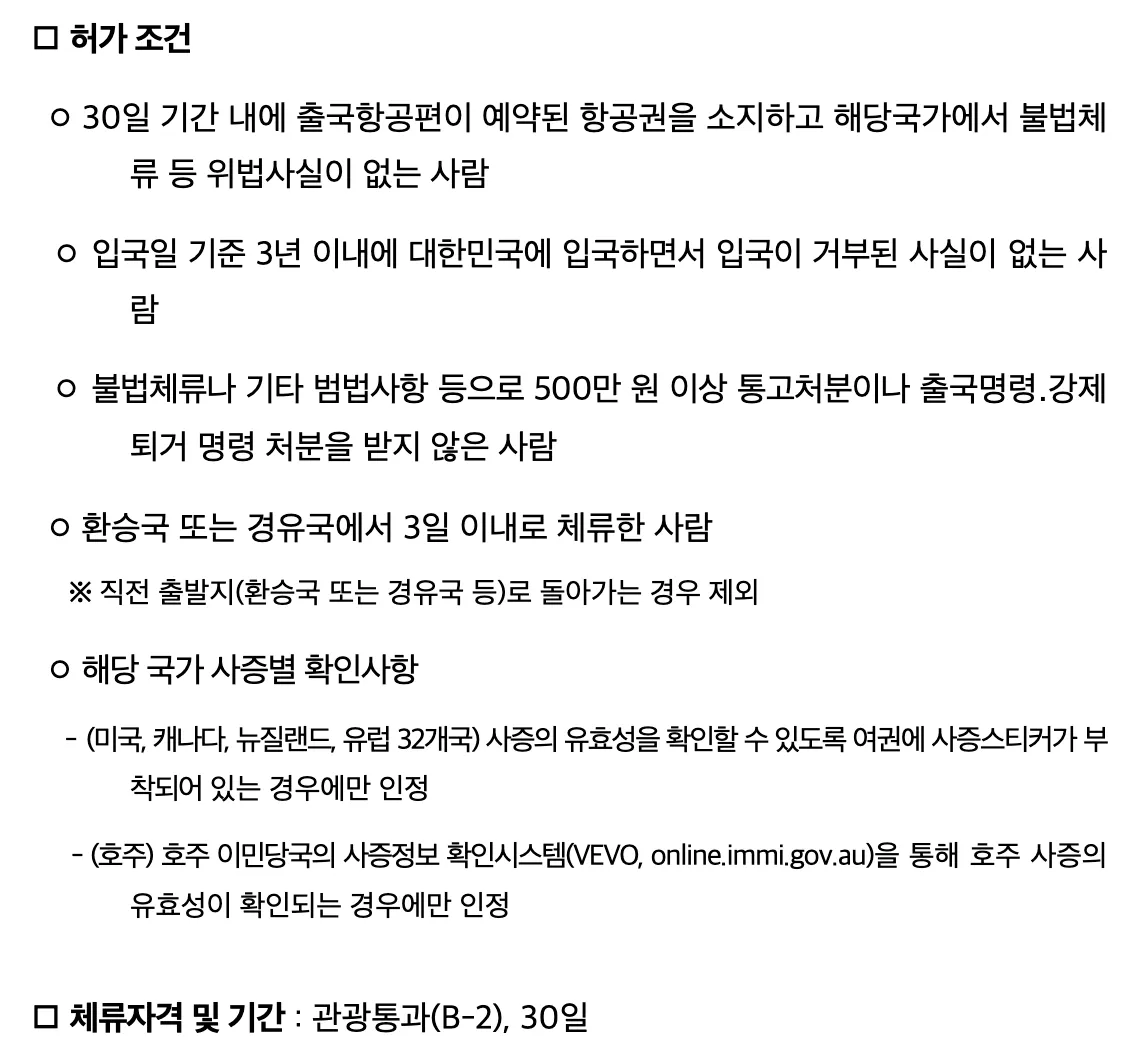
| Onward ticket | A booked departure flight within a 30-day period, and no record of unlawful stay in the country whose visa you hold |
| Form of the visa | Recognised only as a sticker physically in the passport |
| Australia exception | Accepted without a sticker if valid in the VEVO system |
| Previous refusals | No refusal of entry to Korea within three years |
| Penalties | No deportation order, departure order, or a notified penalty of 5 million won or more |
| Time in a country you stop in on the way | Three days or less in an intermediate country before Korea. Time spent in the qualifying country itself is not limited |
| Excluded nationalities | The same 23 countries excluded from the Jeju visa-free scheme, whatever visa you hold |
The sticker rule is the one that quietly disqualifies people. A great many countries now issue visas as a PDF or a digital record rather than a label glued into a passport, and the notice says a sticker is what is recognised, with Australia named as the single exception.
The itinerary has to pass through, not bounce
The Toronto consulate publishes worked examples, which is unusual and useful. It lists the permitted routings, and then it lists the forbidden ones. The pattern in the forbidden list is that you go out and come back to the same place.
Canada, then Korea, then Canada again, then home: not allowed. Home, then Korea, then home again, then Canada: not allowed. Korea appears exactly once in every one of the forbidden routings, so the rule is not about how often you touch Korea. It is that you may not go back to the place you set out from and then carry on.
The same worked examples settle the three-day question above. Home, then a third country for three days or less, then Korea, then Canada is listed as permitted. The three-day limit applies to an intermediate stop between the qualifying country and Korea. It says nothing about the years you may have spent in Canada, which is just as well, since the people this scheme names are mostly people who live there.
Separately, Incheon Airport’s own transit tour page states that the Ministry of Justice does not permit two entries within a single visit to Korea. That reads like the same idea, and it may well be, but the two pages do not reference each other and I have not found a document that connects them. Treat them as two statements that happen to point the same way.
The 24-hour cliff
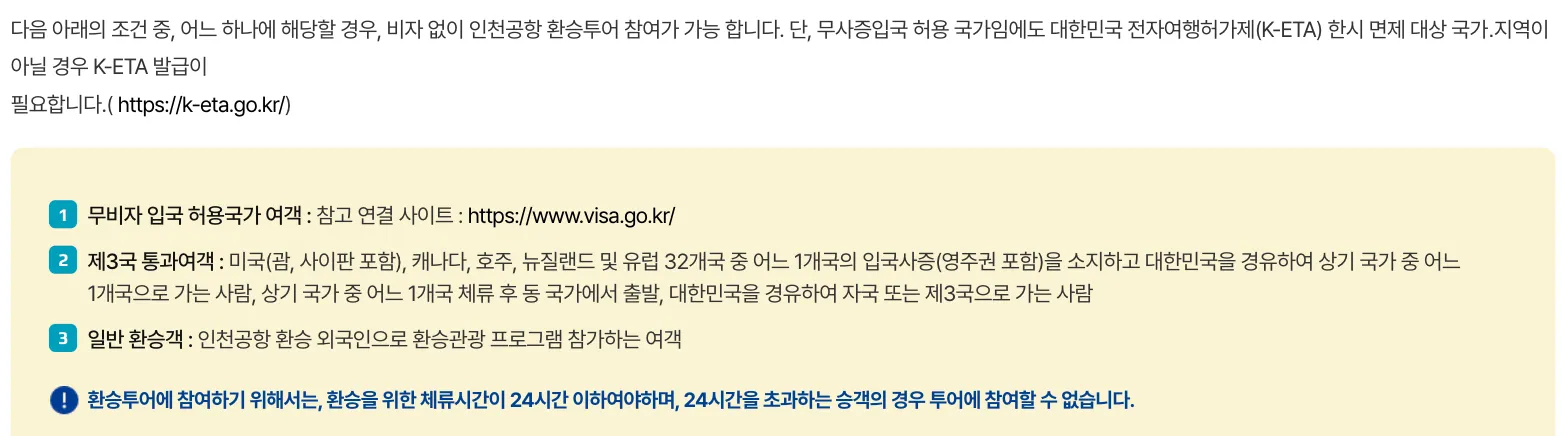
Now the other route, the one for travellers who do not hold a qualifying third country visa. You can be admitted visa-free if you join a recognised transit tourism programme. That grants B-2 for up to 3 days, on a transit ticket inside 72 hours, staying in the Seoul, Incheon and Gyeonggi area.
Incheon Airport says the free transit tours require a layover of 24 hours or less. Passengers whose connection exceeds 24 hours cannot join. Its paid K-Stopover packages, the ones with a hotel night bundled in, are sold to transit passengers of 24 hours or more and within 72 hours.
It is tempting to read those as one ladder, the free rung and the paid rung, and this is the place I would not assume. The tour page is the page that carries the visa-free permission. The K-Stopover page never mentions B-2 or visa-free entry at all, and sets a condition of its own instead: you must have no problem entering Korea in the first place. Its hotel list also reaches Jeonbuk and Gangwon, well outside the capital-area boundary the transit tourism scheme imposes. It reads like a commercial bundle sold to travellers who are already admissible, not a second door for travellers who are not.
If that reading is right, then a visa national with a 20-hour layover gets the free tour, a 30-hour one gets nothing, and buying a package does not buy the permission. I have not found a document that states this in terms, and it is exactly what I would ask 1345 before paying for anything.
The two windows do not meet cleanly either. One is stated as 24 hours or less and the other as 24 hours or more, so a connection of exactly 24 hours sits in both. They are not even measuring the same quantity: the tour page measures the layover, the stopover page measures time spent in Korea.
The tours themselves are mostly free, running from about three to six hours to places like Insadong, Hongdae, the DMZ observatories and Incheon’s markets. Two of them carry a $4 admission, the Third Tunnel and the Seoul Botanic Park, and there are two golf packages at 170,000 won and 180,000 won. Transit tour registration is at desks 19 and 20 on the first floor of Terminal 1 and desks 5 and 6 on the first floor of Terminal 2, both after immigration. The K-Stopover desk uses the same Terminal 1 numbers but sits near exit 3 in Terminal 2, and it is staffed 07:00 to 18:00. If you cancel a K-Stopover package the refund is 100% at seven days out, 50% at three days, 30% at two days and 0% on the day.
There is also a K-Culture Zone in the Terminal 1 transfer lounge, 09:00 to 20:00, the only item on the airport’s tour list you can reach without clearing immigration.
Does a transit passenger need K-ETA?
The ministry that runs the scheme and the company that runs the airport answer this differently, and neither defines its terms.
The Ministry of Justice’s immigration page lists who is outside the K-ETA system: diplomatic and official passport holders, ABTC holders, crew, transit passengers, and travellers aged 17 and under or 65 and over. Transit passengers are simply on the list.
Incheon Airport’s transit tour page says the opposite for the people it is addressing. Its wording is that even for a national of a visa-free country, if that country is not inside the temporary K-ETA exemption, K-ETA must be obtained.
Both can be right if “transit passenger” means someone who never crosses the immigration line, because a tour participant plainly does cross it. That is the reading I would bet on. But neither page says so, and if you are inside the exemption the question does not arise. Whether you are inside it is a separate mess of its own, where the government’s pages contradict each other about Switzerland.
For what it is worth, K-ETA costs 10,000 won with an online payment fee charged on top, is valid for three years, and the official guide asks for it before boarding rather than on arrival. Holding one also exempts you from the electronic arrival card.
A 2014 notice is still online and still looks current
While checking this I found the earlier version of the same scheme, published by the embassy in Uzbekistan, sitting live on a government domain. In that version the third-country route covers holders of a visa for the United States, Japan, Canada, Australia or New Zealand, and Europe appears only as a 30-country list open to Chinese nationals. The transit tourism route beside it grants 72 hours rather than 3 days, and the nationalities it shuts out number 11 rather than 23.
The current notices drop Japan, open the 32-country European list to anyone who otherwise qualifies, and apply the 23-nation exclusion to both routes. The older page was posted in 2016 and gives its start date as 6 April 2014, and those two dates are the whole of what it offers you. Nothing in the layout, the domain or the tone says it has been replaced.
This is now the third time this site has been caught by a Korean government page that is live, well ranked and out of date. The habit that catches it is boring and works: find the date on the notice before you believe the notice.
What I would actually do
If your connection is short and you were going to stay airside anyway, do nothing. There is no filing, no fee and no scheme to join.
If you hold a US, Canadian, Australian, New Zealand or European visa in sticker form and Korea sits between you and any country in that group, stop treating this as a layover. Check the 30-day scheme before you book, because a connection can become a trip. Ring the immigration information line on 1345 with your exact routing before you commit money to it, since the eligibility turns on the shape of the itinerary rather than on your passport alone. Check the 23-country exclusion list first, because it overrides everything else on the page.
If neither applies and your connection is under 24 hours, book a free transit tour. If it runs longer than that, the free tour is closed to you, and whether the paid package opens anything is the open question above. If you would have been admitted to Korea normally in any case, the comparison worth making is against just taking the train into Seoul.
What is not checked here
The scheme rules, the conditions, the stay periods and the exclusion list come from the Chicago consulate’s Korean-language notice, and the tour and stopover rules from the airport operator’s own Korean pages. Three of those pages were opened again on 21 September 2026 for the pictures here: the Chicago notice, the airport’s transit tour page, and the Ministry of Justice K-ETA page. Every figure quoted from them below still reads the same, and the K-ETA disagreement is still there in both directions, with 환승객 sitting in the ministry’s exclusion list and the airport still telling visa-free tour joiners to apply. The Hamburg, Toronto and Uzbekistan notices and the course and package pages I have not re-opened since August.
One thing to be straight about. Every condition on this page rests on that one Chicago notice. The Hamburg notice corroborates the two stay periods and the two resumption dates and nothing further, because its body does not carry the conditions at all. Chicago’s body does transcribe them in full, so for once the attached PDF is not hiding anything from me, but a single mission’s page is still a single page.
I have not verified several things. The notices date from May 2023 and carry the resumption dates of that year, and I could not find a Korean-language notice from 2025 or 2026 restating the scheme, so I cannot show that no condition has moved since. Whether a K-Stopover package can be bought by someone who is not otherwise admissible is my reading of two pages rather than anything either page says.
The Toronto page also contradicts itself and I have not resolved it. Under the heading about excluded countries it states that study and work permit holders are not eligible. Four bullets later, under eligibility, it lists permanent residency, study permit and work permit as qualifying documents. I do not know whether the first line applies to everyone or only to nationals of the excluded countries, and the Korean notice does not settle it because it says only entry visa, permanent residence and re-entry permit.
Nor have I confirmed the current transit tour timetable. The airport’s course list still carries a tour badged to the 80th anniversary of liberation, dated 13 and 27 August without a year, which suggests the page is not pruned every season. Times and running days should be confirmed on the numbers the airport publishes before anyone plans around them.
Finally, this page does not cover Jeju, which runs its own visa-free entry with its own limits and has already produced a court case about them.
If you have used one of these routes recently, especially the 30-day one, I want to hear how the counter actually handled it. Tell me.
Questions people actually ask
- Korea transit visa requirements: is there one set of them?
- No, and that is the first thing to get straight. It is not one policy. Staying inside the transit area, joining an airport tour, and holding a visa for a qualifying third country are three separate situations with completely different limits. The largest of them is the least advertised: hold a visa or permanent residence for the United States, Canada, Australia, New Zealand or one of 32 European countries, with Korea on the way to or from that same group, and immigration can admit you visa-free on a B-2 for 30 days.
- Layover in Korea: can I leave the airport, and does that change my paperwork?
- If you never pass immigration you are not entering Korea and there is nothing to file. If you leave the airport on any of the transit routes you are entering, on a B-2, and the ordinary arrival card rules apply to you from that point. The two questions are decided by the same thing: whether you cross the counter.
- Do I need a transit visa for a layover in South Korea, or just a K-ETA?
- Neither, on the routes above, and the K-ETA half is where the two official pages disagree. The Ministry of Justice lists transit passengers among those who do not apply for K-ETA. Incheon Airport tells transit tour joiners from visa-free countries to get one anyway unless they are inside the temporary exemption. Neither page defines who counts as a transit passenger, so the two are not reconcilable from the outside and the airport's advice is the cautious one.
- Incheon layover free tour: how long can the layover be?
- 24 hours or less, and that is the airport's own wording. How long you can stay in the country is a different question and depends which route admitted you. Third-country transit visa-free entry is a B-2 for up to 30 days. The airport tour route is capped the other way: Incheon Airport says its free transit tours require a layover of 24 hours or less, and the paid stopover packages it sells above that length require that you can already enter Korea, so they are not a second door for someone who cannot.
Where these numbers came from
Read on . 8 of 10 are Korean-language primary pages.
- Consulate General of Korea in Chicago, transit visa-free entry permission scheme (five schemes with conditions and stay periods) KO
- Consulate General of Korea in Hamburg, the same scheme with the resumption dates KO
- Incheon International Airport Corporation, transit tour eligibility and rules KO
- Incheon International Airport Corporation, transit tour course list and prices KO
- Incheon International Airport Corporation, K-Stopover packages and refund terms KO
- Korea Immigration Service, Ministry of Justice, K-ETA scheme page listing who is outside it KO
- Embassy of Korea in Switzerland, visa-free entry and K-ETA notice revised January 2026 KO
- Consulate General of Korea in Uzbekistan, the superseded version of the same scheme, dated 2014 KO
- Consulate General of Korea in Toronto, English notice with the permitted and forbidden itineraries
- K-ETA official site, application guide with the fee and validity