Jeju island visa-free entry: a permit for Jeju, not Korea
Cite this page
Hwang, J. (2026). Jeju island visa-free entry: a permit for Jeju, not Korea. Korea, Verified. https://koreaverified.com/jeju-visa-free-entry/ (checked 21 September 2026)
Search for Jeju and visas and the answer arrives immediately, in the same words, on page after page. Jeju is visa-free. Thirty days. Just turn up.
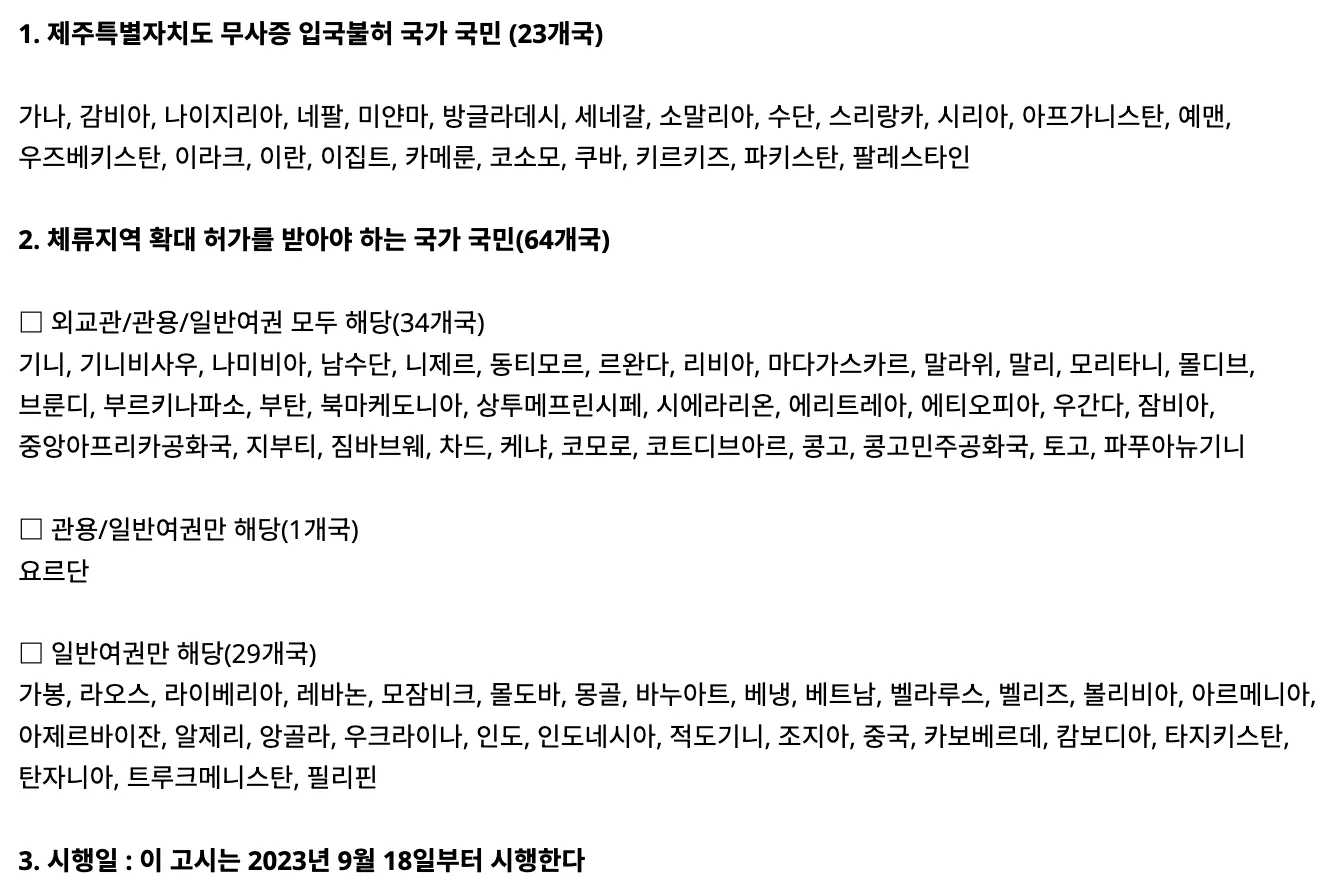
All of that is drawn from a real Korean rule, and all of it stops one sentence too early. The rule does not waive a visa for Korea. It grants permission to be in Jeju, and that permission ends at the water. The Ministry of Justice notice that creates the scheme contains two lists, and the English-language guides reproduce only the first one.
It is a status, and the status has conditions
HiKorea, the government’s service portal for foreign nationals, files Jeju under visa-free admissions alongside transit passengers and ABTC holders. The entry reads as a set of conditions rather than a welcome. The traveller must be arriving for tourism, transit or similar purposes, must come in on a direct service to a Jeju airport or Jeju port, and may stay only in Jeju. The status granted is B-2, tourist transit, for up to 30 days. Immigration records the Jeju route under its own sub-code, B-2-2, which is how it appears in court papers.
Two of those conditions get lost in translation constantly.
The first is the direct service. Landing at Incheon and connecting onward to Jeju is not this scheme. If you need a visa for Korea, you needed it to clear the counter at Incheon, and the Jeju rule never reaches you.
The second is the geography. Only in Jeju is not a recommendation about where the good beaches are.
One notice, two lists
The legal machinery sits in the Jeju Special Act, and the Minister of Justice fills in the country names by public notice. The current notice took effect on 18 September 2023, and its title says exactly what it contains: countries barred from Jeju visa-free entry, and countries whose nationals need a stay-area expansion permit to go anywhere else in Korea.
| List | What it does | Who is on it |
|---|---|---|
| Barred from Jeju visa-free entry, 23 countries | Cannot use the scheme at all | Ghana, Gambia, Nigeria, Nepal, Myanmar, Bangladesh, Senegal, Somalia, Sudan, Sri Lanka, Syria, Afghanistan, Yemen, Uzbekistan, Iraq, Iran, Egypt, Cameroon, Kosovo, Cuba, Kyrgyzstan, Pakistan, Palestine |
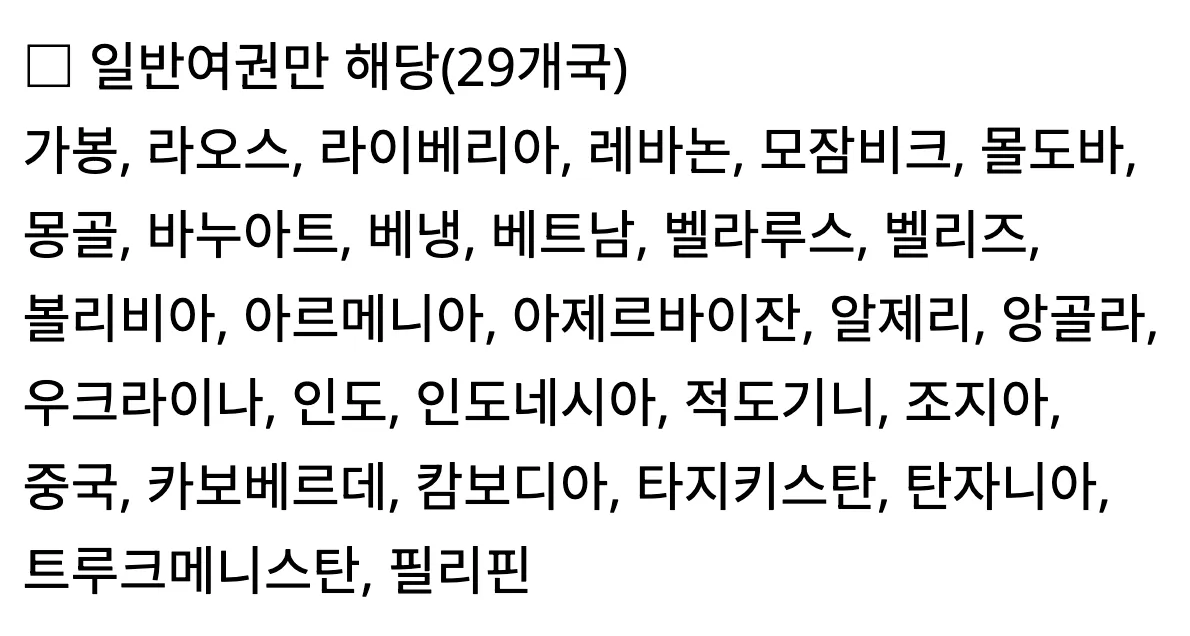
| Stay-area expansion permit required, 64 countries | May enter Jeju, but must be authorised before moving to any other part of Korea | 34 countries for every passport type, Jordan for service and ordinary passports, and 29 more for ordinary passports only |
| The ordinary-passport group of 29 | The group most travellers belong to | Includes China, Vietnam, Indonesia, the Philippines, Mongolia, India, Cambodia, Laos, Ukraine, Georgia, Belarus, Armenia, Azerbaijan, Moldova, Algeria, Lebanon, Bolivia and Gabon |
Read the second list against the first and the design becomes clear. Jeju visa-free entry is aimed at people who would otherwise need a visa for Korea. The same notice then takes most of those nationalities and says: not past Jeju, not without asking.
China is the case where that design is easiest to misread, because a Chinese passport has a second visa-free route onto the mainland through a designated tour agency, with a shorter stay and an end date the English pages have wrong. Jeju’s 30 days are unaffected by any of it, and still stop at the island.
That is the sentence missing from the English pages. They quote the 23, conclude that everyone else is welcome, and leave the reader believing they have found a side door into the country.
What the Act actually does to someone who moves
The Jeju District Court set the scheme out in full in a 2024 judgment, which is the clearest statement of it we have found in either language.
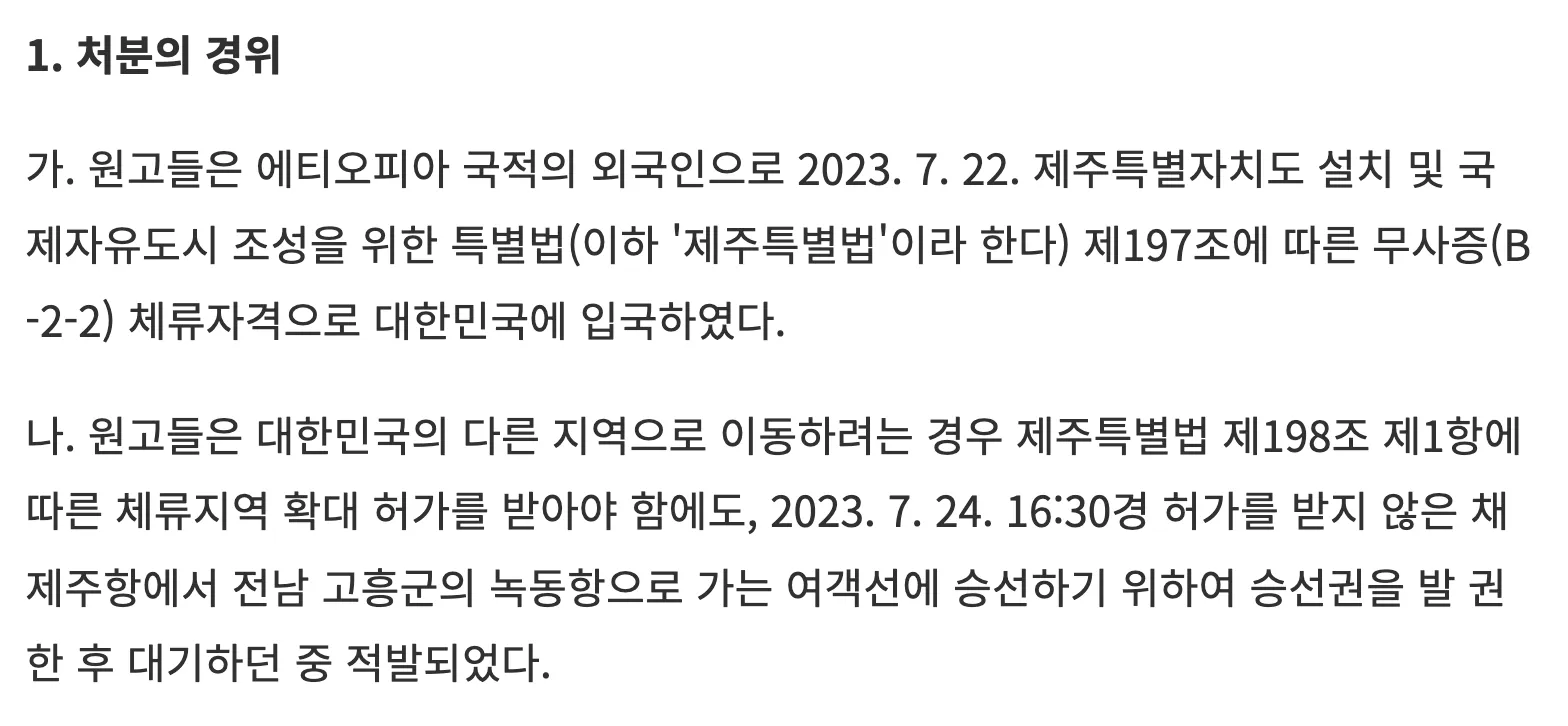
Article 197 grants the visa-free entry. Article 198 says that a national of a designated country who wants to move to another part of Korea may apply for a stay-area expansion permit. Article 202 then does the damage: a foreign national who moves without that permit is treated as having entered the country with no visa at all, and may be deported on that basis. Alongside the deportation there is a criminal penalty of up to three years and a fine of up to 20 million won, and the Act separately punishes the attempt.
Two more provisions sit either side of the traveller. One criminalises anyone who moves such a person, arranges it, or supplies a vessel or a passport for it. The other puts a duty on the operator of any ship running between Jeju and the mainland to check whether a foreign passenger holds the expansion permit and to refuse boarding if not, on pain of criminal punishment.
So the boarding gate is, on paper, an immigration checkpoint. Keep that in mind for what follows.
The court has already ruled on what leaving looks like
On 22 July 2023 two Ethiopian nationals entered Jeju under the scheme, on B-2-2. Ethiopia is in the first group of the second list, so a permit was required before they went anywhere else. On 24 July, at around 16:30, they were at Jeju Port with tickets for the ferry to Nokdong, on the mainland in South Jeolla, waiting to board when they were detected. A deportation order followed on 26 July.
They challenged it. On 11 June 2024 the Jeju District Court rejected the challenge to the deportation order on the merits, and threw out a separate challenge to their detention as filed too late. The Gwangju High Court dismissed their appeal on 13 November 2024.
Their central argument was that they had never actually left, so at most this was an attempt. The court refused the distinction. A deportation order is an administrative sanction, it held, so the criminal law of attempts does not apply to it, and moving is not the same thing as having finished moving. Once the tickets were issued and the travellers were waiting to board, the main part of the act was done and the risk the rule exists to prevent had become real.
They also said they spoke no Korean, thought they were boarding a sightseeing boat, and did not know Nokdong was off the island. The court did not believe it, and the reasons matter more than the outcome. On 17 May 2023 they had applied to the same office for a short-term visit visa, a C-3, and been refused; they entered through the Jeju scheme on 22 July instead. And the court recorded that they had been told at the border, on entry, that they could not leave Jeju.
That last point is the one to carry away. The restriction is not buried in a statute nobody reads. It is stated to the traveller at the counter.
The ticket office is not the safety net the law says it is
The judgment contains one detail that should worry anyone relying on being stopped. The travellers were sold ferry tickets. The Act obliges the carrier to check for the expansion permit and to refuse boarding without one, and that check did not happen, or did not work.
The duty exists. Do not plan around it. Being sold a ticket is not permission to use it, and the consequences of the carrier’s failure landed on the passengers, not on the carrier.
The duty is written for ships between Jeju and the mainland. The small ferries to islands that are part of Jeju are a separate matter, though they check papers too: the boat to Gapado asks foreigners for a passport or residence card before it sells a ticket.
If Korea is already open to you, Jeju adds nothing
There is a second audience for this topic, and their position is the reverse.
If you hold a passport from a country that enters Korea without a visa, the Jeju scheme is irrelevant to you. You are admitted to the whole country under a different rule, and the thing that governs your trip is the K-ETA.
Flying to Jeju used to be the way around that. It is not any more. From 1 September 2022 the travel authorisation was extended to Jeju-only itineraries. The Ministry of Justice puts the scheme’s scope at 112 countries and regions, 67 under visa-waiver agreements and 45 under tourist transit arrangements. The fee is 10,000 won, the authorisation lasts three years or until your passport expires, whichever comes first, and the guidance asks for applications at least 72 hours before departure.
Before you go and pay it, check whether you need it at all. A large group of nationalities is currently excused from K-ETA under a temporary exemption, and that exemption has been extended again to run to 31 December 2026. Travellers aged 17 and under or 65 and over are outside the requirement as well. Nobody in either group has to apply, and an airline will board them without it.
Checking which group you are in is harder than it sounds, and worth doing before you assume: the Korean and English versions of the exempt list disagree on both the count and the countries, and two nationalities are exempt on one page and required to apply on another. Which page says what, and how to tell, is the K-ETA exemption page.
Both groups can still apply and pay if they want to, and there is one concrete reason to consider it. Holding a K-ETA excuses you from the arrival card, and not holding one puts you back on the form, which is the trap we set out in the piece on the e-Arrival Card.
For a worked example of how differently the same trip reads depending on which passport is in your hand, see Korea for Indonesian passport holders.
What we have not checked
- What the stay-area expansion permit involves in practice. Documents, processing time, cost and refusal rate are not published on any page we read. The general enquiry line for foreign nationals in Korea is 1345.
- What happens to a Jeju visa-free entrant whose nationality is on neither list. The Act attaches the permit requirement, and the deportation ground that follows it, to nationals of the designated countries. HiKorea states separately and without qualification that Jeju visa-free entrants may stay only in Jeju. We have not confirmed what a traveller outside the 64 is actually told at a domestic ferry or airport counter, and this is not a point to test in person.
- Whether the temporary K-ETA exemption applies identically to a Jeju-only itinerary. The extension notice is written in general terms and does not mention Jeju either way. This is unverified.
- Whether the 23-country list has moved since the January 2025 restatement. That is the most recent version we could find published by a Korean mission, and it matches the notice in force since September 2023.
If you have been through the expansion permit yourself, or you have seen a newer version of the notice, tell us on the contact page and we will re-check and re-date the page.
Questions people actually ask
- What is Jeju island visa free entry, and what does it actually permit?
- It grants tourist transit status, B-2, for up to 30 days, at a Jeju airport or port, to travellers arriving on a direct service. Immigration files the Jeju route under its own sub-code, B-2-2, which is how it appears in court papers. Read the last condition carefully: it is permission to be in Jeju, not permission to be in Korea, and connecting through Incheon is not this scheme at all.
- Jeju visa free countries: who can use the scheme, and who is barred?
- The Ministry of Justice notice in force since 18 September 2023 carries two lists, and English guides quote only the first. List one bars 23 nationalities outright: Ghana, Gambia, Nigeria, Nepal, Myanmar, Bangladesh, Senegal, Somalia, Sudan, Sri Lanka, Syria, Afghanistan, Yemen, Uzbekistan, Iraq, Iran, Egypt, Cameroon, Kosovo, Cuba, Kyrgyzstan, Pakistan and Palestine. Everyone else may land. That is where the English pages stop reading.
- Jeju island visa policy: can I travel on to mainland Korea, or does it end at the water?
- It ends at the water for 64 nationalities, the second list nobody quotes. They may enter Jeju but need a stay-area expansion permit before moving anywhere else in Korea, and the group is mostly the nationalities for whom Jeju is the only visa-free way in: China, Vietnam, Indonesia, the Philippines, Mongolia, India, Cambodia and Laos, all eight in the same 29-country ordinary-passport paragraph. Moving without the permit is a deportation ground and a criminal offence, attempts included. On 11 June 2024 the Jeju District Court upheld a deportation over a ferry ticket never used: the travellers were caught at Jeju Port waiting to board.
- Do the Jeju island visa-free countries need a K-ETA as well?
- Yes, unless your nationality is inside the temporary exemption that now runs to 31 December 2026. Flying to Jeju used to be the way around the travel authorisation; since 1 September 2022 a Jeju-only itinerary needs a K-ETA like any other. And if your passport already gets you into Korea without a visa, Jeju offers you nothing extra: you are admitted to the whole country under a different rule.
Where these numbers came from
Read on . 7 of 9 are Korean-language primary pages.
- HiKorea, visa-free entry categories including the Jeju scheme (Korean) KO
- Korean Consulate in Kobe, full text of the notice in force since 18 September 2023, with both lists (Korean) KO
- Korean Embassy in Bulgaria, January 2025 restatement of the barred list (Korean) KO
- Jeju District Court, 11 June 2024, case 2023구합6223, deportation upheld, with the statutory scheme quoted in full (Korean) KO
- Korean Consulate in Dubai, 2022 notice recording the extension of K-ETA to Jeju (Korean, superseded on the country lists) KO
- Ministry of Justice, K-ETA scheme, scope, validity and fee (Korean) KO
- Government press release, K-ETA extended to Jeju from 1 September 2022 (Korean) KO
- K-ETA portal, application page showing the fee
- K-ETA portal, notice extending the temporary exemption through 2026