Korea's Modu Card is a residency check, not a travel card
Cite this page
Hwang, J. (2026). Korea's Modu Card is a residency check, not a travel card. Korea, Verified. https://koreaverified.com/k-pass-modu-card-visitors/ (checked 1 October 2026)
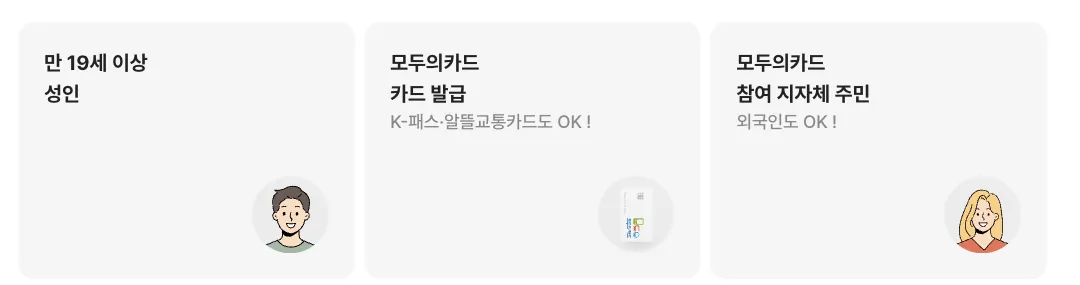
Seoul’s Climate Card has been switched off and replaced by a national scheme, Korea’s Modu Card. That much has reached the English internet. The next sentence everybody is about to write, so get the new one instead, is the part that does not work, and the reason is not on any English page I can find.
Modu Card is run by the transport ministry’s metropolitan transport commission under the existing K-Pass brand, and the ministry’s own explainer is blunt about what it is: not a new card, but a new refund method bolted onto the K-Pass card you may already hold.
A refund method has to know who to refund. That is where a visitor’s trip ends.
First, the dates moved
I have to start here, because the article I published on 30 July carries the old ones. On 30 July the city rewrote its own shutdown notice and pushed every date back by a month. The URL did not change. The dates on it did.
| Date | What happens |
|---|---|
| 31 August 2026 | Last day to charge a prepaid 30-day Climate Card (passed) |
| 1 September 2026 | Prepaid charging stopped; Seoul’s Modu Card variant launched (passed) |
| 29 September 2026 | Last day a prepaid Climate Card worked (passed) |
| 30 September 2026 | Last day a postpaid Climate Card worked (passed) |
| 1 October 2026 | Prepaid and postpaid Climate Cards both ended (passed) |
Both of the first two dates arrived as printed. I re-read the end-of-service FAQ and the Climate Pass FAQ on 17 September: charging closed on 31 August, the city dates its own layer to 26.9.1, and it says a Seoul resident already carrying a Modu Card had the benefit applied from that day without doing anything.
Updated 1 October 2026. The last three rows used to read as things still to come. I re-read the end-of-service FAQ today: the table is unchanged, with no further postponement, so 29 September was the last prepaid day, 30 September the last postpaid day, and both ended on 1 October. The same FAQ still says the 1 to 7-day short passes are kept.
The city’s stated reason for the extension is to avoid a gap between the old pass ending and the new benefit starting. One detail inside it is easy to miss: a card charged on 31 August still runs to its own expiry, which is what pushes the final prepaid day out to 29 September. On that last charge you cannot pick a start date.
If you are reading an English page that says the pass dies on 1 September, it was right until 30 July.
Worth knowing if you go and look for yourself: the city’s shutdown notice now carries both schedules at once. The body has the new dates; the automatically generated summary sitting above it still has the old ones. The dated FAQ table is the version to trust.
What Modu Card actually is
The old K-Pass refunded a percentage of what you spent. Modu Card adds a flat-rate method on top: you carry the fare yourself up to a monthly threshold, and everything above the threshold comes back in full. There are two versions, a standard one for journeys costing under 3,000 won and a Plus one with no fare ceiling that reaches metropolitan commuter buses and the GTX.
You do not choose. The system runs your month through all three methods (old percentage, standard, Plus) and applies whichever returns most.
For the Seoul area the standard threshold is 62,000 won, which is not a coincidence: it is exactly what the 30-day Climate Card cost. The government matched the price and then made it national.
Two things were temporarily true on top of that from April, both under a supplementary budget and both ending with journeys on 30 September 2026: the thresholds were cut by around half, and the percentage rates were lifted inside four commuting windows. From October the thresholds are back to the standing ones, and as of 1 October I found no announced extension. The right-hand column below is history.
| Who | Standing rate | Off-peak, April to 30 Sept 2026 (ended) |
|---|---|---|
| General | 20% | 50% |
| Youth, over-65, two children | 30% | 60% |
| Three or more children | 50% | 80% |
| Low income | 53.3% | 83.3% |
The windows are 5:30 to 6:30, 9:00 to 10:00, 16:00 to 17:00 and 19:00 to 20:00, judged on when you board. They are shoulder hours either side of the rush, and the point of them is to move people off the peak.
None of that matters unless you can join.
The sign-up wall, screen by screen
The Korean sign-up flow has four steps, and it names them across the top of every screen: identity verification, card verification, remote eligibility check, account details.
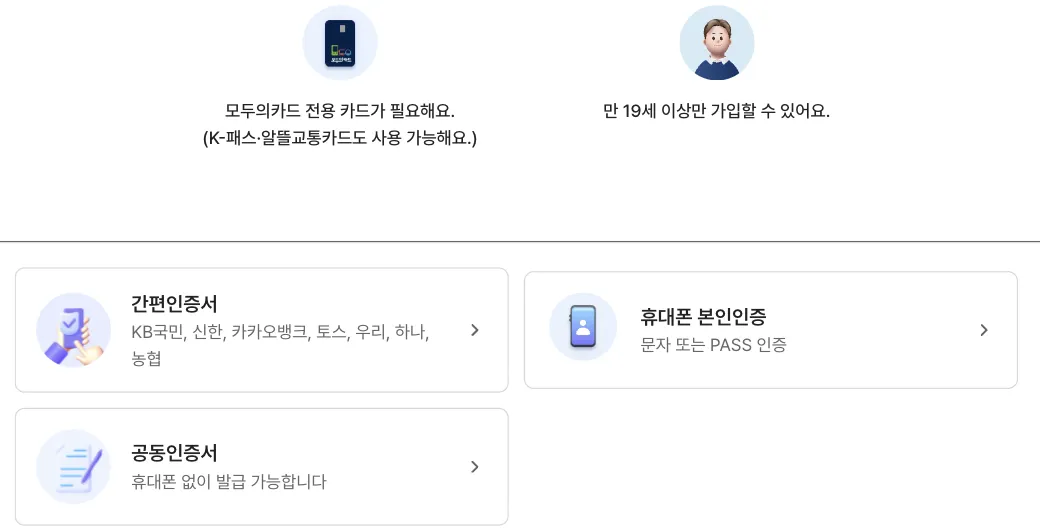
Step one wants one of three things: a simplified certificate through a Korean bank app, phone identity verification by SMS or the PASS app, or a Korean joint certificate. It also states the age floor, 19 and over. Be precise about what the barrier is here: the page annotates the joint certificate as issuable without a phone, so a phone is not strictly required. What all three routes do require is an existing Korean financial or telecom identity in your own name. If you arrived on a data-only eSIM you cannot take the middle route, which is the trap in the connectivity article, and the other two want a Korean bank behind them.
Step two wants a K-Pass card, issued by one of the participating Korean card companies. A government policy briefing in March 2026 put the number of issuers at 27; none of the pages I read gives a current count.
Step three is the one that settles the question. The page explains the remote eligibility check in plain terms: it reads your resident registration number to confirm your place of residence, and to pull the low-income and multi-child flags that set your refund rate. The consent notice underneath lists what is collected and from whom: name, and a resident registration number or a foreigner registration number, checked against the interior, welfare and justice ministries.
Then the warning that ends it for a tourist:
If your registered address cannot be confirmed, sign-up may be restricted.
Step four is just a username and password.
The rule is registration, not nationality
The published statements of who this is for do not agree with each other, and the disagreement is the finding.
The K-Pass front page says the benefit is for any citizen of the Republic of Korea. The card operator T-money is narrower and more procedural: residents aged 19 and over who hold a resident registration in a participating local authority. The sign-up form is broader than both, because it accepts a foreigner registration number, which no holder of a resident registration has.
Two clicks from that front page, the scheme settles the argument against itself. Its own eligibility page lists three conditions and nothing else: adult aged 19 or over, a Modu Card issued, and a resident of a participating local authority. Printed under the third one, in grey type a third the size of the heading above it, is the line no English page carries: foreigners OK too. So the scheme agrees with its card operator and contradicts its own front page, and it is the operator’s wording that survives. The test is residency. It was never nationality. Screenshot above; I read the page on 20 September 2026.
Take the form as authoritative, since it is the thing that actually decides. The rule it implements is not nationality and not residence in the ordinary sense. It is possession of a state registration number attached to an address the government can look up.
Every local authority in the country now participates, so geography is not the constraint either. A short-stay visitor (visa-free, K-ETA, tourist visa, any of them) holds no resident registration and no foreigner registration number, because foreigner registration applies to people staying more than 90 days, who must register within 90 days of arrival.
That 90-day line is not quite a clean rule, and it is worth knowing where it bends. HiKorea lists exemptions: diplomatic, official and agreement status (A-1, A-2, A-3) and their families; Canadian nationals staying under six months on certain culture, religion, cohabitation, accompanying and miscellaneous statuses; and anyone under 17. Those people can be here far longer than 90 days and still hold no foreigner registration number, which, by the mechanism above, locks them out too.
So the answer to “can a tourist use Modu Card” is no, and the interesting part is how. There is no clause excluding visitors anywhere in the flow. There is no nationality test. There is a form field that accepts exactly two kinds of number, and a tourist holds neither. The exclusion is a side effect of the plumbing.
The obvious objection is the prepaid route, and it fails. Seoul’s FAQ does point people without a bank account towards a prepaid T-money version of Modu Card that pays out in T-mileage instead of cash. But the operator is explicit that the card number still has to be registered on the K-Pass site or app to earn anything, and the city states the refund conditions as card issued, membership and card registered, and 15 journeys in the month. Every path leads back through the same eligibility check.
If you live here, this section is for you
The consent notice accepts a foreigner registration number, and the page goes further: it describes what to do when that number does not resolve. I have not found an English page that says either thing.
Be careful how far you take this. The route the sources describe is conditional, not equal treatment. The operator’s own eligibility line is written around resident registration, and what the sign-up page adds is a specific remedy: where residence cannot be confirmed from a foreigner registration number, you may join by submitting documents directly, and refunds can be paid once the address is confirmed that way. So the honest summary is that a registered foreign resident has a documented path in, with a manual step that a Korean national will usually not need. The page does not list which documents, so budget a phone call.
Seoul runs the same manual-documents pattern on the pass this one replaces, and there it does name them and attach a deadline. If you held a 30-day Climate Card in the spring, the payback on it is claimed on paper and closes at the end of August.
One more thing on the same screen, easy to trip over: if you have changed your legal name, the check fails until your telecom or certificate issuer has the new name on file. That is common enough among naturalised and married residents to be worth flagging.
The refund needs 15 journeys in a calendar month, with the first month exempted, and there is no upper limit on how many count. It arrives the following month through your card company. Airport railroad journeys are covered. Airport buses, intercity and express coaches, KTX and SRT are not. Since the two high-speed operators merged on 1 September 2026 those trains are all sold as KTX, and none of them counts towards the refund either way.
One Seoul-only wrinkle, live since 1 September 2026: the youth band is stretched from 34 to 39 for people registered in Seoul, so residents aged 35 to 39 move up to the youth refund rate automatically, with no new card.
Updated 15 August 2026. This paragraph used to end by telling you to treat the 35 to 39 band as announced rather than running, on the strength of the city saying its system linkage was still being verified. That was too weak a reading of the source. The clause about linkage is followed, in the same answer, by a sentence stating that 35 to 39-year-old Seoul residents will receive the youth refund, the city repeats it in two other answers, and its news release dates the change to 1 September. The verification clause is the plumbing and I mistook it for the decision. Check your first refund rather than assuming, but budget for the youth rate.
What a visitor should do instead
Nothing changes, which is the genuinely useful finding here. The short-term Climate Card passes are staying, and Seoul is explicit about why: they cannot be combined with Modu Card, so there is nothing to merge them into.
| Pass | Price |
|---|---|
| 1 day | 5,000 won |
| 2 day | 8,000 won |
| 3 day | 10,000 won |
| 5 day | 15,000 won |
| 7 day | 20,000 won |
Those prices are for the pass. The plastic card itself is a separate 3,000 won, bought once, so a first 1-day pass really costs 8,000 won. No English page I found prints both numbers together.
The coverage is not quite “Seoul”, and the difference will cost you a fare if you take the slogan literally. It is Seoul’s subway plus some Gyeonggi sections, with the listed reaches running out past Dobongsan, Jinjeop, Ori, Pangyo, Ilsan and Gimpo, plus Seoul-licensed city and village buses, which stay valid even when they board and alight outside the city. What is out: the Sinbundang line, the GTX, subway stations beyond the listed sections, metropolitan and airport buses, and buses licensed by other cities. The short-term passes also exclude the bike share and the river bus, which the 30-day versions could include, and they start the day you charge them, so no buying one in advance.
Buy the plastic one, not the mobile one. Here the city’s own page contradicts itself and I am not going to pretend otherwise: in one block it gives the mobile card’s payment methods as bank transfer or a credit or debit card in your own name, and a few lines later as bank transfer alone, with other methods “to be expanded later”. Either way it is pointed at people with Korean bank relationships. The physical card avoids the question. It is sold at the newer ticket machines inside subway stations on lines 1 to 8, and at convenience stores around line 9, Ui-Sinseol and Sillim stations, and the station machines take cash.
One correction to how this is usually described, including by me until today. The city does not say registration is optional: it says physical-card holders must register the card on the T-money Card & Pay site, one card per person, and that an unregistered card cannot be refunded or used for the bike share. Riding works without it. Getting your money back does not.
And the refund is worse than it sounds for anyone flying home. It is the balance minus what you actually spent minus a 500 won fee, it must be claimed inside the pass’s own validity period. After expiry there is no refund at all, on a working card as much as a broken one. And if you have no Korean bank account, the page’s stated route is a cash refund in person at T-money’s head office. None of which you will do on the way to the airport. Charge close to what you will really use.
Seoul makes the same recommendation itself, in a roundabout way. Its end-of-service FAQ has a question from people who cannot sign up for K-Pass, whether for want of a phone or because registering is simply too hard, and the city’s answer is to use the short-term Climate Card. That question is not about tourists. The answer fits them exactly.
If you are here for a few days and mostly moving around by subway, the plain T-money card and the transfer rules still beat a pass on most itineraries, which is the arithmetic in the T-money article. Nothing in this change touches that.
Decision guide for international visitors
For foreign tourists arriving at Incheon or Gimpo, the choice comes down to two practical paths:
- Intensive Seoul itinerary (1 to 5 days, 4+ journeys daily): Buy a physical short-term Climate Card (₩5,000 for 1 day, ₩8,000 for 2 days, up to ₩15,000 for 5 days) at Seoul subway station convenience stores. Note that the physical card costs ₩3,000 cash, and loading the pass requires cash at station machines. It does not cover the AREX express train from Incheon Airport.
- Standard itinerary, multi-city travel, or light transit use: Buy a standard T-money card. It works nationwide across Seoul, Busan, and Jeju, accepts taxi payments, and recovers its cost through Seoul’s 30-minute free transfer discounts.
You can calculate whether a pass pays for your specific itinerary using our Climate Card breakeven calculator.
What is not checked here yet
The dates, the thresholds, the refund rates, the sign-up steps, the identity requirements and the short-term pass prices all come from the ministry’s, the city’s and the operator’s own Korean pages.
Be precise about when each was read, because that is the only thing this page sells. The city’s end-of-service FAQ, its scheme page, its shutdown notice, its news item on the 1 September launch and the K-Pass scheme intro were all re-read on 15 August 2026, and they carry the prices and refund rates above. The end-of-service FAQ and the Climate Pass FAQ were read again on 17 September, to check the two dates that had passed by then. The HiKorea registration page was last read on 2 August 2026. Sign-up step one and the eligibility page were opened again on 20 September 2026 and photographed as they stood that day, which is where the two screenshots on this page come from. Steps two, three and four sit behind the identity check, so I cannot reach them without a Korean registration number and have not tried: treat those three as a 2 August reading.
I have not confirmed which documents the manual submission route actually requires for a foreign resident whose address check fails. The page names the route without listing them. That is the one gap here I would most like closed.
Since 1 September 2026 Seoul has discounted the short-term passes for 13 to 18-year-olds, charging a 7-day pass at 13,000 instead of 20,000 won.
Updated 15 August 2026. This paragraph used to say I had no source for how that age is checked. The city has since answered it in the end-of-service FAQ, in a question that opens by stating adolescents cannot sign up for Modu Card at all: the discount is reached by verifying as an adolescent on the T-money website, and then charging the 7-day pass. What that verification accepts from somebody with no Korean registration record is still unconfirmed, so a visiting teenager should assume the full price. The wider question of who the replacement admits and who it turns away is its own article now.
The survival of the short-term passes is the city’s stated plan rather than a fixed commitment. The FAQ says in one place that they are simply being kept, and elsewhere that they are planned to continue; I have taken the weaker of the two readings. Re-read on 1 October 2026, the day the 30-day pass ended, it still says they are kept.
The HiKorea page setting out the 90-day registration rule carries a last-modified date of 2021, which is old for a government page. The threshold itself is statutory and has not moved, but I am noting the age of the page rather than hiding it.
If you have registered for Modu Card on a foreigner registration number, or been refused, tell me what happened. That is the gap I would most like to close. And if none of this applies because you have not landed yet, start here.
Questions people actually ask
- What is Modu Card Korea, and is it a card at all?
- Not a card. It is a refund formula attached to a K-Pass card, run as the national scheme that Seoul's Climate Card was folded into, and Seoul's own local variant of it launched on 1 September 2026. Modu Card pays anywhere in the country; the extra layer Seoul added pays only people registered in Seoul.
- How to get Modu Card as a short-stay visitor to Korea
- You cannot, though not because of any nationality rule in the terms. The scheme's own eligibility page sets three conditions, and the third is residency in a participating local authority. Joining means passing an identity check that reads a resident registration number or a foreigner registration number against government records, and a short-stay visitor holds neither. It is the identity field on the sign-up form that shuts the door.
- Is Modu Card Seoul what replaces the Climate Card?
- For residents, yes: Seoul's own Modu Card layer launched on 1 September 2026. For a visitor nothing needs to replace it, which is the part that gets lost. Seoul is keeping the 1, 2, 3, 5 and 7-day Climate Card passes at 5,000 to 20,000 won, precisely because they cannot be merged into the national scheme. Only the 30-day version ended, on 1 October 2026.
- Foreign residents: how to get Modu Card on a foreigner registration number
- You can, and the scheme's front page does not mention it. Its eligibility page prints "foreigners OK too" under the residency condition, the identity check accepts a foreigner registration number, and where that number will not resolve to an address you may join by submitting documents by hand instead. Under-19s cannot join at all, which is why Seoul has sold them a 7-day short-term pass at 13,000 won since 1 September.
Where these numbers came from
Read on . 13 of 13 are Korean-language primary pages.
- K-패스, 사업소개 (지원대상·환급기준·한시 적용기간) KO
- K-패스, 가입조건 (만 19세 이상·참여 지자체 주민·외국인도 OK) KO
- K-패스, 회원가입 1단계 (본인인증 수단·연령 요건) KO
- K-패스, 회원가입 3단계 (비대면 자격조회·외국인등록번호 처리) KO
- K-패스, 회원가입 4단계 (회원정보 입력) KO
- 티머니, 모두의카드(K-패스) 서비스 안내 (지원 대상 및 대상 교통수단) KO
- 대한민국 정책브리핑, 모두의 카드 도입 문답 (대광위 담당자 설명) KO
- 서울특별시, 기후동행카드 운영종료 FAQ KO
- 서울특별시, 기후동행카드 30일권 이용 종료 안내 (2026-07-30 수정) KO
- 서울특별시 내 손안에 서울, 기후동행패스 9월 1일 출시 KO
- 서울특별시, 기후동행카드 소개 (권종별 가격표) KO
- 서울특별시, 기후동행카드 소개 2026-09-14 보관본 (30일권 종료 뒤 빠진 권종별 가격표) KO
- 하이코리아, 외국인등록 대상 및 시기 KO