Taiwan to Korea: there are two immigration lines, not one
Cite this page
Hwang, J. (2026). Taiwan to Korea: there are two immigration lines, not one. Korea, Verified. https://koreaverified.com/korea-from-taiwan/ (checked 21 September 2026)
A Taiwan passport is one of the easiest documents to arrive in Korea on. Ninety days without a visa, and no K-ETA to file until the end of 2026. That part is covered accurately by the English pages that rank for it.
What they leave out is that Korea has built a second way through the border for Taiwan specifically. Hi Korea lists its mutual automated-immigration arrangements under five partner headings, and Taiwan is one of them, next to the United States, Hong Kong, Macau and Germany. Neither of the two English pages currently answering this question mentions it once, and both are longer than this one.
What the passport is worth at the counter
The figure comes from the Korean side rather than from a travel guide. Hi Korea, the Ministry of Justice’s own service, publishes the list of places whose nationals may enter without a visa by designation rather than by treaty, and Taiwan sits in the Asia row at 90 days, alongside Japan, Hong Kong, Macau and Kuwait. Taiwan’s own mission in Seoul states the same thing from the other direction. Anything longer or different, business, study, visiting family, needs a visa applied for through the Korean Mission in Taipei.
Asking about a visa to Korea from Taiwan is really asking two questions, because the visa and the travel authorisation are administered separately and only one of them is waived.
The K-ETA is separate from the visa question and it is waived. Taiwan’s mission in Seoul is the source that names Taiwan and the date together, publishing the extension of Korea’s temporary K-ETA exemption through to 31 December 2026. The Ministry of Justice carries a notice of the same extension on its own K-ETA site, under the heading Notice on Extension of K-ETA Temporary Exemption, dated 20 March 2026. Read the ministry’s notice yourself before you rely on the date, because the country list sits inside it rather than on the front page, and this article confirmed the heading rather than the list. The exemption carries a date rather than a permanent status, so treat 1 January 2027 as the day the filing comes back unless Korea announces another extension before then. Our page on who actually needs a K-ETA holds the wider list.
The arrival card is the third document and it has not gone away. Taiwan’s mission records that Korea currently runs the electronic and paper arrival cards side by side and that a traveller may choose the paper one, which is worth knowing because English coverage tends to report the paper card as abolished. The arrival card page covers the split in detail.
The line most people never learn about
Korea’s automated immigration gates are not only for Koreans and residents. Under a mutual programme with Taiwan, a Taiwanese visitor can register once and use the automated gates on every trip afterwards.
Hi Korea describes the point of it in one sentence: a person enrolled in the mutual arrangement does not need to stand in line waiting for immigration inspection at the airport. The legal basis it cites for the foreign half is articles 12(2) and 28(5) of the Immigration Act, which are the provisions for automated inspection of foreign nationals rather than the ones covering Korean citizens.
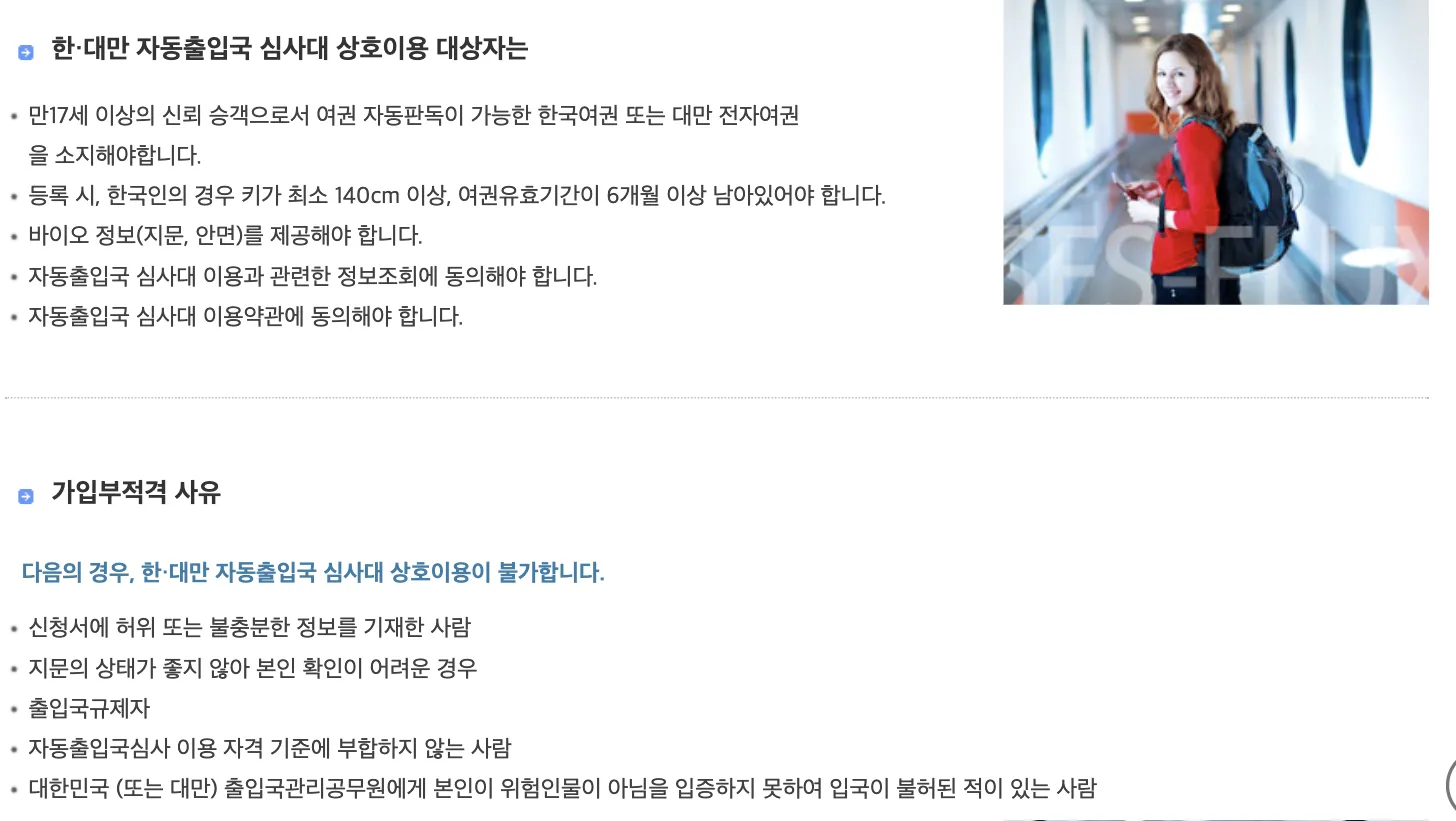
The conditions Hi Korea sets for Taiwanese applicants are short, and they are not quite as short as the page addressed to Taiwanese travellers makes them look. That page names two: at least 17 years old, holding a Taiwan-issued electronic passport. The joint eligibility page adds the rest of them, and they are all things you agree to at the desk rather than before you fly: giving fingerprint and facial data, consenting to the record checks the gates run, and accepting the terms of use. It also describes the applicant as a trusted traveller, which is the wording the refusal grounds later hang from.
No fee appears on any of those pages, and neither does a form to file in advance or a minimum number of previous visits.
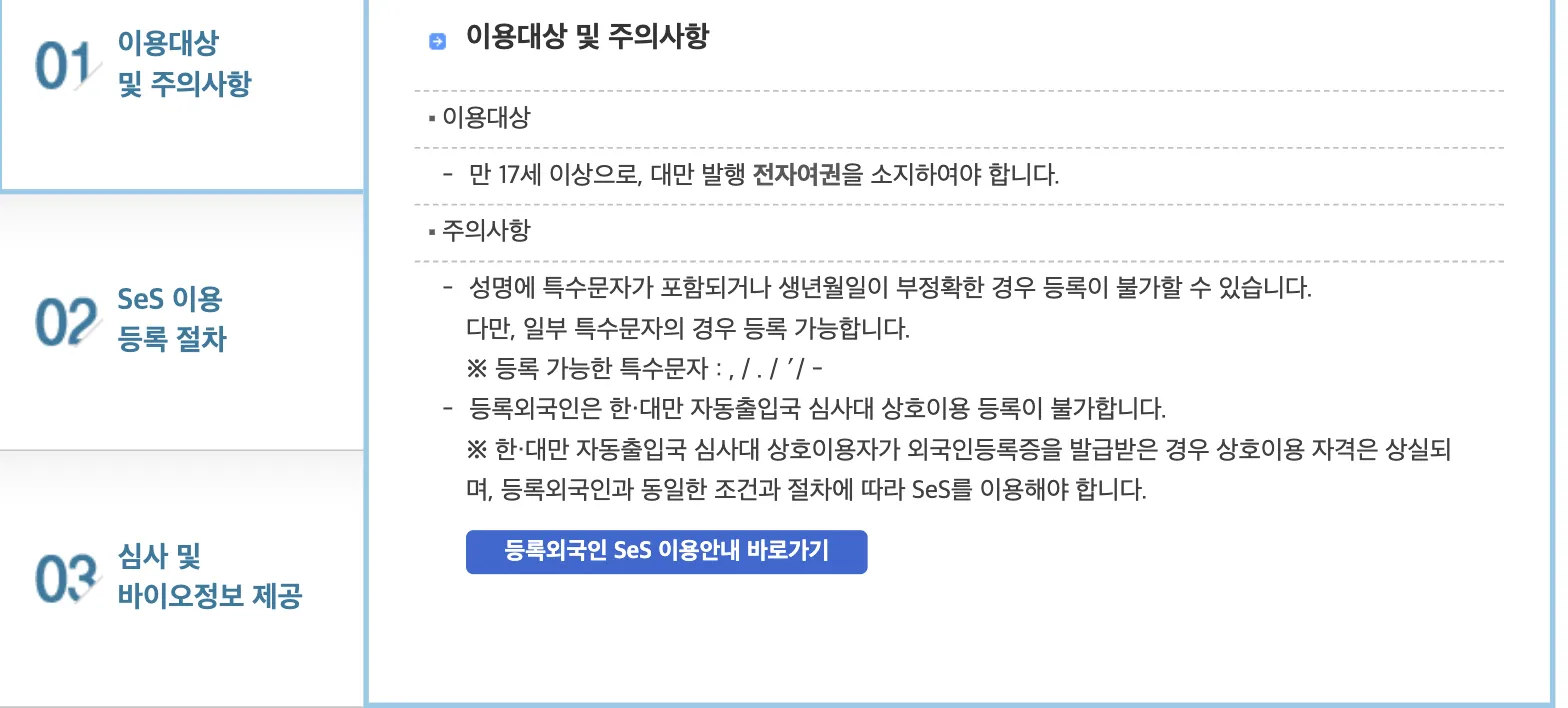
There is one clerical trap worth reading twice. Hi Korea warns that registration may fail if your name contains special characters or your date of birth is recorded inaccurately, and it lists the characters that survive the process: a comma, a full stop, an apostrophe and a hyphen.
You have to queue exactly once
Registration is not something you can do from Taipei. Hi Korea sets out the sequence and the first step is entry to Korea itself: you clear a staffed inspection desk in the ordinary way, and only then go to a registration centre.
At the centre you hand your passport to the registering officer, who may ask your purpose of visit and where you are staying in Korea, and who can decline the registration on the strength of those answers. You confirm an electronic application on a monitor, then give fingerprints from the index fingers of both hands along with a facial image. Approval runs from the registration date to the expiry date of that passport, and a sticker goes on the last page of the visa section.
So the first queue is unavoidable and every queue after it is optional. For somebody who comes to Korea twice a year on a Taiwan passport, that is a reasonable trade; for a single holiday it buys nothing at all, because the only inspection on the trip is the one you had to attend to sign up.
A residence card cancels it
This is the part that would catch somebody out, and Hi Korea states it twice.
A registered foreigner cannot enrol in the Korea-Taiwan mutual arrangement. And if somebody who is already enrolled is later issued an alien registration card, the entitlement is lost, and they must use the Smart Entry Service on the same terms and through the same procedure as any other registered foreigner.
Read that in the order it will happen. A Taiwanese who visits Korea often, registers for the gates, then takes a job or a place at a university and picks up a residence card has just cancelled the thing they registered for. The service is not withdrawn, but the route in changes, and nothing about receiving a residence card announces this. Hi Korea links across to the separate guidance for registered foreigners at exactly that point, which is the clearest signal that it treats the two as different programmes rather than one.
Where the desks are
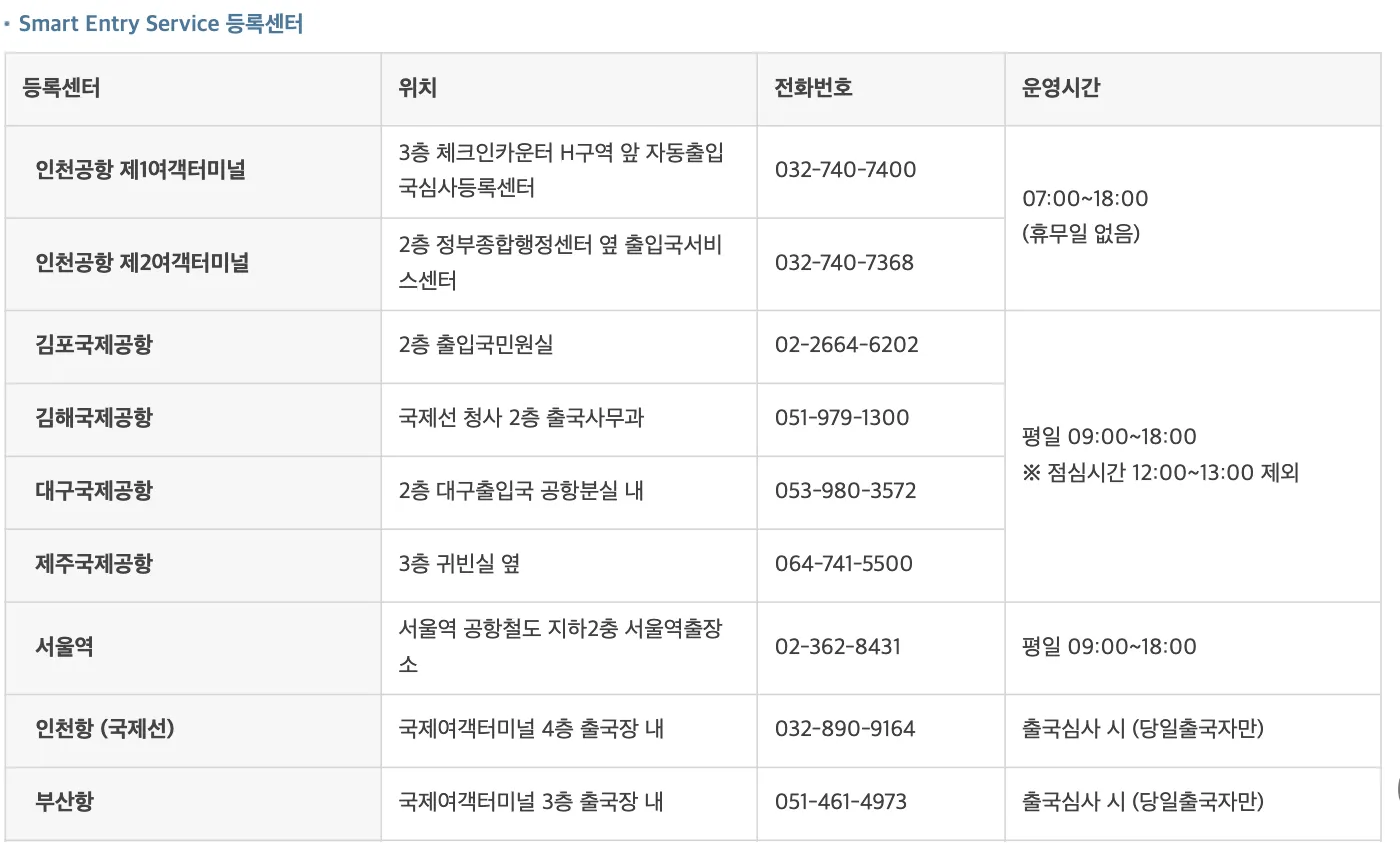
Hi Korea lists seventeen registration centres, and most of them are not at an airport at all. Only seven sit anywhere a traveller would pass through; the other ten are ordinary immigration offices in the cities.
| Where | Position |
|---|---|
| Incheon Airport Terminal 1 | 3F, in front of check-in counter zone H |
| Incheon Airport Terminal 2 | 2F, beside the government administration centre |
| Gimpo International Airport | 2F immigration office |
| Gimhae International Airport | International terminal, 2F departures office |
| Daegu International Airport | 2F, inside the Daegu immigration airport branch |
| Jeju International Airport | 3F, beside the VIP room |
| Seoul Station | B2 of the airport railway station |
| Incheon Port international terminal | 4F, inside departures |
| Busan Port international terminal | 3F, inside departures |
| Seoul Immigration Office | 1F, global talent and investment support centre |
| Busan Immigration Office | 1F general services, window 8 |
| Incheon Immigration Office | 1F residence services |
| Suwon Immigration Office | 1F, window 17 |
| Southern Seoul Immigration Office | 1F residence services |
| Daejeon Immigration Office | 1F residence room, window 7 |
| Cheongju Immigration Office | 1F residence services |
| Gwangju Immigration Office | 1F residence services |
Opening hours are on the same page, and in August this article refused to print them. The hours column merges cells across several rows, and reading the page as extracted text left no way to tell which desk a given time belonged to. Opening the rendered table on 21 September 2026 settles it, because the merges are visible as boxes: 07:00 to 18:00 with no closing day covers both Incheon terminals, and weekdays 09:00 to 18:00 with an hour closed at noon covers Gimpo, Gimhae, Daegu and Jeju. Seoul Station has its own cell at weekdays 09:00 to 18:00. The Incheon and Busan port centres are open only during departure inspection and only to travellers leaving that same day, which means neither is usable on the arrival that registration has to follow. Check the source page for the desk you actually want before you build a day around it.
Incheon’s two desks sit on different floors of different buildings, which matters if you land at one terminal and are told to go to the other. Our page on moving between Terminal 1 and Terminal 2 covers the shuttle.
Once registered, the gates themselves work at Incheon, Gimpo, Gimhae, Jeju, Cheongju, Daegu, Muan and Yangyang airports, and at the international ferry terminals at Incheon, Busan, Pyeongtaek and Gunsan.
The two halves are not the same deal
Reading the Korean-side and Taiwan-side conditions next to each other shows an asymmetry that neither government presents as one.
| Taiwanese registering in Korea | Koreans registering in Taiwan | |
|---|---|---|
| Minimum age | 17 | 17 |
| Passport | Taiwan-issued electronic passport | Korean electronic passport |
| Minimum height | Not stated | 140cm |
| Passport validity | Not stated | At least six months remaining |
| Arrival card afterwards | Not mentioned | Online arrival card before every visit |
The height and validity conditions appear on the shared eligibility page, in a sentence that attaches them explicitly to Korean applicants, and they are not repeated in the section addressed to Taiwanese applicants. That is what the page says rather than a claim about what officers do, and a Taiwanese traveller with two months left on a passport would be unwise to read the silence as a promise. The safer reading is that Korea has published a condition for its own citizens and has not published one for Taiwanese, so ask at the desk rather than assume either way.
The last row needs reading narrowly. Hi Korea tells a Korean registering for Taiwan’s e-Gate to complete and submit Taiwan’s online arrival card ahead of every visit, and prints no equivalent reminder for Taiwanese registering in Korea. That is a difference in what the two halves of one page bother to say, not proof of a lighter load, because Korea runs an arrival card of its own that a Taiwanese traveller fills in regardless. The gate removes the queue in both directions and leaves the paperwork alone.
What I have not confirmed
Three things, and here is what each one changes.
Whether a Taiwan passport issued without a national identification number gets the same treatment. Taiwan issues passports to nationals who have no household registration, and those books do not carry the ID number that ordinary Taiwan passports show. Several countries’ visa-waiver schemes turn on that number. Korea’s designation list names a place rather than a class of passport, which leaves the question open on the page that answers everything else, and the two English pages ranking for this question do not raise it at all. If you hold one of those passports, the 90-day figure above is the part to verify with the Korean Mission in Taipei before booking, rather than the gate registration, which is the smaller loss.
What the automated gate does about the entry record. Taiwan’s mission in Seoul records that Incheon and Gimpo stopped stamping foreign passports in February and May 2018 and issue a printed Entry Confirmation instead. Whether the automated gate prints that slip, or whether the record exists only in the system, is not stated on any page I read. It matters only if something later asks you to prove your entry date on paper, and Hi Korea does publish an online lookup for permitted stay, so the practical risk is small.
Whether registration survives a new passport. Hi Korea says approval runs to the expiry date of the passport you registered with. It does not say what happens when you renew, and the natural reading is that you register again. I have not found that written down, so treat renewal as a re-registration and build the extra visit to a desk into the first trip on the new book.
Dates and figures on this page were read from the sources listed below on 24 August 2026. If one of them has moved since, tell us and the page gets corrected with the date on it.
Questions people actually ask
- Do Taiwanese need visa for Korea, or just the 90 days at the desk?
- No visa for a short visit. Hi Korea, the Ministry of Justice service, lists Taiwan at 90 days on its register of places granted visa-free entry by designation, and Taiwan's own mission in Seoul states the same from the other side. A separate authorisation, the K-ETA, is waived for Taiwan until 31 December 2026, so for the rest of this year there is nothing to file and nothing to pay before boarding. Business, study and family-reunion stays are a different matter and need a visa applied for through the Korean Mission in Taipei.
- Is Korea visa free for Taiwanese by treaty or by designation?
- By designation. Hi Korea puts Taiwan on the list of places whose nationals may enter without a visa 지정에 의한, by designation, rather than under a signed exemption agreement, in the Asia row beside Japan, Hong Kong, Macao and Kuwait. The foreign ministry table marks the same 90 days with 상호주의, reciprocity. The stay is identical to Singapore's 90 days, which is marked 협정, treaty. What differs is how easily the arrangement can be changed.
- Does South Korea recognize Taiwan, and does that change the border?
- Not as a state, and the border arrangements are built around that. Korea has no embassy in Taipei and Taiwan has no embassy in Seoul; both run representative offices instead. What the Korean systems read is the passport book rather than a recognised nationality, which is why Korea's automated-gate scheme with Taiwan is written in terms of a Taiwan-issued electronic passport rather than in terms of citizenship.
- Taiwan passport entering Korea: can it use the automated gates?
- Yes, after registering once inside Korea. Korea and Taiwan run a mutual automated-immigration programme, and Hi Korea sets the conditions for Taiwanese applicants as being at least 17 years old and holding a Taiwan-issued electronic passport. Registration cannot be done before you travel: you clear a staffed desk on your first arrival, then visit a registration centre. Approval lasts until your passport expires, and an alien registration card issued later cancels it.
- Does Taiwan passport need visa for Korea after the K-ETA waiver ends?
- Still no visa. The waiver that runs to 31 December 2026 suspends K-ETA, not visa-free entry, and the two are administered separately. If it lapses rather than being extended again, a Taiwan passport holder would be filing a K-ETA before departure, which the Ministry of Justice prices at 10,000 won and says generally takes up to 72 hours to assess. The 90 days at the desk is unaffected either way.
Where these numbers came from
Read on . 5 of 7 are Korean-language primary pages.
- Hi Korea (Ministry of Justice), foreign national entry inspection: designated visa-free entry list, showing Taiwan at 90 days KO
- Hi Korea (Ministry of Justice), Korea-Taiwan automated immigration programme: scope, eligibility, procedure and registration centres KO
- Hi Korea, Korea-Taiwan automated immigration: eligibility and grounds for refusal KO
- Hi Korea, Korea-Taiwan automated immigration: application by Taiwanese travellers KO
- Hi Korea, Korea-Taiwan automated immigration: registration centres and usable airports and ports KO
- Taipei Mission in Korea, visa and entry notes for travellers to Korea
- K-ETA, Ministry of Justice: fee and assessment time. Carries the extension notice as a heading; the country list is inside the notice, not on this page