Incheon Terminal 1 to Terminal 2: there are two transfers, not one
Cite this page
Hwang, J. (2026). Incheon Terminal 1 to Terminal 2: there are two transfers, not one. Korea, Verified. https://koreaverified.com/incheon-terminal-1-to-terminal-2/ (checked 20 September 2026)
Search for how to get from Incheon Terminal 1 to Terminal 2 and you will be told there is a free shuttle bus every few minutes and a train that takes six minutes. Both of those sentences are roughly true and neither one is the answer, because the question has two answers and you do not get to choose between them.
Which transfer is open to you was settled before you got on the first plane, and neither of the airport’s pages puts it that way. Reading its two sets of pages against each other: if you can hold an onward boarding pass and have no bag to collect off a belt, the airport moves you between terminals without ever letting you into the country. If you have to go and fetch a suitcase, none of that exists for you. You are an arriving passenger, then a departing one, and the gap between them is a bus stop.
That usually lines up with one ticket against two, but not reliably. Airlines with an interline agreement can tag a bag through on separate tickets, and a self-transfer carrying hand luggage only may hold both boarding passes already. The bag and the boarding pass are what decide it, not the number of bookings.
First, check which terminal you are in
The code names the airport rather than the building. A booking that reads ICN gives you no terminal at all, because Incheon is one airport with two passenger terminals in separate buildings. Searching for ICN Terminal 1 to Terminal 2 and searching for Incheon Terminal 1 to Terminal 2 are the same question. The answer turns on your bag and your boarding pass, not on the code.
This is not a formality any more. Asiana moved its entire Incheon operation to Terminal 2 on 14 January 2026, and the Korean consular notice announcing it lists what moved: check-in counters, ticket desks, the transfer counter, the gates and the lost baggage counter. Jin Air, Air Busan and Air Seoul are at Terminal 2 as well.
A great deal of English travel writing still places Asiana in Terminal 1, where it had sat since Terminal 2 opened in 2018. Following that advice puts you in a building with no Asiana counter and a bus ride ahead of you. The lounges split the same way: Asiana passengers now use Korean Air’s lounges in Terminal 2, and the Asiana lounges left in Terminal 1 serve Star Alliance flights.
The airport publishes a directory that tags each airline with a terminal. Read from it today, the Terminal 2 list is Korean Air, Asiana, Jin Air, Air Busan, Air Seoul, Delta, Air France, KLM, Virgin Atlantic, Scandinavian Airlines, China Airlines, Xiamen Air, Garuda Indonesia and Aeroméxico. The Korean carriers in neither of the two big groups are all in Terminal 1: Jeju Air, T’way, Eastar Jet, Air Premia and Aero K.
Two cautions, because that directory is not the clean lookup it appears to be. Its terminal column has four values rather than two. Besides T1 and T2 it uses Cargo(N) and Cargo(S), and Japan Airlines and All Nippon Airways are both filed under Cargo(S), so for those two the directory does not answer the question a passenger is asking. And its footnote says the list is built from the previous month’s scheduled passenger and cargo services, with ferry legs between airports excluded. It describes what was flying recently rather than what is on your booking.
The consular notice adds the trap that catches experienced travellers. For a codeshare or a marketing flight, you use the operating carrier’s terminal, not the one printed on your ticket’s airline code. The same notice warns, in as many words, that your departure and arrival terminals may differ. On the way out that also decides where you claim a tax refund, because the staffed refund counters sit inside each terminal’s own duty-free area and the kiosk that sends you to customs has to come before you check a bag.
With a boarding pass and no bag: a train you cannot get off
If you hold an onward boarding pass and your luggage is going through, you do not use the bus and you do not use the airport railway. You follow the green transfer signs to a shuttle train inside the secure area.
The route surprises people who expect one hop. From Terminal 1 you take a shuttle train to the Concourse, get out, change platforms, and take a second shuttle train to Terminal 2. Each leg runs every five minutes. The reverse trip works the same way, via the same middle stop.
Both of the airport’s own step-by-step pages print the same warning under each leg, twice per direction:
Once you board, you cannot come back.
That is the sentence to take seriously. The connection is a one-way valve, not a corridor. If you get on before you are sure of anything, you cannot walk it back.
That includes anything you meant to do in the terminal behind you. If you were planning to pray during the connection, there is no need to hurry before boarding: the concourse has a prayer room on its fourth floor and Terminal 2 has two on its gate level, all airside, which is the whole map of Incheon’s prayer rooms.
The two directions are not mirror images, either.
| Terminal 1 to Terminal 2 | Terminal 2 to Terminal 1 | |
|---|---|---|
| Transfer security screening | Before the trains | After the trains |
| Shuttle train legs | 2, changing at the Concourse | 2, changing at the Concourse |
| Transfer desk the page names | Terminal 2, floor 3, after security | Floor 2 before security, floor 4 after |
So going one way you queue for screening first and travel afterwards, and going the other way you travel first and queue at the far end. If the screening hall is backed up, that decides whether your slack sits at the start of the transfer or at the point where you have already used it up.
On boarding passes the airport is careful rather than reassuring. If you do not have one, it says, the answer depends on your airline and you should ask your airline. It also says a missing boarding pass can be issued at the transfer desk near the gates. Read those two lines together with the one-way rule and the order of operations is obvious: settle the boarding pass question before you step onto the first train.
If you are only passing through Korea and wondering whether you could leave the airport instead, that is a separate set of rules with a thirty-day door in it.
With a suitcase on the belt: outside, in the weather
A bag to collect makes you an ordinary arriving passenger. You clear immigration, which means the arrival card applies to you, collect your bag from the belt, walk out through customs, and then start again at check-in in the other terminal.
Nothing about the transfer is airside. You are in Korea now, in public, with a bag, looking for a bus stop.
The free bus is not a shuttle
Every English page calls it a shuttle bus between the terminals. The airport does not, and the difference matters.
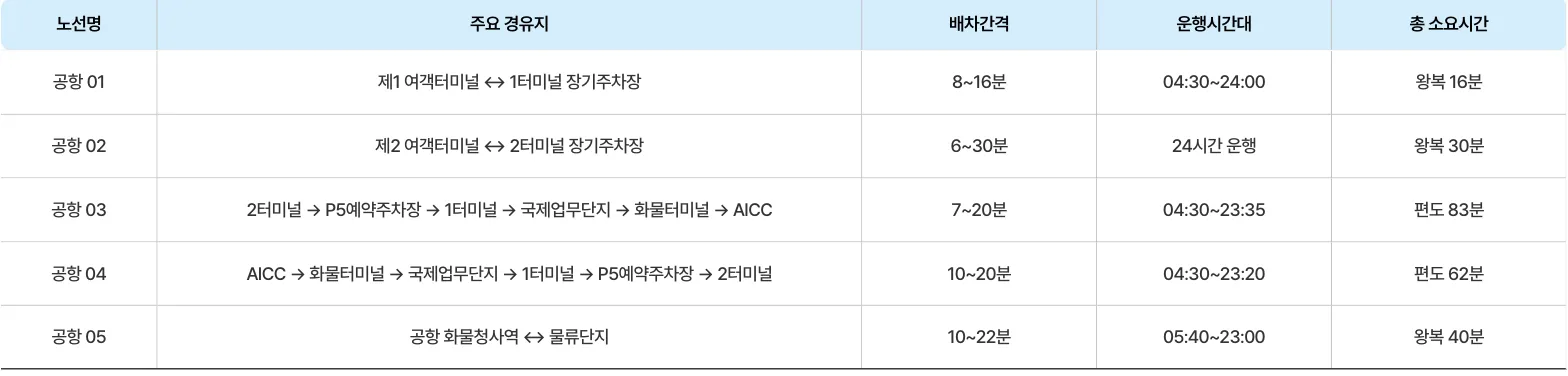
There is no bus that goes back and forth between the two terminals. There are two long one-way runs across the whole airport, cargo terminals, post office, catering plant and all, pointing in opposite directions, and each one happens to call at both passenger terminals somewhere along the way. The airport marks both of them one-way on its own route table, and marks the car park shuttles as round trips, so this is the operator’s distinction and not my reading of a map.
| Airport 03 | Airport 04 | |
|---|---|---|
| Direction between terminals | Terminal 2 to Terminal 1 | Terminal 1 to Terminal 2 |
| Headway | 7 to 20 minutes | 10 to 20 minutes |
| Service window, whole route | 04:30 to 23:35 | 04:30 to 23:20 |
| Fare | Free | Free |
Those windows describe the route, not your stop, and each route reaches the passenger terminals well into its run. Route 04 begins out by the air traffic control centre and works through the cargo estate before it gets anywhere near Terminal 1, so turning up at 04:30 for the first bus of the day is not how it behaves. The far end of the window is not the last bus at your door either. It is the last bus on the road.
The stops are the second thing nobody writes down. They are on the departures level, floor 3, not on the arrivals level where you walk out with your bag. Route 03 boards at Terminal 2 by gate 7 and sets down at Terminal 1 at two separate points, gate 3 on the east side and gate 12 on the west. Route 04 stops at Terminal 1 by gate 8 and reaches Terminal 2 by gate 6.
Count those, because at Terminal 1 the door you arrive at and the door you leave from are different doors, and what that sets up is worse than a long wait. Gates 3 and 12 are not dead stops. The airport lists them as boarding points for route 03, which from there carries on to the business district, the cargo terminals and the control centre. So somebody who noted “gate 3” on the way over goes back to gate 3, watches a bus pull in more or less on time, gets on it, and is driven away from Terminal 2. The bus to Terminal 2 was at gate 8.
The airport gives a total running time of 83 minutes one way for route 03 and 62 minutes for route 04, but those cover the full run out to the control centre, not the leg between the terminals. The stop-by-stop timetable is published as an interactive widget that does not render as text, so neither the terminal-to- terminal time nor the last bus at each terminal is a number I can quote.
The train, and a fare the two operators disagree on
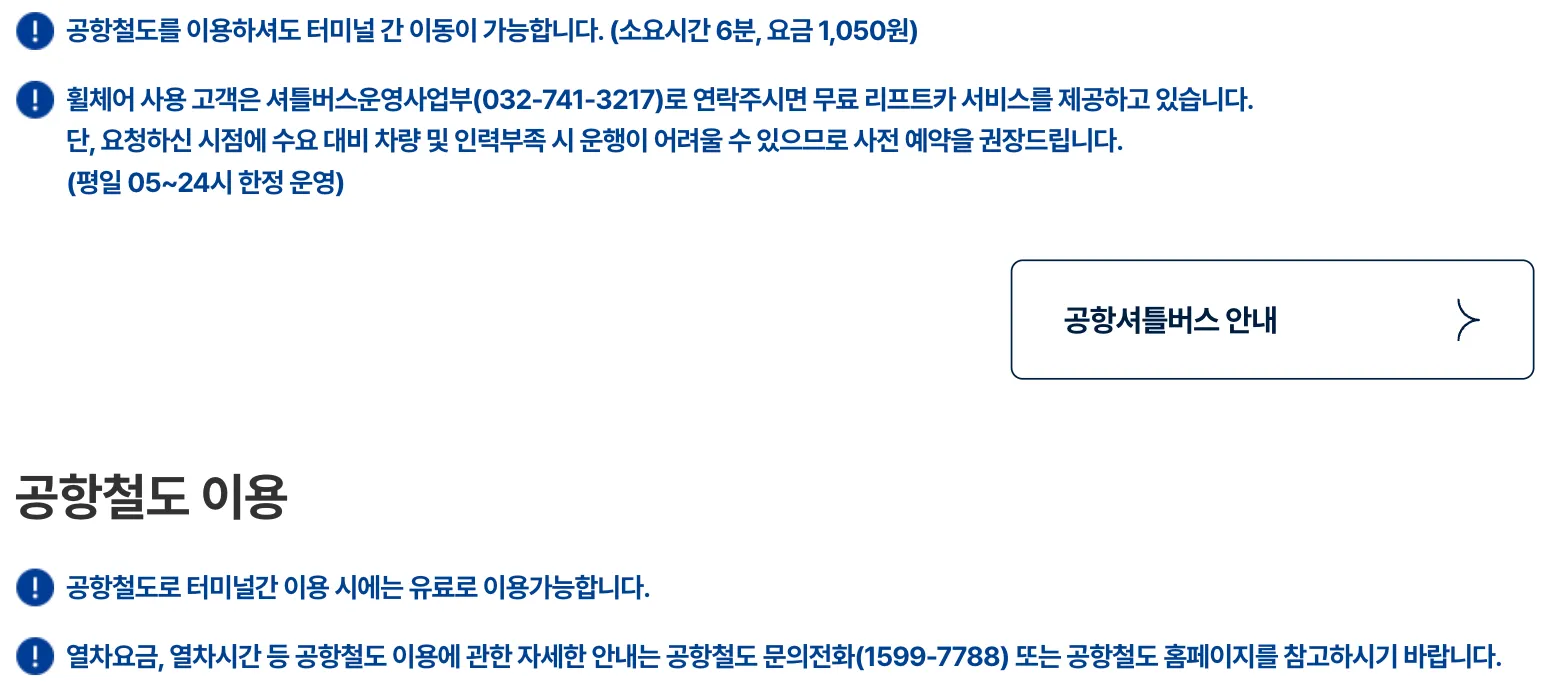
The airport railway also links the terminals, and it is the fast option. The airport gives the journey as six minutes.
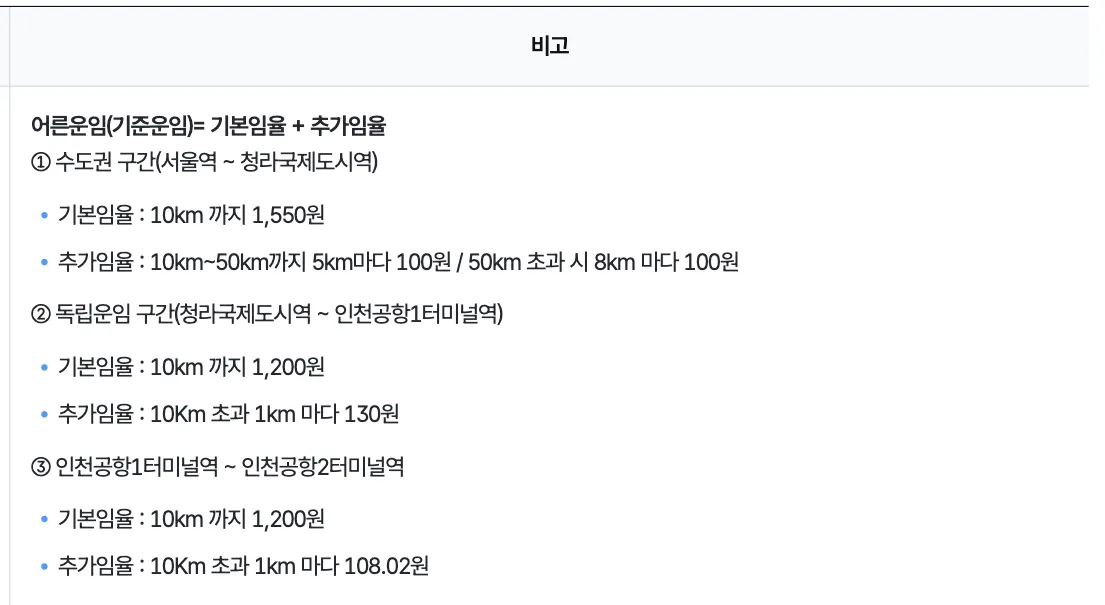
It is not free. Here the two official pages stop agreeing. The airport’s own page on moving between terminals prices the trip at 1,050 won. The railway’s own fare table, which is the document that governs what the gate charges you, prices Terminal 1 to Terminal 2 at 1,200 won on a transport card.
Both pages are photographed above, so you can read the contradiction rather than take my word for it: the airport’s parenthesis on one, block ③ of the railway’s fare structure on the other, opened within a few minutes of each other on 20 September 2026.
The railway’s table is hard to dismiss because it does not merely print a number in a grid, it sets out the rule that produces it. The section between the two terminals is given its own fare basis, with a base of 1,200 won covering the first ten kilometres, and the neighbouring section of the line out to Cheongna carries the same 1,200 won base. The 1,050 figure has no working behind it on any page I could find, and it appears as a parenthesis on a page about buses rather than in a tariff. If you have met Korean fares before, the shape of this is familiar: published rates get revised and the second-hand pages do not.
Without a transport card, a single-use ticket costs 100 won more and carries a 500 won deposit that you reclaim from a machine at the destination, so
1,300 won plus a deposit you have to remember. If you arearriving and heading into the city afterwards, the same railway is the way in, and the card you buy for this hop is the card you will use all week.
The overnight hole in the free option
Read those service windows again, because this is where a connection stops being merely awkward.
The free buses are on the road from 04:30 until 23:35 going one way and until 23:20 going the other, and the last one to call at a terminal is earlier still. Outside that, the free crossing does not exist. Flights at Incheon do not stop before midnight, so a self-transfer that lands late in one terminal and departs early from the other sits in a window where getting across the airport costs money.
Whether the airport railway is still running through that window is something I could not confirm, so I am not going to tell you it is shut. What is sourced is that the free bus is not the answer in the small hours, which leaves a paid train if one is running and a taxi if one is not. Budget for the taxi and be pleased if you do not need it.
The airport also offers a free lift-car service for wheelchair users, on 032-741-3217, with advance booking recommended. The route page for Airport 03 gives its hours as five in the morning to 24:00. The terminal-transfer page prints the same window and adds that it runs on weekdays only, which is the narrower and safer reading of the two, but ring the number rather than plan around either.
What I would do
On one ticket with the bag checked through, allow for the screening queue and two train rides, sort the onward boarding pass out before you board anything, and remember that the first train commits you.
On two tickets, treat it as two journeys rather than a connection. Arrivals in Korea can be slow, the bag has to appear, and the bus runs on a loop that does not care about your schedule. If the flights are close together, or if either end of the trip falls near midnight, the train is worth the 1,200 won and a taxi is worth more than a missed flight.
And before any of it, check the terminal for each flight against your airline’s own booking or notice, and treat the airport’s directory as the cross-check rather than the answer. It looks a month backwards and it does not resolve every carrier. Getting this wrong is the failure that costs the most and takes the least time to prevent.
What is not checked here
The route numbers, headways, operating hours, stop gates, terminal assignments and the airside transfer sequence all come from the airport operator’s Korean pages, and the fares from the railway’s own fare table. I opened all of them again on 20 September 2026, checked the route table row by row, and photographed the three that carry the load: the all-routes table, the airport’s 1,050 won line, and the railway’s fare structure. Those are the three screenshots on this page. Nothing had changed since the first reading.
Three things are not confirmed.
I could not read the stop-by-stop shuttle timetable, and that is the document which would answer two separate things: how long the bus takes between the two terminals, and what time the last one actually calls at each terminal. The widely repeated “about 15 minutes” is not something I can trace to the operator, and the 83 and 62 minute figures the airport does publish are whole-route times that would be wrong to quote as a terminal-to-terminal journey.
I have not confirmed the last train of the night on the airport railway between the terminals. The station timetable pages did not return readable text for me. The overnight gap above is therefore stated from the bus hours, which are sourced, and not from the train’s.
I have not established which of the two fares, 1,050 or 1,200 won, a gate reader actually deducts. The railway publishes the fare table and the airport publishes the other number, and I have not put a card through the gate to settle it. If you have, and you still have the receipt, tell me.
Questions people actually ask
- How do you get from Terminal 1 to Terminal 2 at Incheon Airport?
- There are two separate transfers and your ticket decides which one is open to you. With an onward boarding pass and no bags to collect you stay airside and take the shuttle train, which runs in two legs via the concourse at five-minute intervals and cannot be ridden back. Otherwise you leave the secure area and take bus 04 from Terminal 1 exit 8 on the third floor, which is the departures level rather than arrivals.
- How do you get to Terminal 1 from Terminal 2?
- Not on the same bus. Route 04 runs Terminal 1 to Terminal 2 and route 03 runs Terminal 2 to Terminal 1, and the airport labels both one-way. At Terminal 2 you board at stop 7 and alight at stop 6. Waiting where you were dropped off will not get you back.
- What is the difference between Terminal 1 and Terminal 2 at Incheon?
- They are different buildings with different airlines, roughly fifteen minutes apart. Korean Air, Delta, Air France and KLM use Terminal 2, and Asiana moved there on 14 January 2026 along with Jin Air, Air Busan and Air Seoul. Most English guides still list Asiana at Terminal 1. Check your airline on your booking rather than on a guide.
- How long does it take to transfer between Incheon terminals?
- The airport quotes about five minutes for the airside shuttle train per leg and around fifteen minutes for the free bus between terminals. The bus figure is the terminal-to-terminal portion, not the whole route: bus 04 runs 62 minutes end to end because it also serves the cargo area and the airport city, so the timetable you find is for the route rather than for your stop.
- Is ICN Terminal 1 to Terminal 2 the same as the Incheon Airport terminal transfer?
- Yes. ICN is the airport code for Incheon International Airport and it covers both passenger terminals, so a booking that shows ICN does not tell you which building you are standing in. The transfer is the same one either way. With an onward boarding pass and no bag to collect you take the airside shuttle train, and without one you take free bus 04 from Terminal 1 exit 8 on the departures level.
Where these numbers came from
Read on . 8 of 8 are Korean-language primary pages.
- Incheon International Airport Corporation, moving between the terminals KO
- Incheon International Airport Corporation, all shuttle bus routes with stops, headways and operating hours KO
- Incheon International Airport Corporation, shuttle route Airport 03 KO
- Incheon International Airport Corporation, transferring from Terminal 1 to Terminal 2 KO
- Incheon International Airport Corporation, transferring from Terminal 2 to Terminal 1 KO
- Incheon International Airport Corporation, airline directory listing the terminal each carrier uses KO
- AREX, all-stop train fare table KO
- Korean Consulate General in Guangzhou, notice of Asiana moving to Terminal 2 KO