Seoul's Climate Card has ended: which transit card to buy now
Cite this page
Hwang, J. (2026). Seoul's Climate Card has ended: which transit card to buy now. Korea, Verified. https://koreaverified.com/climate-card-ending-which-card-now/ (checked 1 October 2026)
Seoul’s 30-day Climate Card stopped working on 1 October 2026, and what you buy instead depends on three things about you. Are you registered in Korea at all, is that registration in Seoul, and are you 19 yet.
The card that was switched off asked none of those questions. Anyone standing at a ticket machine could buy one, which is why English guides could recommend it to a tourist and a commuter in the same paragraph. Its replacement is a refund paid into an account, and a refund has to know whose account it is.
What ended, and the date most English pages printed
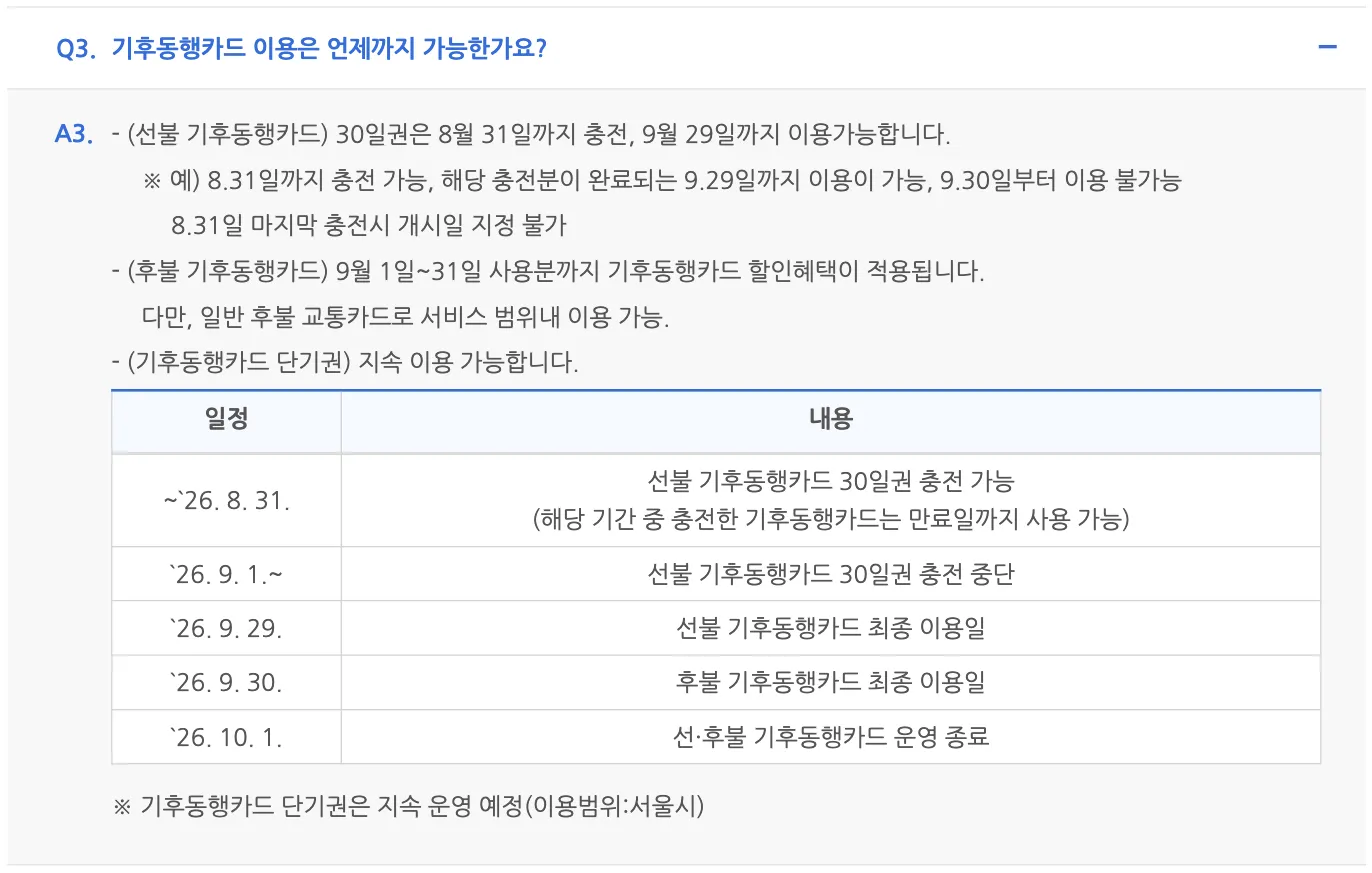
Seoul revised its own shutdown notice on 30 July and moved every date back by a month. This is how it ran, from the city’s end-of-service FAQ:
| Date | What happens |
|---|---|
| 31 August 2026 | Last day to charge a prepaid 30-day pass (passed) |
| 1 September 2026 | Prepaid charging stopped; the replacement launched (passed) |
| 29 September 2026 | Last day a prepaid 30-day pass worked (passed) |
| 30 September 2026 | Last day a postpaid Climate Card worked (passed) |
| 1 October 2026 | Both ended (passed) |
The first two of those dates have gone. Charging closed on 31 August, and the replacement went live on 1 September: the city dates its own layer to 26.9.1 and says a Seoul resident already carrying a Modu Card had the benefit applied from that day without doing anything.
Updated 1 October 2026. This paragraph used to end “What is left is the two days in late September”, and the table above listed the last three dates as still to come. They have all arrived. I re-read the end-of-service FAQ today and the table is unchanged, with no further postponement: 29 September was the last prepaid day, 30 September the last postpaid day, and both ended on 1 October. The same FAQ still says the 1 to 7-day short passes are kept.
Of the three English pages I read on 15 August that rank for this question, two gave the July schedule, which had charging closing on 31 July and the card dying on 29 August. The third did not mention the shutdown at all. In August that cost a reader a fortnight of recharging they still had. In September it cost more: a page still printing 29 August retired the prepaid pass a month before it actually stopped, and the reader who believed it threw away September.
The reason is sitting at the top of Seoul’s own notice. That page carries an automatically generated summary above the body, the summary still says 31 July and 31 August, and the body underneath it says 31 August and 30 September. Both were still on the page on 17 September. If you go and look for yourself, scroll past the summary and read the notice.
One more disagreement worth knowing about, because it is small enough to trust the wrong half of. The end-of-service FAQ writes the postpaid deadline in prose as “1 to 31 September”, and September has thirty days. Its own dated table, and a separate answer on the same page, both say 30 September. Take 30 September.
The city’s stated reason for closing the card is duplication rather than failure. The national government launched Modu Card in 2026 at the same price and on the same unlimited principle, so Seoul was running a second copy of a scheme it no longer had to run.
If you are visiting, buy what you would have bought anyway
Nothing on this page changes a short trip. The short-term passes are staying, and Seoul is direct about why: they cannot be merged into the national scheme, so there is nothing to merge them into.
| Pass | Price |
|---|---|
| 1 day | 5,000 won |
| 2 day | 8,000 won |
| 3 day | 10,000 won |
| 5 day | 15,000 won |
| 7 day | 20,000 won, or 13,000 for 13 to 18-year-olds from 1 September |
The conditions are printed once against the whole short-term block rather than band by band, so they apply to all five. The passes are Seoul only, they do not include the Ttareungi bike share or the Han River bus, and they start on the day you charge them. The five-day start-date window that 30-day passes get is written to exclude short-term passes, so there is no charging one in advance for a later date, and the FAQ says the card is sold and used inside Korea only, so there is no buying one before you arrive.
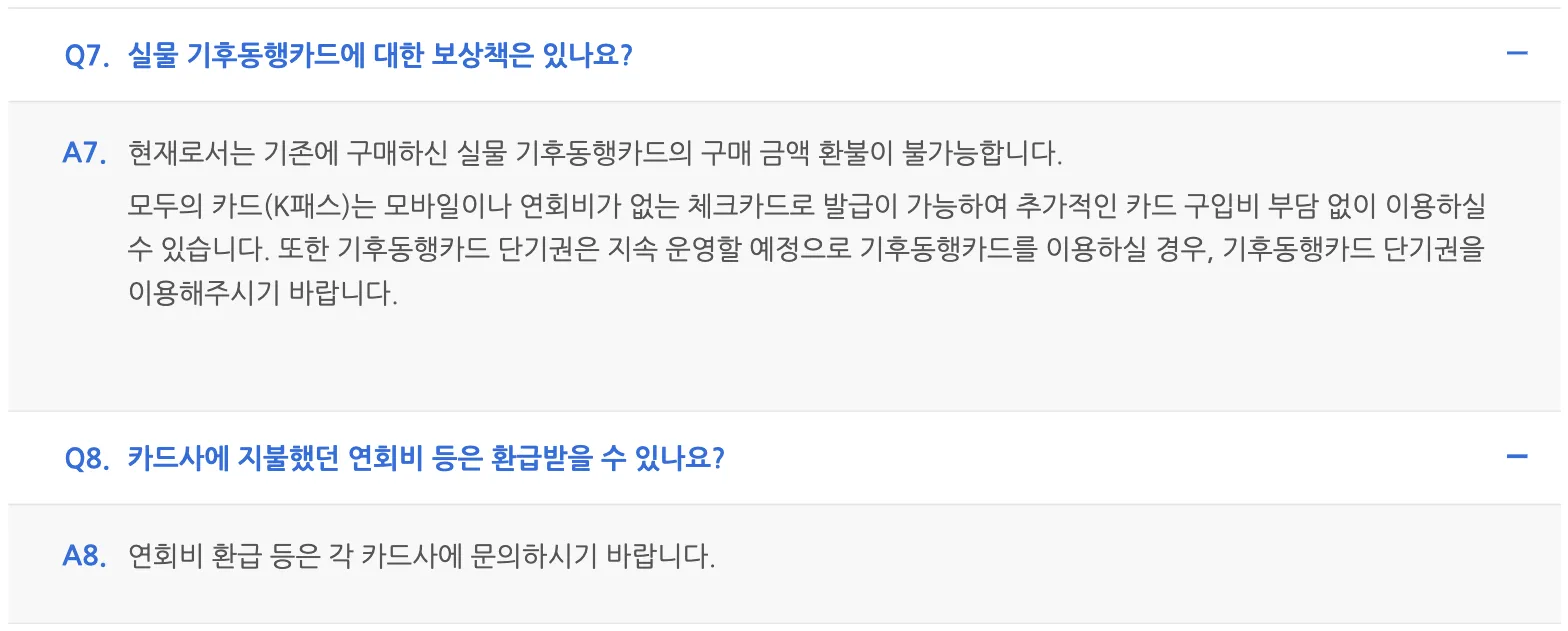
The plastic card is a separate 3,000 won on top, and the city now states plainly that this money is gone. Its end-of-service FAQ says the purchase price of a physical Climate Card cannot be refunded, and offers as consolation that the replacement can be issued as a mobile card or a check card with no annual fee. That consolation is only available to people who can join the replacement, which is most of the rest of this page.
Whether a pass beats paying per ride is arithmetic rather than opinion, and it turns on the transfer rules rather than the fares, which is the calculation in the T-money article. Nothing in this change touches that either.
The pass switches itself off if you skip a tag-off twice
Here is the part I have not seen in English, and it applies to the pass a visitor is being told to buy.
You must tag off at the end of every journey, transfers included. Miss it twice during a card’s validity period, and the Climate Card is suspended for 24 hours. The city states this in its FAQ and again on the scheme’s main page, and the two put the clock in slightly different places: the FAQ times it from your second untagged boarding, the main page from the boarding immediately before.
The city gives its reason, and the reason does the explaining for me. An ordinary transit card punishes a missed tag-off by charging double the base fare on your next boarding. An unlimited card has already been paid, so there is no fare to double, and Seoul says a penalty is applied instead. The card cannot take your money, so it takes your day.
Getting off outside the covered area is the ordinary way to trigger this without meaning to. The FAQ says a Climate Card cannot tag off at a station beyond the Seoul range at all: you call a member of staff at the gate, pay the fare from where you boarded, and the trip is recorded as one untagged alighting. Do that twice on a two-day pass and you lose a day of the two you bought.
The city writes this rule of the Climate Card without naming a band. It sits among answers about the 30-day pass, which is a reason to doubt it reaches the short-term ones, and it also appears on the scheme’s main page under how to use the card, which is the page that sells all five short-term bands. So treat it as applying to whatever you are holding until somebody tells you otherwise, and tag off.
If you are registered in Seoul: Modu Card, with a Seoul layer
Modu Card is the national scheme, and joining it means passing an identity check that reads a registration number against government records. What that check does to a visitor, and the documented route through it for a registered foreign resident, is the Modu Card article.
What arrived on 1 September is a Seoul-only layer on top of it. Two Korean names are in circulation for this and they are not synonyms, which is worth thirty seconds because searching the wrong one returns the wrong half of the story. 기후동행패스 is the whole product, the national card with Seoul’s additions attached. 기후동행카드 플러스 is what the city calls the additions themselves, and it is that part, not the national refund underneath it, which is restricted to people registered in Seoul.
The most valuable addition is an age band. The national scheme defines a young adult as 19 to 34, following the statute it is built on, while the Climate Card paid its youth rate up to 39. Seoul is carrying those five years across: the city states in three places that a Seoul resident aged 35 to 39 receives the young-adult refund, and its announcement dates the change to 1 September. If you already hold a Modu Card and are registered in Seoul, you need no new card, because the benefit attaches by itself.
The answer that carries this is built to be misread, and it caught me on the first pass. It opens by saying Seoul has requested the extension and that the system linkage and verification are in progress, which reads like a delay. The next sentence, in the same answer, says the 35 to 39 band will be supported. The first clause is the plumbing and the second is the outcome. Take the outcome, and check your first refund rather than assuming it.
The second addition is discounts at Seoul cultural and leisure sites, including Seoul Botanic Park and Seoul Grand Park.
The third is a discount on the Ttareungi bike share, and it is not running yet. The city says it will arrange for the card number to be entered in the T-money GO app as it is now, and marks that answer as still under discussion with the bodies involved. Its news announcement lists the same discount among things to be applied later. So treat the age band as live since 1 September and the bike share as an intention, because that is the distinction the city draws itself.
The veteran discount is in the third category rather than the first. One answer says it is excluded from the transfer and under discussion with the transport ministry, another lists a discount for 40 to 42-year-old veterans as a feature of the new pass, and a third says that extension will be applied later. Two of those three describe something that has not started, so treat it as coming rather than present.
There is no compensation for what is lost in between. Asked by somebody aged 35 to 39, or a veteran, who had been getting a Climate Card discount and now cannot, the city answers that there is currently no plan for compensation or a backdated refund.
If you live in Gimpo, Goyang, Gwacheon, Seongnam, Hanam, Namyangju or Guri
Be exact about what you lose here, because it is less than it first looks. The national card underneath all of this is national: Modu Card refunds journeys anywhere in the country and the scheme says so in as many words, including journeys outside the area you live in. Nobody is losing that.
What is Seoul-only is the layer. Seoul answers the question in one line and it is the sharpest sentence in the FAQ: unlike the Climate Card, which anyone could use, the Seoul benefits go to Seoul citizens. Residents of those seven Gyeonggi cities are told to switch to The Gyeonggi Pass, the province’s own layer on the same national card.
That is a real scheme rather than a brush-off. Gwacheon, one of the seven, publishes its terms: The Gyeonggi Pass sits on top of a K-Pass card, the benefits attach automatically once the card is issued and registered, and it reaches wide-area buses, the Sinbundang line, the GTX and the airport railroad, which the Climate Card never did. The eligibility line is the familiar one. Resident registration in Gyeonggi, 19 or over, at least 15 journeys a month.
So the move is sideways rather than downward for most people in those cities, and it is still a move nobody told them about in English. If you are a foreign resident registered in one of the seven, the thing to check before September is that your foreigner registration resolves to a Gyeonggi address in the same way Seoul’s checks want a Seoul one.
The short-term passes stay available to you, and stay Seoul-only.
If you are under 19, you cannot join the replacement at all
Seoul prints the exclusion as a premise rather than a finding. One of its questions opens with the words that adolescents cannot sign up for Modu Card, and then answers what to do about it.
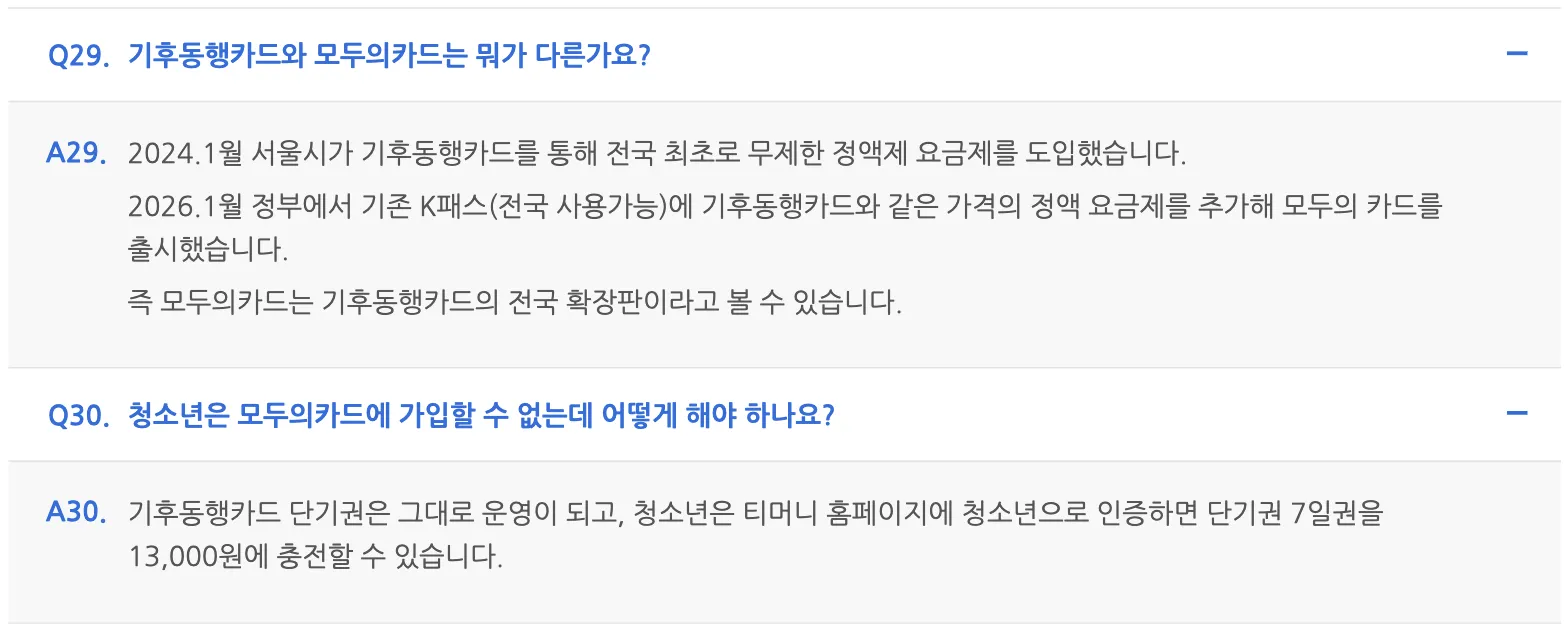
The answer is that the short-term Climate Card passes continue, and that a teenager who verifies as an adolescent on the T-money website can charge a 7-day pass for 13,000 won instead of 20,000. That started on 1 September and runs until a youth band exists on the national card. Seoul makes the comparison itself. The 30-day adolescent pass was 55,000 won, and four discounted 7-day passes cover 28 days for 52,000 won.
Name what that is. A national refund scheme has an age floor its own FAQ acknowledges shuts adolescents out, and Seoul’s answer for the ones inside its boundary is the pass it sells to tourists, at a discount. The arithmetic is close to honest and the passes work. They are still tourist passes handed to commuters, bought four at a time, because the commuter product stopped.
Elsewhere the answer is different rather than absent. Gwacheon lists a separate children and adolescent transit-cost scheme alongside The Gyeonggi Pass, so a teenager in the seven cities has somewhere else to look, and I have not read its terms.
Which also means the discount runs through a Korean website’s age verification rather than through a card. I have not confirmed what that verification accepts, so a visiting teenager should assume the full 20,000 won and treat 13,000 as a possibility to ask about at the machine.
The last charge was on 31 August, and not everyone qualified for it
That day has passed, and this section stays because it decides what a card already in your pocket is worth. If you were running a 30-day pass in August, the recharge rules and the shutdown did not line up, and the mismatch cost money.
The ordinary rule is that you can recharge from five days before your card expires, and the new period is added to your existing expiry date rather than to the day you paid. The end-of-service FAQ then narrows it: a card expiring between 1 and 4 September could be charged on 31 August, and a card expiring on 5 September or later is not eligible for the last charge at all. Under the ordinary five-day rule, a 5 September expiry would have qualified.
The two rules together produced a shortfall, and the city gave you the outcome without doing the subtraction. That same answer says the charged pass is usable until 29 September and ends after that. Apply the renewal rule to it: a card expiring on 4 September, recharged on 31 August, would run to 4 October, so the last charge fell five days short of the month you paid for. Neither the notice nor the FAQ mentions refunding the difference, so if you made that last charge, the days on it are the days you get.
Charging on 31 August with no card already running was the clean case, and the FAQ’s own worked example is exactly that: charge on the last day, run the full thirty days, finish on 29 September. On that final charge you could not choose a start date, so it began immediately.
One more thing about postpaid cards. After 30 September the discount ended and the card did not: the FAQ says it keeps working as an ordinary transit card. So there is nothing to cancel and nothing to throw away, and also nothing to notice, which is how somebody ends up paying full fare for a month without registering that anything changed.
If you charged a 30-day pass between April and June and let it expire, Seoul owed you money on it. The end-of-service FAQ says only that the payback covers charges up to 30 June, and the deadline for asking, along with the paper form a foreign resident has to use, is in the payback article with its own sources. That deadline was 30 September, the same fortnight the card itself ran out in, and it has now passed.
Questions people ask about the change
Can I still buy a Climate Card today? Yes. The FAQ says new prepaid cards can be bought at any time, because the short-term passes continue. What ended is the 30-day charge, on 31 August. The physical card is sold at the newer ticket machines inside line 1 to 8 stations and at convenience stores nearby, and the city’s list of sellers also names convenience stores around line 9, Ui-Sinseol and Sillim stations. Those newer machines are also the ones that now take an overseas card for the purchase, so if you are visiting, buying the card is no longer the errand that sends you looking for cash.
Does my existing Climate Card become a Modu Card? No, and the city explains why in mechanical terms. The Climate Card was built as a period pass, where one payment covers a stretch of time. Modu Card and ordinary transit cards charge per use. The two are not interchangeable, so the plastic does not convert.
What happens to money left on the card? A refund is the charge minus what you actually spent minus a 500 won fee, and it has to be claimed inside the card’s validity period. There is no refund after expiry, on a working card as much as a broken one. If you have no Korean bank account, the city’s stated route is a cash refund in person at T-money’s head office, which is not a thing you do on the way to the airport.
Is the airport covered? Only outbound, and only in part. On the airport railway the pass covers Gimpo Airport to Seoul Station. Separately, you may get off at Incheon Airport Terminal 1 or 2 having boarded inside the zone, and you may not board at those stations. Passengers arriving at Incheon pay for the train like everyone else. Arriving at Gimpo is the exception, because that station is inside the zone.
Does the early-bird discount stack with it? No. The FAQ says the Climate Card is operated separately from the other fare support schemes, and it lists the early-bird discount among them, along with the priority, disabled and expectant-mother ones. It does not print the time the early-bird discount starts, and the fare rules that do are in the T-money article.
Who do I phone? Policy questions about the Climate Card go to Seoul on 02-120. Charging, verification, refunds and errors go to T-money on 1644-0088. Seoul sends everything about Modu Card and K-Pass to 031-427-4415, and it does this seven times in its own end-of-service FAQ rather than answering. That is the operator’s usage line; the national scheme lists other numbers for questions about the policy itself.
What is not checked here
The dates, the prices, the short-term pass terms, the tag-off penalty, the purchase and refund rules, the seven Gyeonggi cities and the adolescent discount all come from the city’s own Korean pages, read today. The Gyeonggi Pass terms come from Gwacheon’s page, and Gwacheon is one of the seven cities Seoul names.
I have not verified The Gyeonggi Pass beyond that one city. Seoul’s instruction to switch is Seoul’s, the province runs the scheme, and six of the seven cities may state their terms differently. If you are in the other six, read your own city’s page before September rather than mine.
I have not confirmed that the 24-hour suspension applies to short-term passes specifically. It is written of the Climate Card without naming a band on two separate city pages, and the short-term passes are Climate Cards, but on the FAQ it sits among answers that define the validity period as the 30 days of the monthly pass. That cuts both ways and I have taken the cautious side. The consequence on a 1-day pass would be most of the pass, so it is the one thing here I would most like a reader to test and tell me about.
I have not confirmed how the T-money website checks that somebody is 13 to 18, which decides whether a visiting teenager can reach the 13,000 won pass. Every other age-based rate in these schemes is checked against a registration record.
Seoul’s two subway coverage lists do not agree. The FAQ gives a shorter set of lines than the scheme’s main page, which carries a modification date of 22 July and includes the Gyeonggi sections the seven cities sit on. The FAQ page shows no modification date at all, so I cannot rank them by age; I have followed the main page because it is the one that reaches all seven cities Seoul names elsewhere. If you are near the edge of the zone the difference is a fare.
The survival of the short-term passes is Seoul’s stated plan rather than a commitment. The FAQ says in one place that they are kept and in another that they are planned to continue, and I have taken the weaker reading. Re-read on 1 October 2026, the day the 30-day pass ended, it still says they are kept.
If you charged a card on 31 August and Seoul did or did not settle the missing days, tell me what happened. And if none of this applies yet because you have not landed, start here.
Questions people actually ask
- Climate Card refund: Seoul says the plastic is not refundable
- Two different refunds get confused here. The 3,000 won you paid for the physical card is gone: Seoul's closure FAQ says plainly that the purchase price cannot be refunded, and offers instead that Modu Card issues as a mobile card or a no-annual-fee check card. Annual fees on a postpaid Climate Card are not Seoul's to return either, and the FAQ sends you to your card company. The money still loaded on a prepaid card is the separate case: that is a T-money refund, the charge minus what you spent minus a 500 won fee, and it has to be claimed inside the card's validity.
- What replaces it, and how to get Modu Card as a visitor?
- Modu Card is the national scheme that replaces the monthly pass, and the honest answer for a visitor is that you probably cannot get it. Joining means an identity check against a resident registration or foreigner registration number, which a short-stay visitor does not hold, and the money comes back as a refund paid into a Korean account. A visitor should buy a Climate Card short-term pass instead. Those are unaffected by any of this: 5,000 won for 1 day, 8,000 for 2, 10,000 for 3, 15,000 for 5, 20,000 for 7, no registration at all.
- Is Modu Card Korea-wide, or only Seoul?
- Korea-wide, and that is the point of it. Seoul's own FAQ calls Modu Card the nationwide extension of the Climate Card: the city launched the flat unlimited fare in January 2024, the central government added the same price to the existing K-Pass in January 2026, and running two identical schemes is the stated reason for shutting the Seoul one. So the national layer pays anywhere in the country. What is Seoul-only is the extra bonus the city stacked on top from 1 September, and that one checks where you are registered.
- Modu Card Seoul bonus: who actually gets the extra money back?
- People registered in Seoul. The national refund reaches anyone in the scheme wherever they travel; the Seoul layer added on 1 September pays only Seoul-registered residents, and Seoul's FAQ tells residents of the seven Gyeonggi cities the old card used to serve to join the province's own scheme instead. Under-19s get nothing from either, because they cannot join Modu Card at all. Seoul's answer for them is a substitute rather than a fix: verify age on the T-money site and charge the 7-day short-term pass at 13,000 won instead of 20,000.
Where these numbers came from
Read on . 8 of 8 are Korean-language primary pages.
- 서울특별시, 기후동행카드 운영종료 FAQ (Q1~Q31, 종료 일정·기후동행패스·경기 7개 시·청소년) KO
- 서울특별시, 기후동행카드 FAQ (Q9 국외 구입·Q15 범위 밖 하차·Q16 미태그 24시간 정지) KO
- 서울특별시, 기후동행카드 사업소개 (권종별 가격·단기권·판매처·환불·미태그 정지) KO
- 서울특별시, 기후동행카드 사업소개 2026-09-14 보관본 (30일권 종료 뒤 현재 페이지에서 빠진 30일권 가격표) KO
- 서울특별시, 기후동행카드 30일권 이용 종료 안내 (2026-07-30 수정) KO
- 내 손안에 서울, 9월부턴 기후동행패스 쓰세요 (환급 기준·청년 39세 확대) KO
- K-패스, 사업소개 (청년 만 19~34세 정의·환급률·한시 적용기간) KO
- 과천시, The 경기패스(K-패스 기반) 지원대상 및 지원범위 KO