Climate Card payback: the paper claim closed on 30 September
Cite this page
Hwang, J. (2026). Climate Card payback: the paper claim closed on 30 September. Korea, Verified. https://koreaverified.com/climate-card-payback-foreign-residents/ (checked 1 October 2026)
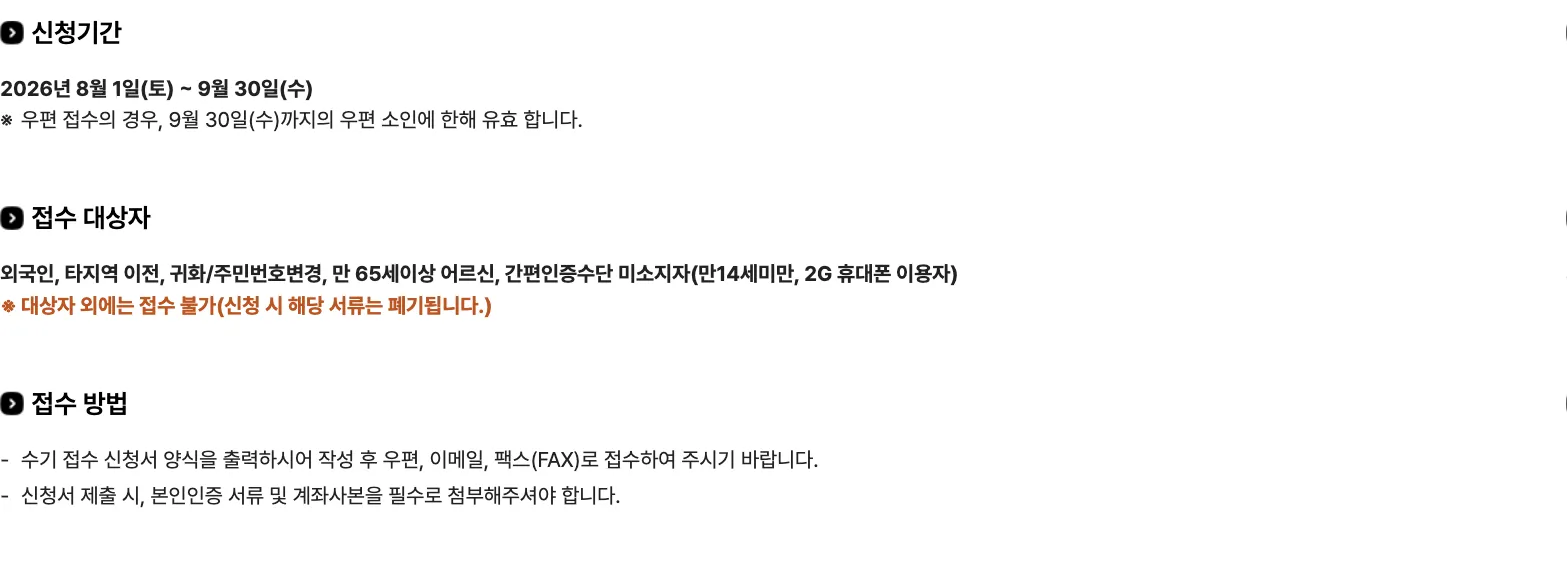
Updated 1 October 2026. The claim window closed on 30 September 2026. Seoul’s payback FAQ, re-read today, still gives the period as 6.10~9.30 with no further extension, so a claim not sent by then is out. If you sent one in the last ten days of September, the published schedule pays it from 30 October. The rest of this page is kept as it stood, because how the city counted the payback is what to check your refund against.
If you were a foreign resident who charged a 30-day Climate Card between April and June, Seoul owed you money and you had until 30 September to ask for it. That was the whole answer. The interesting part is how the city counts it, because everything written about this in English counts it by the month and Seoul does not.
What the payback is
Seoul introduced this in June against fuel prices. Charge a 30-day Climate Card between 1 April and 30 June 2026, let it run to expiry without refunding it, and you get 30,000 won back, to a maximum of 90,000 won. It covers Seoul plus Gimpo, Gwacheon, Guri, Seongnam and Hanam, and every band of the pass qualifies.
| Pass band | Charge | Payback | Effective cost |
|---|---|---|---|
| Adult | 62,000 won | 30,000 won | 32,000 won |
| Youth, 19 to 39 | 55,000 won | 30,000 won | 25,000 won |
| Adolescent, 13 to 18 | 55,000 won | 30,000 won | 25,000 won |
| Two children | 55,000 won | 30,000 won | 25,000 won |
| Three children | 45,000 won | 30,000 won | 15,000 won |
| Low income | 45,000 won | 30,000 won | 15,000 won |
The exclusions are refunding a pass before it expired, buying a short-term pass instead of a 30-day one, living outside those six areas, and never having registered on the T-money Card and Pay website. The online claim opened on 10 June and closed on 30 September.
It is counted per charge, not per month
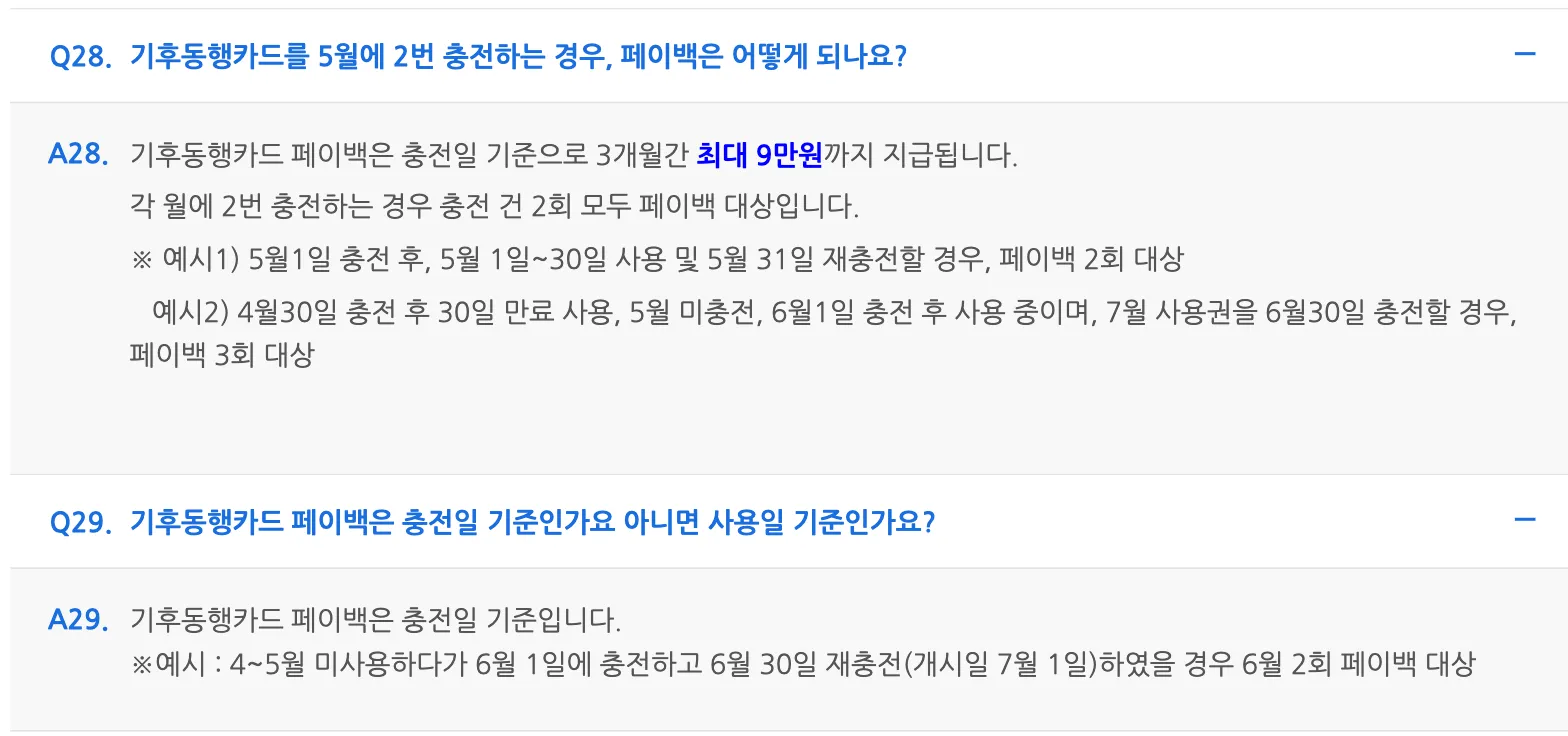
Every English description of this scheme, including Seoul’s own, calls it a monthly refund of 30,000 won for three months. The city’s Korean FAQ says something different, and it is more generous.
The FAQ states the basis plainly: the payback is reckoned on the charging date. Two charges inside a single calendar month are two separate paybacks, and its own worked example runs a card charged on 30 April, nothing at all in May, a charge on 1 June and another on 30 June, and awards three paybacks.
Read that again. A month in which you charged nothing does not cost you a payback, and a month in which you charged twice pays you twice.
The cap is on the total, not the calendar: three paybacks, 90,000 won. So the question to answer before you claim is not “how many months did I hold a pass” but “how many times did I charge one and let it expire between 1 April and 30 June”. If the second number is bigger than the first, the monthly framing has been costing you.
On a postpaid card the amount is a calculation
The second thing the English pages leave out is that 30,000 won is not always the number.
On a postpaid Climate Card the city looks at what you actually spent on public transport in the 30 days from your first use that month. Clear a threshold and you get the full 30,000 won. Fall short of it and you get your spending minus a floor, capped at 30,000 won.
| Band | Full payback at spending of | Floor subtracted below that |
|---|---|---|
| Adult | 62,000 won | 32,000 won |
| Youth | 55,000 won | 25,000 won |
| Two children | 55,000 won | 25,000 won |
| Three children | 45,000 won | 15,000 won |
| Low income | 45,000 won | 15,000 won |
The FAQ works two of these through. A two-children band holder who first used the card on 7 April and spent 58,000 won over the next 30 days clears the 55,000 won threshold and receives the full 30,000 won. A three-children band holder who first used the card on 20 May and spent 29,000 won receives 29,000 minus 15,000, which the FAQ prints as 14,000 won.
Note where the threshold sits. It is the price of the pass, not the floor. An adult has to spend 62,000 won of transport in the 30 days to receive the full amount, and an adult who spent 45,000 won receives 13,000 won.
It is a ceiling, not a rate. If you carried a postpaid card through a quiet month, plan on less.
A prepaid card is not calculated this way at all. The FAQ says outright that a prepaid card has no threshold: charge it, do not refund it, let it expire, and the payback is yours. You may also register a prepaid card on the T-money website after the fact and still claim, where a postpaid card had to be registered before you used it. There is no registering a postpaid card now to rescue a claim.
Two city pages disagree about the untouched card
One question sits underneath all of that, and Seoul answers it twice, in opposite directions.
The FAQ says the payback does not depend on use, and that a card charged and never once tapped still qualifies. The city news page announcing the scheme puts people who did not spend the charged money on its list of the excluded, next to short-term pass holders and people who took a refund.
Both are Seoul, both are cited here, and neither mentions the other. The FAQ is the document written to answer this exact question and it is the more specific of the two, so it is the better reading. It is still a reading. If you rode the card at all this does not touch you. If you charged one and left it in a drawer, treat the money as arguable rather than owed, and phone 1644-0088 before you count on it.
Why a foreign resident is sent to a paper form
Seoul states eligibility as a residency test, and the wording is doing work. The FAQ says the payback goes to people whose resident registration address is in one of the six areas, and that an address outside them does not qualify.
A registered foreign resident does have a legally registered address in Korea. It sits under foreigner registration rather than resident registration, and the state issues a certificate of it. The obstacle is not the address. It is the check: the FAQ reveals, in an answer about a scheduled outage, that the online residence verification runs through the Government24 system, and that is the door a foreigner registration does not open in the same way. The same wall shows up under the scheme replacing this one, which the Modu Card article sets out in detail.
So a separate channel exists, and it is a paper form open during August. That channel was not built for foreigners. Seoul announced it in June for over-65s who struggle with online services, and foreigners were added to it alongside people who moved out of the city, people whose login broke after naturalisation or a registration number change, under-14s and 2G phone users. Those five categories matter to you for a practical reason covered below.
The pages do not agree on whether every foreigner may use it. Seoul’s own FAQ carries both versions: one answer says a foreigner registered on the T-money site and living in the eligible area can claim, with no further test, and another says the manual route is for foreigners whose residence cannot be verified. T-money’s page says foreigners with no qualifier. The Seoul Foreign Portal notice, the page actually addressed to you, adds the test back. The Korea Herald followed the narrower version.
Apply anyway. Every route into the online form runs through the verification that the narrow wording describes failing, so the two versions land on substantially the same people, and the operator that receives the envelope is the one using the unqualified wording. If your own residence check did go through online, you did not need this article.
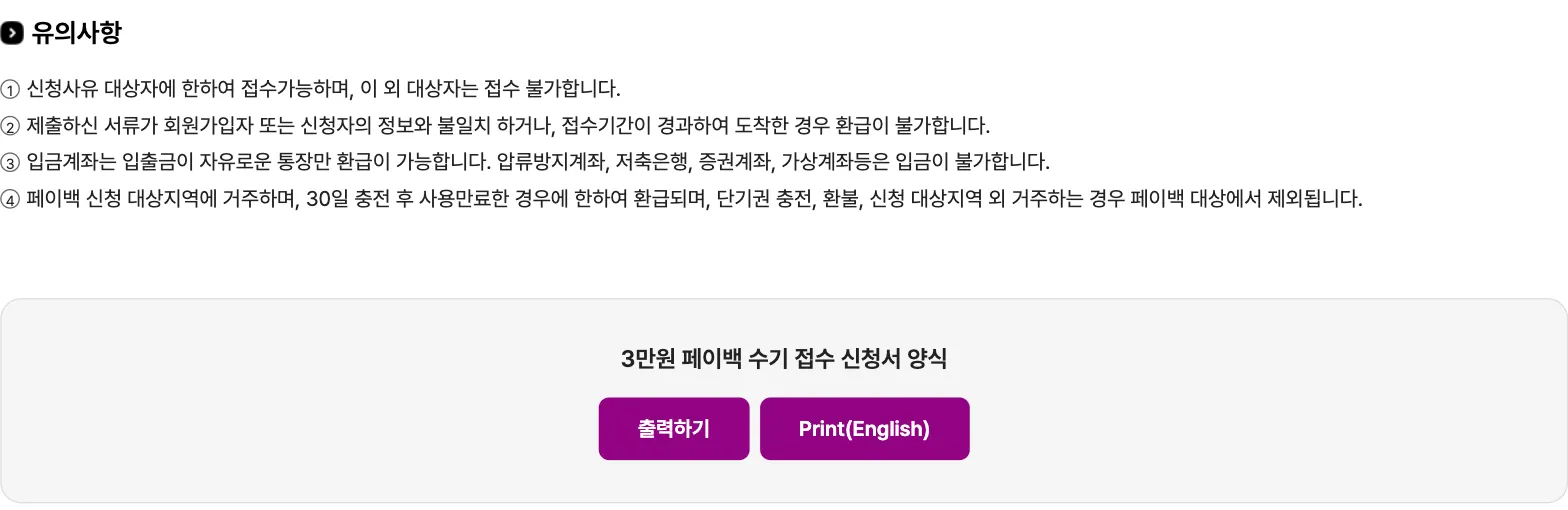
That is worth settling rather than guessing at, because T-money attaches a penalty. It says applications from outside the eligible categories cannot be accepted and that the documents sent in are destroyed. Name that plainly: the body deciding whether you belong to a category is the body that shreds your registration certificate and your bank details if it decides you do not, and its city does not define the category the same way twice.
What goes in the envelope
Two places carry the form. T-money’s manual-application page carries it as two buttons, 출력하기 and Print(English), so an English copy exists and is one click away on the page Seoul’s English announcement pointed at. The Seoul Foreign Portal posted it on 3 August as a PDF and a HWP file, in Korean only, which is the version most write-ups link to.
Three items go in:
- The completed application form with its personal-data consent section.
- A certificate of alien registration facts. This is the printed certificate stating your registered address, not a photocopy of the plastic residence card. Sending the card instead is the mistake this route punishes.
- A copy of a bank passbook or account document in your own name. An account belonging to somebody else is refused outright.
The account has to be an ordinary one you can pay in and out of. Between them the FAQ and the Foreign Portal rule out seizure-protected accounts, suspended and closed accounts, savings bank accounts, securities accounts and virtual accounts.
| Channel | Detail |
|---|---|
| climate@tmoneycsp.co.kr, with your name, your district and your reason for applying in the subject line | |
| Fax | 02-6989-0120 |
| Post | (04535) T-money Climate Card Manual Refund Team, PO Box 2023, Seoul Central Post Office, 70 Sogong-ro, Jung-gu, Seoul |
The reason in that subject line is why the five categories above are worth knowing. Yours is that you are a foreign resident.
Two more conditions. The details on the documents have to match your T-money membership, and the operator lists a mismatch as a reason to refuse. And the Korea Herald’s English write-up says the certificate has to have been issued within the past month, which the city’s own notice does not say. A fresh certificate costs nothing, so get one dated this month rather than betting on the looser reading being the one applied.
The deadline moved, and this page had the old one
Until 17 September this page said the window was 1 to 31 August. It is not, and it has not been for some time: T-money’s paper-claim page gives the window as 1 August to 30 September 2026, and Seoul’s payback FAQ now writes the whole claim period as 6.10~9.30. If you read this page in early September and concluded you had missed it, you had not. You had until 30 September.
For post it is the postmark that has to fall inside the window, up to and including Wednesday 30 September, so the envelope has to leave your hands by that day rather than arrive by it. T-money’s general caution elsewhere on the page, that a claim cannot be paid if documents arrive after the application period, is the catch-all that the postal sentence carves an exception out of.
Email sidesteps the question entirely and confirms itself, which is the reason to use it unless you have none.
One inconsistency worth knowing about, because it is on Seoul’s own page.
Question 2 of the payback FAQ gives the claim period as 6.109.30. Question 5,
further down the same page, still says 6.108.31. The operator’s page is the
one that runs the paper route, and it says 30 September. That is the date this
page follows, and it is the later of the two, so acting on it costs a reader
nothing if the earlier one were somehow revived.
The payment schedule is published per batch, and the last two batches are still ahead:
| Claim filed | Paid from |
|---|---|
| 21 July – 20 August | 31 August |
| 21 August – 20 September | 30 September |
| 21 – 30 September | 30 October |
Those dates belong to the online route. No separate date has been published for the paper route, so a claim posted now should be treated as arriving in late October rather than late September, and not planned around.
This is the last money this card pays out
The Climate Card has been switched off. Seoul extended it by a month in July, so the last day to charge a prepaid 30-day pass was 31 August, a prepaid card worked until 29 September and a postpaid one until 30 September, and the 30-day pass ended on 1 October 2026. From 1 September the city’s version of the national Modu Card scheme takes over.
Which settles one thing: charging a pass today earns no payback. Only 1 April to 30 June charges count. The charging deadline and the claim deadline were originally the same day, 31 August, which is the coincidence that made the single date easy to remember and easy to get wrong once one of them moved. They are now different dates: charging ended on 31 August, claiming ends on 30 September.
If you are moving onto the replacement scheme, the registration check that sent you to this paper form is waiting there too, and the Modu Card article covers what its sign-up flow asks for. If you are working out whether any pass beats paying per journey once the Climate Card is gone, the T-money article has the arithmetic.
What is not checked here
The amounts, the formula, the charging-date rule, the documents, the channels and the dates above come from the city’s and the operator’s own pages, read today.
The Seoul Foreign Portal notice that first announced the paper route, and that this page cited from August, now returns a server error, and the portal’s whole notice board answers 404. The portal restructured and took the page with it. That notice is therefore gone from the sources above rather than left as a link that looks like evidence and is not. Nothing it supported is lost: the paper route, its window, its documents and its postmark rule are all on T-money’s own page, which is the operator that actually runs it.
I have not read the application form itself. It is a PDF and a HWP attachment and neither opens to text here, which is a limitation this site has run into on government attachments before. Everything above about the documents comes from the notice the form hangs off. If the form asks for something else, the form wins.
I have not confirmed that a foreign resident can complete T-money website membership in the first place. Both the FAQ answer and the operator’s mismatch rule assume you are already a member, and the paper route replaces the payback application rather than the membership behind it. The sign-up verification page returns nothing readable, so if you have never registered, treat that as the step to settle first and phone 1644-0088 about it rather than posting a form and hoping. The verification methods are the same family of Korean bank and phone checks that the connectivity article covers, and a data-only eSIM does not satisfy them.
The FAQ’s table of postpaid spending floors omits the adolescent band, which appears in the charge table earlier on the same page at 25,000 won. That is unverified for postpaid purposes, so a 13 to 18-year-old cardholder should ask rather than assume the floor carries across.
The 13,000 won figure above is my arithmetic on the city’s rule, not a number Seoul prints. The two examples the FAQ works through are the ones quoted before it.
If you send this in and something here turns out to be wrong at the receiving end, tell me what happened. This route opened on 1 August and almost nothing about how it behaves in practice is public yet. And if you have just arrived and none of it applies, start here.
Questions people actually ask
- Climate Card refund: Seoul counts it per charge, not per month
- Seoul paid back up to 90,000 won to people who charged a 30-day Climate Card between 1 April and 30 June 2026 and let it run to expiry. Its FAQ settles the question every English page gets backwards: the payback goes by the date you charged, not the date you travelled. Two charges inside one month therefore pay twice, and a month you charged nothing in costs you nothing. Seoul's own worked example counts three paybacks from April, June and a 30 June charge whose pass does not start until July.
- Is the climate card refund Seoul offers still claimable, and until when?
- No. The window closed on 30 September 2026, after being moved once. T-money's manual-claim page gave the window as 1 August to 30 September, and Seoul's payback FAQ, re-read on 1 October, still gives the whole claim period as 10 June to 30 September with no further extension. For post it was the postmark that counted, so an envelope that left your hands on the 30th is inside the window. Claims filed between 21 and 30 September are paid from 30 October.
- How does a foreign resident claim it, and what does the paper form need?
- On paper, by post, email or fax, because the online route runs through a residence check a foreign registration number does not pass. 외국인 is the first entry on T-money's eligible list. Three things go in: the completed form, a certificate of alien registration facts rather than a photocopy of the plastic card, and a copy of a bank account in your own name. Seizure-protected, savings bank, securities and virtual accounts are all refused. T-money destroys the documents of anyone it judges ineligible, so the category matters before the envelope does.
Where these numbers came from
Read on . 6 of 8 are Korean-language primary pages.
- 서울특별시, 기후동행카드 페이백 FAQ (환급 기준·후불 정산식·충전일 기준·외국인 신청) KO
- 서울특별시, 페이백 주소지 인증이 되지 않은 경우 별도 접수 안내 (2026-06-22 수정) KO
- 서울특별시, 기후동행카드 30일권 이용 종료 안내 (선불 8.31 충전 종료·후불 9.30 이용 종료, 수정일 2026-08-31) KO
- 티머니 카드&페이, 기후동행카드 3만원 페이백 수기접수 안내 (접수 대상·소인·서류 폐기) KO
- 내 손안에 서울, 최대 9만 원 기후동행카드 환급 신청 6월 10일 개시 (제외 대상) KO
- 내 손안에 서울, 기후동행패스 9월 1일 출시 및 30일권 운영 한 달 연장 KO
- Seoul Metropolitan Government (English), SMG Launches KRW 30,000 Monthly Climate Card Payback Program
- The Korea Herald, Climate Card users, claim back your 30,000 won