Korea's visa-free entry for Chinese groups runs to December
Cite this page
Hwang, J. (2026). Korea's visa-free entry for Chinese groups runs to December. Korea, Verified. https://koreaverified.com/korea-from-china/ (checked 21 September 2026)
 중국 단체관광객 한시 무사증 시행계획 발표 in hwpx and pdf. The single paragraph below reads that on 6 August the government announced at the Prime Minister's tourism task force that the temporary visa-free scheme for Chinese group tourists would run 올해 9월 29일부터 내년 6월 30일까지, and that the ministries have now prepared this detailed implementation plan.](/_astro/cn-plan-still-says-30-june.sqf-9_dX_1RetRC.webp)
A Chinese passport can enter Korea on three different legal footings, and which one you are on is usually decided by a travel agency rather than by you. The three differ on how long you may stay, whether you may walk away from the group, and whether you fill in a form before the plane lands.
The middle one, the group visa-free scheme, was published to end on 30 June 2026. It did not end. It was extended to 31 December, and the document everyone links to has not been updated to say so.
Do Chinese citizens need a visa for South Korea?
On an ordinary Chinese passport, travelling alone, yes. China is not among the nationalities Korea admits without a visa, and the K-ETA question does not arise, because K-ETA is the electronic authorisation for people who are already visa exempt. If you are checking whether a different passport in the family is exempt, that list is which nationalities need a K-ETA and until when.
The three routes below are what sit around that default.
| Route | Who it is for | Stay | Who arranges it |
|---|---|---|---|
| Individual visa | Anyone, applying at a visa centre | Per the visa issued | You, or an agency acting for you |
| Group route | 3 or more travellers recruited by a designated agency | 15 days, anywhere in Korea | A designated agency only |
| Jeju visa-free | Chinese nationals arriving in Jeju | 30 days, Jeju only | You |
What the group scheme actually asks for
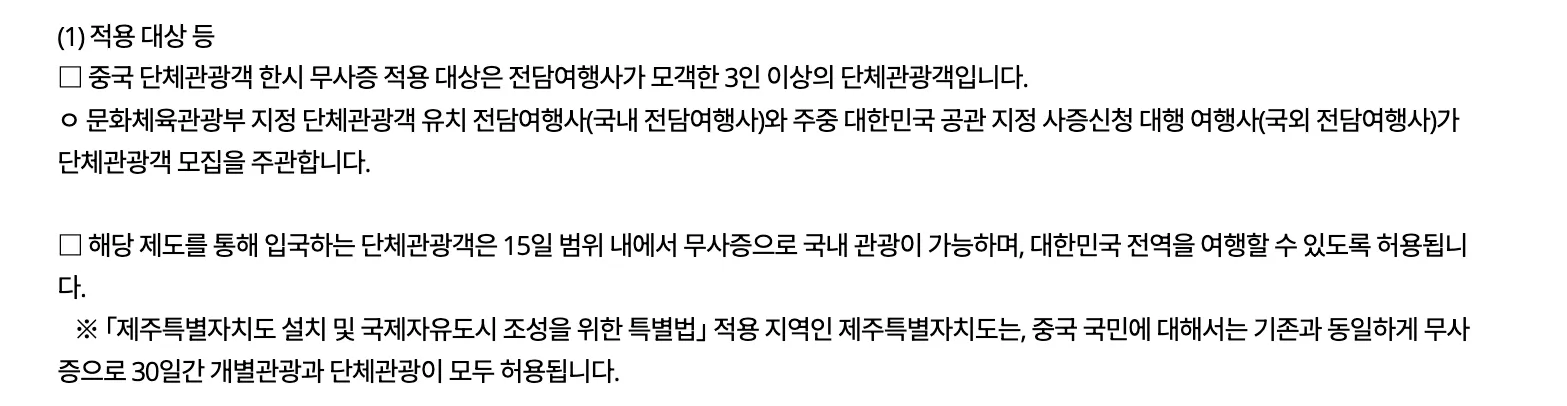
The implementation plan the Ministry of Foreign Affairs published on 7 September 2025 is specific, and most of its conditions fall on the agency rather than on the traveller.
A group is 3 or more tourists recruited by a designated agency. The domestic side of that is a 전담여행사 designated by the Ministry of Culture, Sports and Tourism, which then registers with the immigration authorities and works through HiKorea; the overseas side is a visa agency appointed by a Korean mission in China. The group may travel anywhere in Korea for up to 15 days. The agency must upload the passenger list to HiKorea no later than 24 hours before arrival, and 36 hours before if the group is coming by ship.
People the ministry classes as high risk are cut out and told to apply for a visa at a mission instead, which the plan describes as covering entry-barred travellers and those with a record of overstaying.
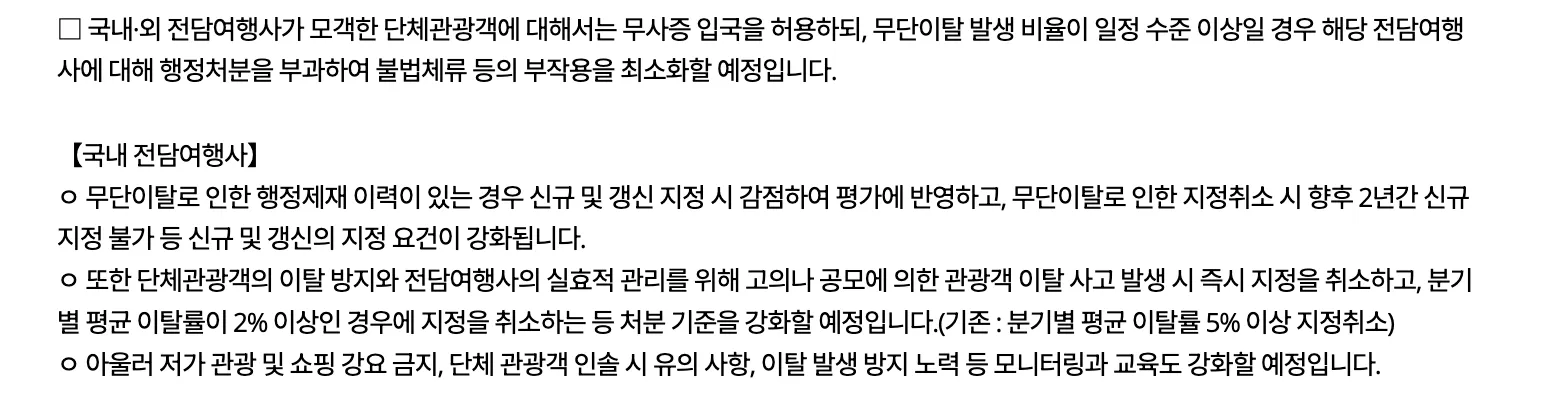
Note who is exposed here. The plan sets the agency’s quarterly average absconding rate at 2% and cancels the designation when it reaches that, with no new designation for two years. The traveller’s inconvenience if a tour member disappears is nothing; the agency’s is its licence. That is the reason a group itinerary is held as tightly as it is, and it is worth knowing before you ask to skip an afternoon.
The designation is live administration rather than a formality. The Ministry of Culture, Sports and Tourism opened a renewal assessment in January 2026 covering a published list of about 150 agencies.
The date in the plan, and the date that applies
The plan says the scheme runs from 29 September 2025 to 30 June 2026. That is still the date printed on it, and English pages describing the scheme still print it too, several of them written this year.
The scheme was extended before it expired. On 23 June 2026, at the Korea and China premiers’ meeting in Dalian, Prime Minister Kim Min-seok told Premier Li Qiang that the visa-free policy for Chinese tourists, then due to end in June, had been extended to the end of December. His office briefed that to reporters the same evening, and the Seoul Economic Daily reported the two sides as having settled on the same thing. Six days later the Ministry of Justice told the trade paper Travel Times that the scheme’s period tracks the period for which China admits Korean nationals without a visa, and China has set that to 31 December 2026.
Three separate accounts, one date. The extension is real.
What has not happened is that any of it reached the implementation plan. The document that sets out the conditions, the one a travel agency or a diligent English writer would go and read, still ends on 30 June 2026. So an English page that says the scheme is over is not careless so much as out of date in a specific way: it read the written rule and missed the spoken one.
That cuts both ways, and it is why the route matters more than the rule here. A prime-ministerial readout tells you a decision was taken. It does not tell a border officer what to do, and it does not tell you which conditions changed with the date. So treat the 15 days, the group of 3, the designated agency and the HiKorea upload as still standing exactly as the plan sets them out, because nothing has been published to change them.
What the Ministry re-posted on 1 July
There is an extension notice from the Ministry of Justice dated 1 July 2026, the day after the old expiry. It extends something else.
That notice carries the visa issuance fee waiver for group tourists from six countries, China among them, along with Vietnam, the Philippines, Indonesia, India and Cambodia. The waiver was due to end in June and now runs to 31 December 2026, the same date as the visa waiver. The fee it removes is $15, which the ministry gives as about 22,500 won.
The same notice reports that about 790,000 foreign nationals entered on group visas during 2025, up from roughly 570,000 the year before, and that the rate at which they absconded fell to 0.07% from 0.19%.
Both measures now point at the end of December, and both trace back to the same policy line: the fee waiver is described as following the eleventh expanded national tourism strategy meeting, and the visa-free scheme came out of a tourism policy task force chaired by the Prime Minister in August 2025. What the 1 July notice does not do is mention the visa-free scheme at all. If you were looking for the written extension on the ministry’s own board that week, the thing you would find is the discount on the visa the other route makes unnecessary.
Jeju is a separate answer, and always was
Jeju was never part of the temporary scheme and is not affected by its dates. The implementation plan says so directly: Chinese nationals keep visa-free entry to Jeju for 30 days, for individual and group travel alike, exactly as before.
The catch is the one Jeju has always had, and it is not a small one. The permission is for Jeju, not for Korea, and what it costs to test that, along with the conditions on arriving there, is set out in why Jeju’s visa-free entry does not let you fly on to Seoul.
The five and ten year multiple-entry visas
Separately from any of this, the terms of the ordinary tourist visa were loosened in spring. Digital Times reported that from 30 March 2026 the Korean embassy in China relaxed the criteria on multiple-entry visas: a Chinese national with a record of a previous visit to Korea can be issued one valid for 5 years, as can someone who entered on a medical tourism visa and spent above a set amount on treatment within a year. Residents of 14 major cities including Beijing and Shanghai can have validity extended to 10 years.
This is press reporting of an embassy announcement rather than a consular notice I could read, so treat the date and the city list as reported rather than confirmed, and check both with the visa centre handling your file.
The route decides whether you file an arrival card
Here is where the choice of route stops being abstract.
Korea’s e-Arrival Card is required of travellers entering on a visa, and the Ministry of Justice publishes the list of people excluded from filing it. Two entries on that list matter to a Chinese traveller, and they cover both group routes. The visa-free group tourist is excluded. So is the holder of a group electronic visa applied for through the national visa portal, an exclusion the page spells out for group tourists from China, Vietnam, the Philippines and Indonesia.
So the rule is simpler than the number of routes suggests. Travel with a group and you file nothing, whether your agency put you on the visa-free list or applied for a group visa. Travel on an individual visa and you fill the form in, because holding your own visa is what puts you in scope. The full rule, including the trap where being exempt from K-ETA leaves you filing more rather than less, is in Korea’s e-Arrival Card and who is excused.
There is something else on that exclusion list worth seeing. Alongside the Chinese entries sit the group tourists arriving visa-free at Yangyang and Muan airports, and the page dates those two: Yangyang to 31 May 2025, Muan to 31 March 2026. Both dates have passed. Both lines are still printed as current exclusions.
An expired line nobody took down reads exactly like a live one, and today this page is describing that failure in both directions at once. The exclusion list prints two schemes whose dates have gone. The implementation plan prints a date the government has already moved past. One page is behind because nobody retired it, the other because nobody updated it, and a reader trusting either date on its face gets the wrong answer.
What is not checked here
- Whether a formal notice extending the scheme exists. The extension is on the record three times over, in the Prime Minister’s briefing, in the Seoul Economic Daily’s account of the meeting, and in the ministry’s statement to Travel Times. I did not find an updated implementation plan or a numbered notice carrying the new date, and the plan on the foreign ministry’s board still reads 30 June 2026. The scheme was created by press release rather than by gazette notice, so the absence of a numbered document is not the anomaly it would be elsewhere.
- The designated ports. Nothing in the implementation plan names particular airports or seaports for the Chinese group scheme, and the plan grants travel throughout Korea. Any English page listing designated ports for it is describing a different scheme, most likely the Yangyang or Muan arrangements covering other nationalities.
- The multiple-entry visa criteria. Sourced to press reporting of an embassy announcement. The 30 March date and the 14 cities should be confirmed at the visa centre.
- The current count of designated agencies. About 150 were listed for renewal assessment in January 2026. How many hold a live designation today is not published on that page.
- Whether the conditions changed along with the date. The extension was announced as a date, not as a revised plan. The group size, stay length and upload deadlines above are the September 2025 versions, and no source I read says they were altered.
If you have booked through an agency and it has told you in writing which route your entry is on, that is worth more than anything above, and I would like to see it. Send it here and this page gets corrected with a date on it.
Questions people ask around this
Is Korea visa free for Chinese citizens right now? Not for an individual traveller. For a group of 3 or more booked through a designated agency, yes, on a scheme that now runs to 31 December 2026. Jeju admits Chinese nationals without a visa for 30 days separately from either.
Did the visa-free scheme end on 30 June 2026? No. That was its original end date and it is still printed on the implementation plan, which is why English pages repeat it. The Prime Minister announced the extension to the end of December on 23 June, a week before it would have lapsed.
Do I need a visa if I book a package tour? Ask the agency which route it used. A designated agency can enter you on the group visa-free scheme with a HiKorea list upload, and an agency without that designation will apply for a group visa for you. Both are normal, and neither leaves you filing an arrival card.
How many people make a group? 3 or more, recruited by a designated agency. The number alone does not qualify you: 3 friends booking flights themselves are not a group under this scheme.
Can I leave the tour and travel by myself? The scheme is built to prevent that, and the agency’s designation depends on its quarterly absconding rate staying below 2%. Leaving the group is what that statistic counts.
Does the group route cover Jeju as well? Jeju has its own 30-day visa-free entry for Chinese nationals, individually or in a group, and the implementation plan preserves it unchanged. The nationwide scheme grants 15 days.
Questions people actually ask
- Do Chinese citizens need a visa for South Korea, or is the group route enough?
- Travelling alone, yes. China is not on the list of nationalities Korea admits without a visa, and K-ETA does not apply, because K-ETA is the authorisation for people who are already visa exempt. There are two routes around that default and neither is individual: the temporary group scheme, which needs three or more travellers recruited by a designated agency, and Jeju, which is visa-free for Chinese nationals but is permission to be in Jeju rather than in Korea.
- Korea visa free entry for Chinese: did the scheme really end on 30 June 2026?
- No, and the confusion is in the paperwork rather than in the rule. The implementation plan published on 7 September 2025 runs the scheme from 29 September 2025 to 30 June 2026, and that is still the date printed on it today. On 23 June 2026, at the Korea and China premiers meeting in Dalian, Prime Minister Kim Min-seok told Premier Li Qiang the waiver had been extended to the end of December. The Ministry of Justice confirmed the same period to a trade paper six days later. English pages saying the scheme is over are reading the written document and missing the spoken one.
- Korea visa requirements for Chinese citizens: what does a group file on arrival?
- On either group route, no arrival card at all. Group visa-free tourists and group electronic visa holders are both excluded from the e-Arrival Card, so only a Chinese traveller on an individual visa fills the form in. The filing that does happen is done by the agency: it uploads the passenger list to HiKorea at least 24 hours before arrival, or 36 hours if the group comes by ship, and immigration screens that list for high-risk travellers and cuts them out before the flight.
- Is Jeju island visa free for a Chinese passport, and for how long?
- Thirty days, for individual and group travel alike, and it was never part of the temporary scheme. The implementation plan says so in a footnote: Jeju continues under its own special act 기존과 동일하게, the same as before. So none of the 30 June or 31 December dates apply to it. The catch is the old one. The permission is for Jeju and not for Korea, and flying on to Seoul on it is the thing it does not allow.
- Korea visa free for Chinese passport: who decides which of the three routes you use?
- Usually a travel agency, and usually without saying so. The three footings carry different stay lengths, different paperwork and different freedoms: an individual visa for whatever the visa says, the group route for 15 days anywhere in Korea, and Jeju for 30 days in Jeju. The agency also carries the legal risk on the group route. A designated agency whose quarterly average absconding rate reaches 2 per cent loses its designation and cannot be redesignated for two years, which is why it holds the itinerary as tightly as it does.
Where these numbers came from
Read on . 10 of 10 are Korean-language primary pages.
- Ministry of Foreign Affairs, implementation plan for temporary visa-free entry for Chinese group tourists (Korean) KO
- SBS, Prime Minister tells Premier Li Qiang the visa waiver is extended to end December, 23 June 2026 (Korean) KO
- Seoul Economic Daily, Korea and China agree the extension to end December, 23 June 2026 (Korean) KO
- Ministry of Justice, extension of the group visa fee waiver for six countries, 1 July 2026 (Korean) KO
- Ministry of Justice, e-Arrival Card, who is excluded from filing (Korean) KO
- Korean Consulate General in Xi'an, notice on the extension of China's visa waiver (Korean) KO
- Travel Times, Ministry of Justice on how long the scheme runs, 29 June 2026 (Korean) KO
- Ministry of Culture, Sports and Tourism, 2026 renewal assessment for designated agencies (Korean) KO
- Newsis, conditions of the group visa-free scheme at launch (Korean) KO
- Digital Times, reported expansion of multiple-entry visas for Chinese nationals KO