Korean emergency numbers: which interpreter desk is open at 3am
Cite this page
Hwang, J. (2026). Korean emergency numbers: which interpreter desk is open at 3am. Korea, Verified. https://koreaverified.com/emergency-numbers-english/ (checked 21 September 2026)
Every English page about emergencies in Korea gives you the same three numbers and the same three sentences. 119 for fire and ambulance, 112 for police, 1330 for everything else, and they all speak English. The first two are right. The third is where the information goes wrong, because “speaks English” is not the claim any of these services makes about itself.
What they publish is a language list bolted to an opening time. The list travels into English and the opening time does not.
So sort the same numbers by two different questions. Can this number send a vehicle? And is your language staffed at the hour you are actually calling? The answers do not line up with each other. The numbers that can dispatch have the fewest languages. The numbers with the longest language lists shut in the evening.
The two numbers that can send something
119 and 112. Everything else on the standard list is a phone call to somebody who will then make a phone call.
That distinction matters more than it sounds, because the interpreting is not evenly distributed across it. The service with the most languages cannot send anyone. The two that can send someone have the shortest language lists in the country.
What the police measured when they stopped outsourcing
Until the middle of 2023, a 112 call from someone who did not speak Korean was handled by connecting a private interpretation service separately. The police tried it for years, then stopped, and published why.
Be careful what that is and is not. The announcement is about two ways of getting an interpreter onto a 112 call the police had already picked up. It never mentions 1330, and the service it replaced is described in the Korean as 민간, meaning commercial, which 1330 is not. So this is not a measurement of the advice English guides give you. It is the police measuring themselves.
From June 2023 they employed four interpreters of their own in the two languages with the heaviest demand, English and Chinese, working weekdays from 9am to 9pm. After about nine months they compared the two routes.
Taking a report through a private interpretation service took an average of 6 minutes 13 seconds. Taking the same report on a three-way call with the police’s own interpreter took 3 minutes 52 seconds. The gap is 2 minutes 21 seconds. What it counts is 접수, the taking of the report, not how long anybody waited for help to arrive. Narrow as that is, it is the only published figure I have found for what putting an outside interpreter in the middle of an emergency call costs in minutes, and the direction it points is the useful part.
On 18 March 2024 the agency hired twelve more interpreters, took the service to 24 hours a day and 365 days a year, and opened a 112 foreign language interpretation centre at the Seoul Metropolitan Police Agency. It also said the interpreters are trained specifically on crime reporting before going live, and that officers out on the street can call them in mid-job.
It is still English and Chinese. The agency said it planned to widen the service to Japanese and Vietnamese as demand justified it. Whether that has since happened, I have not confirmed.
The example the police chose to publish is worth keeping in mind, because it is not a crime. It is a foreigner who got a leg wedged in rock while hiking in Seoraksan and called 112, and the three-way call with the English interpreter is what pinned down the location. 112 is the police number, but in Korea it is also the number that works when you cannot describe where you are.
119 does not publish anything equivalent
I looked for the fire service’s version of that centre and did not find one. The National Fire Agency publishes no page I could locate describing a staffed interpreter desk for 119 voice calls. That is not proof there is none. It does mean that the one Korean emergency service which has documented its interpreting arrangement in public is the police, not the ambulance service.
What the fire service publishes instead is a different answer to the same problem. Its multi-channel reporting route, introduced in 2011, lets you report by text message, photograph, app or video call, and the stated audience is deaf callers, foreigners, multicultural families and older people. It is a sensible answer if your Korean is written rather than spoken, or if you can point a camera at the problem.
It is also not installed everywhere. In October 2023 the government’s own policy briefing put the number of 119 reception positions equipped to take those non-voice reports at 172 out of 361, or 47.6%, and the agency said at the time it would add more. I could not find a current figure, so treat that share as a 2023 reading rather than today’s.
There is also a web form at 119.go.kr. It describes itself, in its own opening line, as web 119 reporting for people who find speaking difficult and for foreigners living in Korea. Note the wording. Living in Korea, not visiting it. The form asks for a name, a phone number, an address with a postcode, and warns twice on the same screen about a fine of up to five million won for a false report. It is a channel for someone who is settled, has an address to type and a Korean number to be called back on. Filling in a postcode is not what you do while something is on fire.
1330’s eight languages, four of which are an eleven-hour service
1330 is the number every guide names, and the language count every guide quotes is eight. That count is real. It is also not a description of the service at three in the morning.
The Korea Tourism Organization’s own customer service standard sets it out:
| Phone | Text chat | Hours | |
|---|---|---|---|
| Korean, English, Japanese, Chinese | yes | yes | year round |
| Russian, Vietnamese, Thai, Malay-Indonesian | yes | no | 08:00 to 19:00 |
So half the advertised languages are a daytime phone service with no chat option. If you are a Vietnamese or Thai speaker, the multilingual tourist hotline is open for eleven hours a day, and the eleven hours it is open are the ones during which you are least likely to need it.
The four restricted languages arrived on 22 January 2018. The press release announcing them is explicit that the 08:00 to 19:00 window was a trial, and that the plan was to widen it to round-the-clock operation in stages. The service standard published since still prints 08:00 to 19:00 for the same four languages. The trial hours became the hours.
There is a second thing English pages get wrong about 1330, which is what kind of service it is at all. Its entry in the government services directory lists nationwide tourism information, tourism interpreting, complaint handling, and a routing desk to the tourist police, and gives its legal basis as the Korea Tourism Organization Act. It is a tourism service that happens to be excellent at interpreting. It is not an emergency service, and the police measurement above is the cost of using it as one.
Two useful practical details from the same standard. The overseas number is +82-2-1330. And the chat channels are separate from the phone line, running through the 1330 messenger, KakaoTalk, Facebook Messenger and Line, in the four core languages only.
If you are reading this before flying from Vietnam, the language timing lines up badly with the rest of that journey, and the Vietnam route article covers the paperwork end of it. The same 08:00 to 19:00 window applies to Malay-Indonesian, which is the relevant one for readers of the Indonesia article.
1345 closes at 22:00, and at the weekend
The Immigration Contact Center on 1345 is the twenty-language number, and it is genuinely twenty languages. It is also the most narrowly scheduled of the lot.
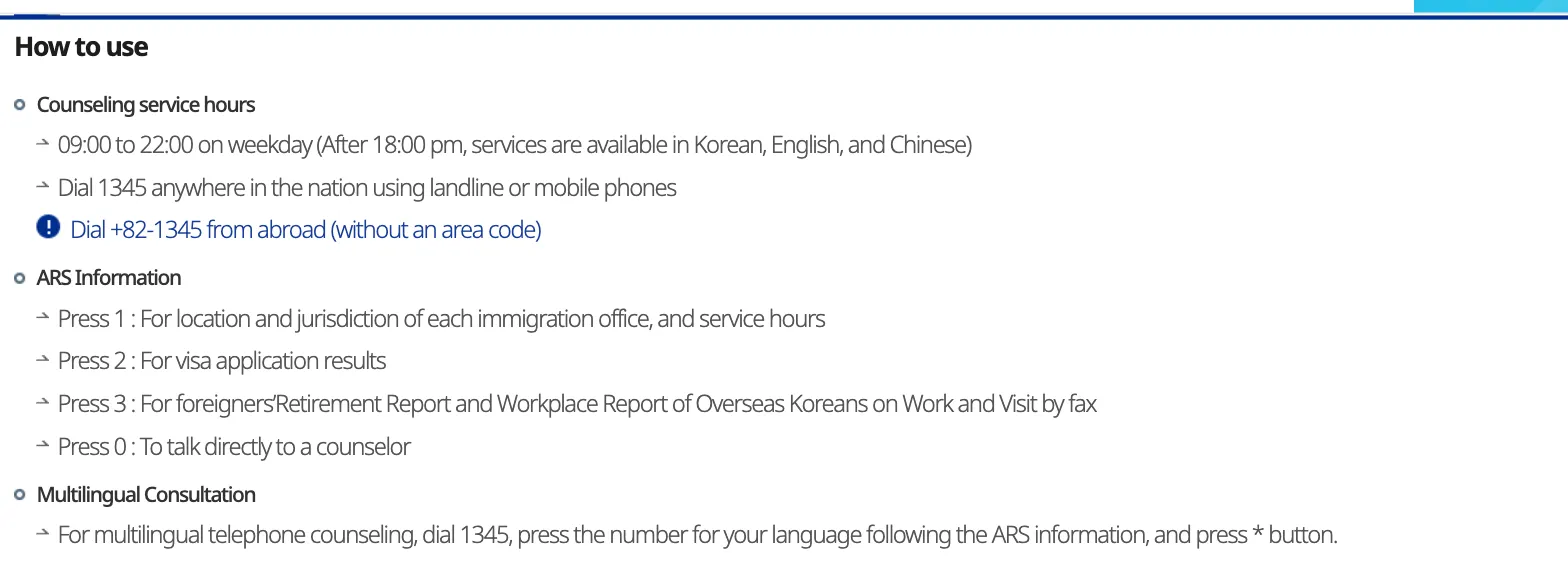
The Korea Immigration Service’s own page states the counselling hours as 09:00 to 22:00 on weekdays, and adds that after 18:00 the service is available in Korean, English and Chinese only. The Ministry of Justice’s contact listing adds two more restrictions that the service page does not spell out: public holidays are excluded, and the call is charged rather than free.
Put those together and the twenty-language line is twenty languages for nine hours a day, three languages for four hours after that, and nothing at all at night, at weekends or on a holiday.
| Window | Languages available |
|---|---|
| Weekdays 09:00 to 18:00 | up to twenty |
| Weekdays 18:00 to 22:00 | Korean, English, Chinese |
| Nights, weekends, public holidays | closed |
The three-way interpreting 1345 offers is also scoped more tightly than the phrase suggests. The service page describes it as three-way interpretation for central administrative agencies, local governments, public institutions and non-profit civic organisations handling foreigner-related work, and for the village lawyer scheme. That is a bridge built for an official on the other end who needs to talk to you. It is not described as a general-purpose bridge you can drag into a pharmacy. Finding a pharmacy that is open at all, at night or on a holiday, runs through a Korean-only finder, set out in how to find an open pharmacy in Korea.
From abroad the number is +82-1345. The menu is an ARS tree, and the instruction on the operator’s own page is worth memorising because guessing it wastes time: dial 1345, press the number for your language, then press the star key.
The line that really is fifteen languages around the clock
There is one, and no English travel page I have seen mentions it.
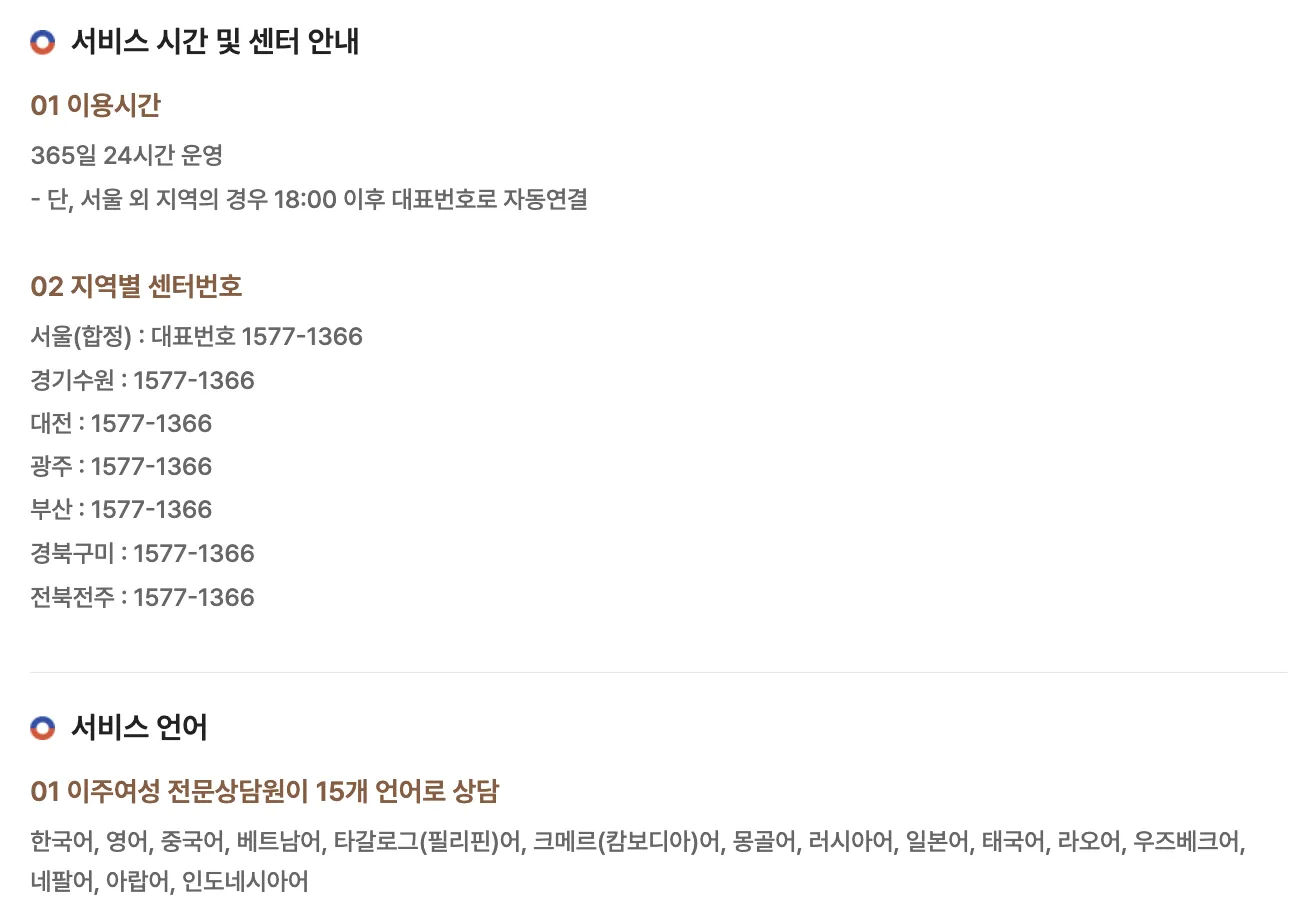
1577-1366 is the Danuri call centre, run under the Korea Institute for Healthy Family. Its published service description is fifteen languages, 365 days a year, 24 hours a day: Korean, English, Chinese, Vietnamese, Tagalog, Khmer, Mongolian, Russian, Japanese, Thai, Lao, Uzbek, Nepali, Arabic and Indonesian.
More to the point, three-way interpreting is not a footnote on that page, it is one of the five listed services, and the page names the places it will bridge you into: police, emergency services, hospitals, community service centres, schools, banks. That is a wider and more explicit list than either 1330 or 1345 publishes.
Two honest caveats, both printed on the same page. Outside Seoul, calls after 18:00 are routed automatically to the head office number, so the regional centres are a daytime layer over a national one. And the centre’s stated purpose is support for migrant women and multicultural families, with counsellors who are themselves marriage migrants. I did not find a page saying a short-term visitor may use it. I also did not find one saying they may not, and the interpreting service it describes is exactly the thing a visitor in trouble needs at 3am.
bbb, 1588-5644, is volunteers answering their own phones
The last number on most English lists is bbb Korea, usually presented as though it were a government hotline. It is not. It is a registered non-profit staffed by volunteers, and reading its own conditions of use changes how you would plan around it.
Twenty languages, from English and Japanese through to Swahili. Interpreting is free and you pay only the call charge. From overseas the number is +82-2-818-1500 with a per-language extension.
What the organisation says about itself is more useful than the language count. Volunteers are ordinary residents answering on their own mobile phones, and it lists retired diplomats, current and former professors, office workers, university students and homemakers. It is anonymity-based volunteering, and the service explicitly does not extend to in-person interpreting, to negotiating prices, or to making bookings on your behalf.
Then there is the detail that matters most for a visitor, and it is the kind of thing that only shows up in the small print. Through the bbb app, three-way calling is built in and works. Through the main phone number, three-way calling only works if the caller has subscribed to a three-way calling service with their own carrier, and the original caller is billed for all of it. Someone roaming into Korea on a foreign SIM has subscribed to nothing with a Korean carrier. The app route is also data-dependent, which the organisation itself flags.
That is the point where this article collides with a different one. Whether you can dial any of these numbers at all depends on what you bought at the airport, and a data-only eSIM is not a phone line. The eSIM and SIM card comparison is the piece that decides which of the numbers above are even reachable from your handset.
All of it in one table
| Number | Run by | Languages | Hours | Can it dispatch |
|---|---|---|---|---|
| 119 | National Fire Agency | not published | always | yes |
| 112 | Korean National Police Agency | English, Chinese interpreters | always | yes |
| 1330 | Korea Tourism Organization | 4 core, plus 4 more | core year round, others 08:00 to 19:00 | no |
| 1345 | Korea Immigration Service | up to twenty | weekdays 09:00 to 22:00 | no |
| 1577-1366 | Korea Institute for Healthy Family | fifteen | 365 days, 24 hours | no |
| 1588-5644 | bbb Korea | twenty | volunteer-dependent | no |
The shape of that table is the article. Read down the dispatch column and the language column at the same time and you can see the problem the police were solving, and why they solved it by hiring their own interpreters rather than telling callers to ring 1330 first.
All three published pages behind the numbers above were opened again on 21 September 2026 for the pictures on this page, and the hours and language lists still read as they do here. The police figures and the 2023 reception-position share come from Korean reports I have not re-opened since August.
What I have not checked
- Whether a data-only eSIM, or a handset with no Korean number, can reach 119 or 112. Many countries allow emergency calls without a subscription. I did not find a Korean rule stating it either way, so I am not going to tell you it works.
- Whether 119 has any staffed interpreter arrangement for voice calls. I could not find a National Fire Agency page describing one, which is not the same as there being none.
- Whether the police added Japanese and Vietnamese to the 112 interpretation centre after saying in March 2024 that they intended to.
- Whether the 172-of-361 figure for 119 multi-channel reception positions still holds. That is an October 2023 reading and the agency said it was expanding.
- Whether a short-term visitor may use 1577-1366. The centre’s stated purpose is migrant women and multicultural families. Neither permission nor exclusion for visitors appears on the page I read.
- Whether calling 1330 is free from a Korean mobile. The 2018 press release calls it a free service; the current service standard does not repeat the word, so I am not repeating it either.
- How quickly any of these lines actually answer. The tourism organisation commits to holding its response rate above 90% as a quality target, which is a target rather than a measurement, and I have none of my own.
- Local and city-level lines, including Seoul’s 120 Dasan call centre, which the police named as one of the bodies at the interpretation centre’s opening. Those are a separate layer I have not read.
- The 119 web form’s identity fields. I could read the labels on the page. I did not submit the form, so I cannot tell you which of them a foreign resident can actually satisfy.
If you take one thing
Call 119 or 112 directly. Do not call an interpreting line first and ask it to call them, which is the sequence most English guides imply and the sequence the police measured at 6 minutes 13 seconds. Say the words fire, police or ambulance in English, say where you are, and stay on the line. For 112 this is documented: the interpreter is theirs, they bring them onto the call, and the desk is staffed around the clock. For 119 I am telling you to do the same thing without a published arrangement to point at, because a call that reaches a dispatcher is still better than a call routed through a third party first.
Then, if what you need is not an emergency but a conversation, pick the line by the clock rather than by the language count. Before 19:00, 1330 in your own language. On a weekday for anything to do with visas or residence, 1345, and before 18:00 if your language is not one of the three that survive the evening. At 3am, in a language none of them cover, 1577-1366 is the only number on this page that publishes fifteen languages and no closing time, with the caveat above that its stated audience is not visitors and I could not confirm either way.
If something here is out of date, or you have called one of these numbers and found it works differently, tell me on the contact page. Opening hours are the fastest-moving fact on this site and the hardest one to keep right from a desk.

Questions people actually ask
- What is the Korea emergency number for foreigners?
- The same as for everybody else, and that is the useful part. Two numbers can send a vehicle: 119 for fire and ambulance, and 112 for police. Everything else on the standard list handed to travellers is a phone call to somebody who will then make a phone call. What differs for a foreign caller is not the number but the interpreting behind it, and only one of the two publishes an arrangement at all.
- Is there a Korea emergency number english speakers can reach at 3am?
- 112. The police employ their own English and Chinese interpreters, took the desk to 24 hours a day and 365 days a year in March 2024, and bring the interpreter onto the call themselves. 119 publishes nothing equivalent that I could find. For a conversation rather than an emergency at that hour, 1577-1366 publishes fifteen languages and no closing time, though its stated audience is migrant women and multicultural families rather than visitors.
- What is the ambulance number in Korea, and is it the same as fire?
- Yes, both are 119, run by the National Fire Agency, and it is one of only two numbers that can send a vehicle. What it does not publish is a staffed interpreter desk for voice calls. What it does publish is a non-voice route: text, photo, app and video reporting, which in October 2023 was installed on 172 of 361 reception positions. Useful if your Korean is written rather than spoken.
- Korea emergency number 119 or 112: which one do I want?
- 119 for fire and ambulance, 112 for police, and for a foreign caller there is a second reason to know the difference. The police are the side with their own interpreters, staffed around the clock. The example the agency chose to publish is not even a crime: a foreigner with a leg wedged in rock in Seoraksan, where the three-way English call is what pinned down the location. 112 is also the number that works when you cannot say where you are.
- Is the 1330 Korea travel hotline an emergency number?
- No. Its own legal basis is the Korea Tourism Organization Act and its listed job is tourism information, tourism interpreting, complaint handling and routing to the tourist police. It cannot dispatch anything. Its advertised eight languages are also four languages year round plus four more that run 08:00 to 19:00 by phone only, so at night it is a four-language service. Call it before 19:00, for a problem rather than an emergency.
Where these numbers came from
Read on . 9 of 10 are Korean-language primary pages.
- Korea Tourism Organization, customer service standard, full text (the 1330 clause) KO
- Korea Tourism Organization press release, 22 January 2018, 1330 expanded to eight languages KO
- Government24 service entry for the 1330 tourist interpretation line KO
- Ministry of Justice, Immigration Contact Center (1345), Korean page and contact list KO
- Korea Immigration Service, Immigration Contact Center (1345), service hours and ARS
- Yonhap News report of the National Police Agency announcement of 18 March 2024, carried on Bokjiro (government welfare portal). A wire story rather than the agency page, which I could not reach; every police figure here is read off this Korean text KO
- Danuri portal (Korea Institute for Healthy Family), 1577-1366 call centre service guide KO
- bbb Korea, how the interpretation line works, and its conditions of use KO
- National Fire Agency, 119 Safety Report Centre web reporting form KO
- Policy Briefing (Ministry of Culture, Sports and Tourism), 119 multi-channel reporting, 27 October 2023 KO